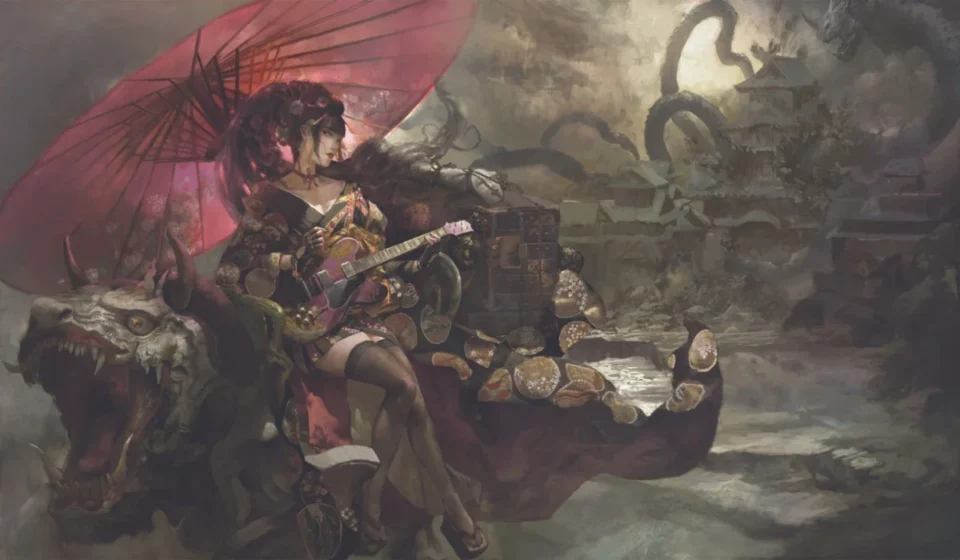

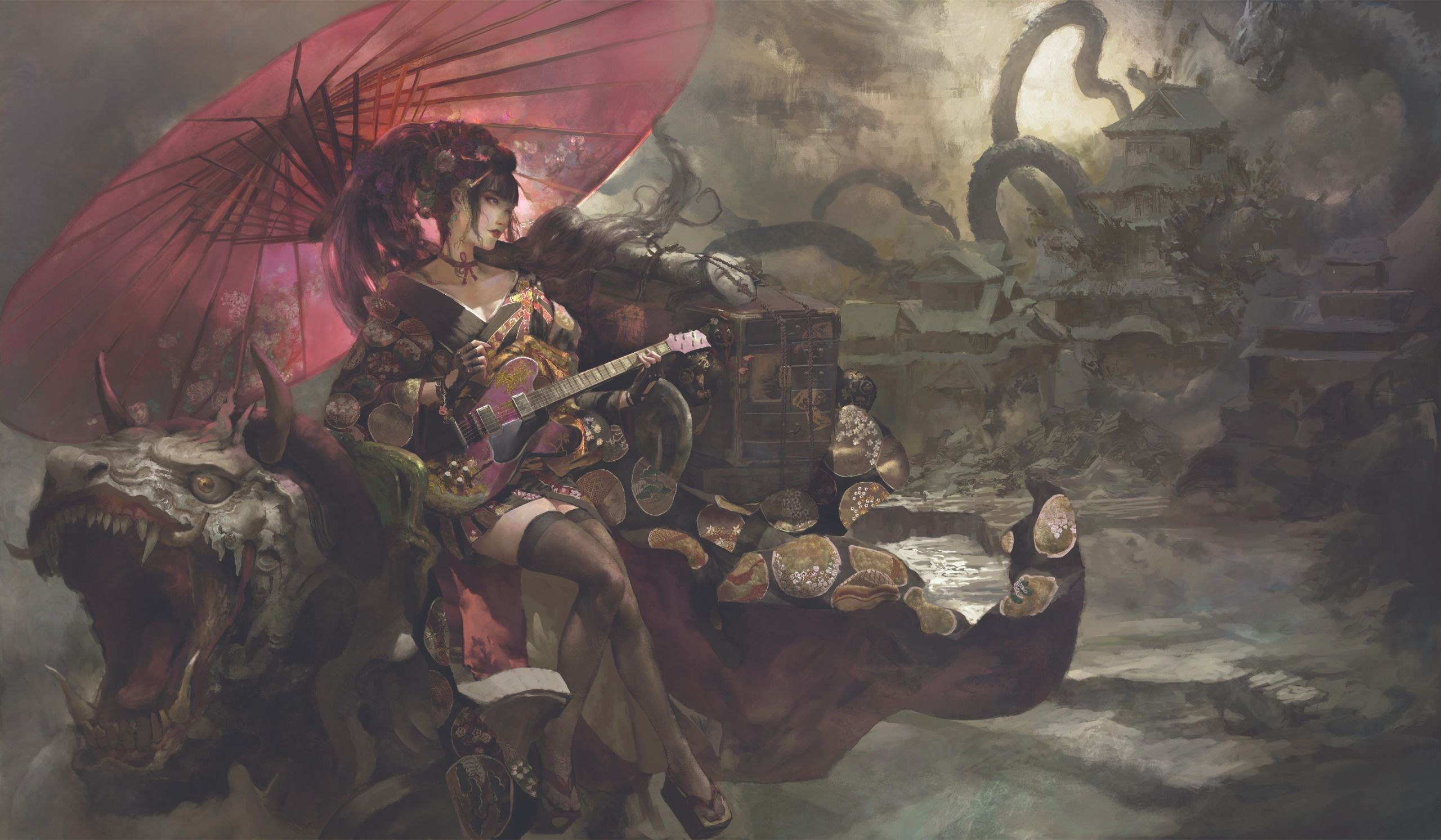
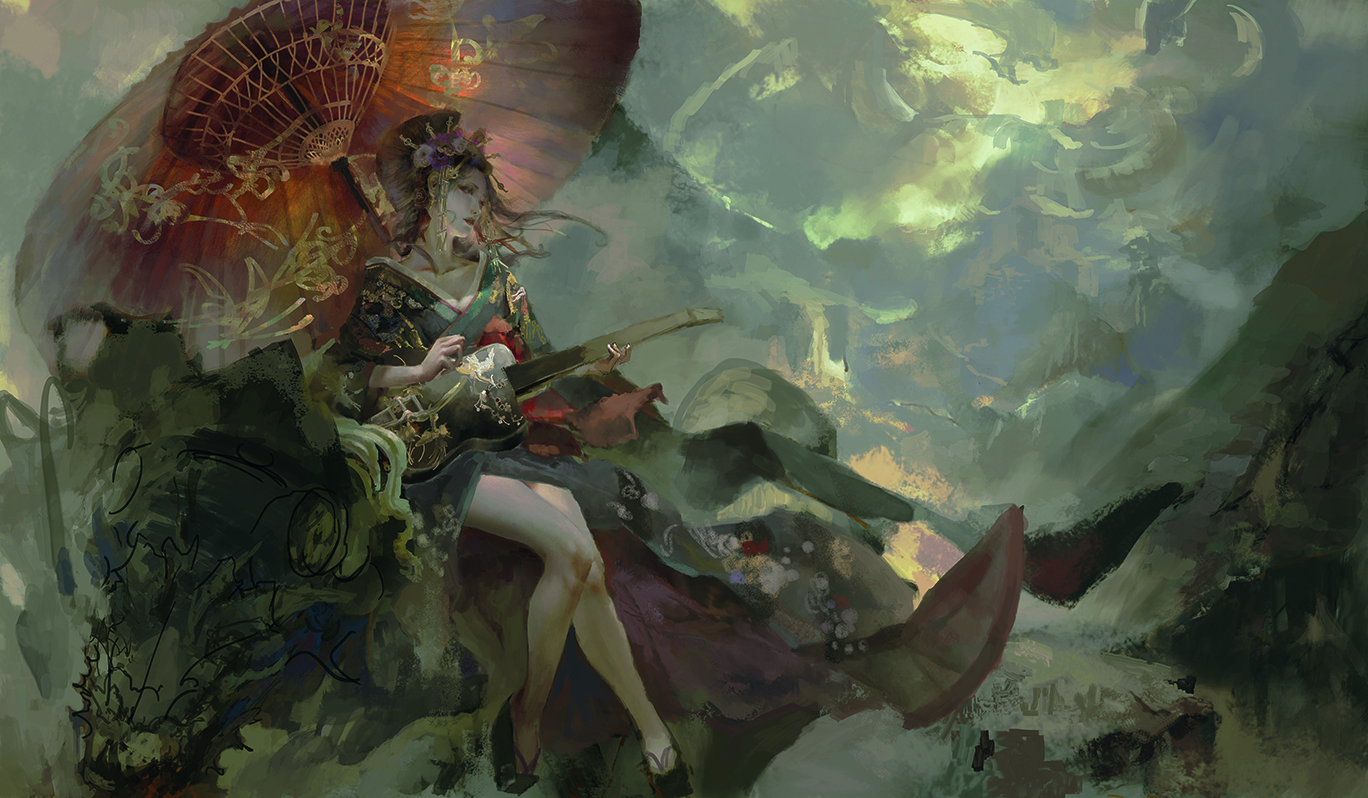
In the evolving landscape of digital fantasy art, few projects capture the imagination quite like Christian Angel’s latest work, Oiran Summoner. A breathtaking fusion of historical Japanese aesthetics and high-fantasy surrealism, the piece serves as the cornerstone for an ambitious new world-building project. By reimagining the traditional Oiran—the high-ranking courtesans of Japan’s Edo period—as powerful conduits for mythical creatures summoned through musical performance, Angel has created a narrative-driven visual experience that bridges the gap between historical reverence and imaginative fiction.
The creation of this piece, which was developed entirely as a passion project during the artist’s personal time, offers a masterclass in digital workflow, technical experimentation, and the importance of narrative intent in character design.
The Creative Process: A Technical Chronology
The development of Oiran Summoner was a non-linear journey that relied on the fluidity of modern digital tools, specifically the synergy between Procreate and Adobe Photoshop.
01. The Conceptual Foundation
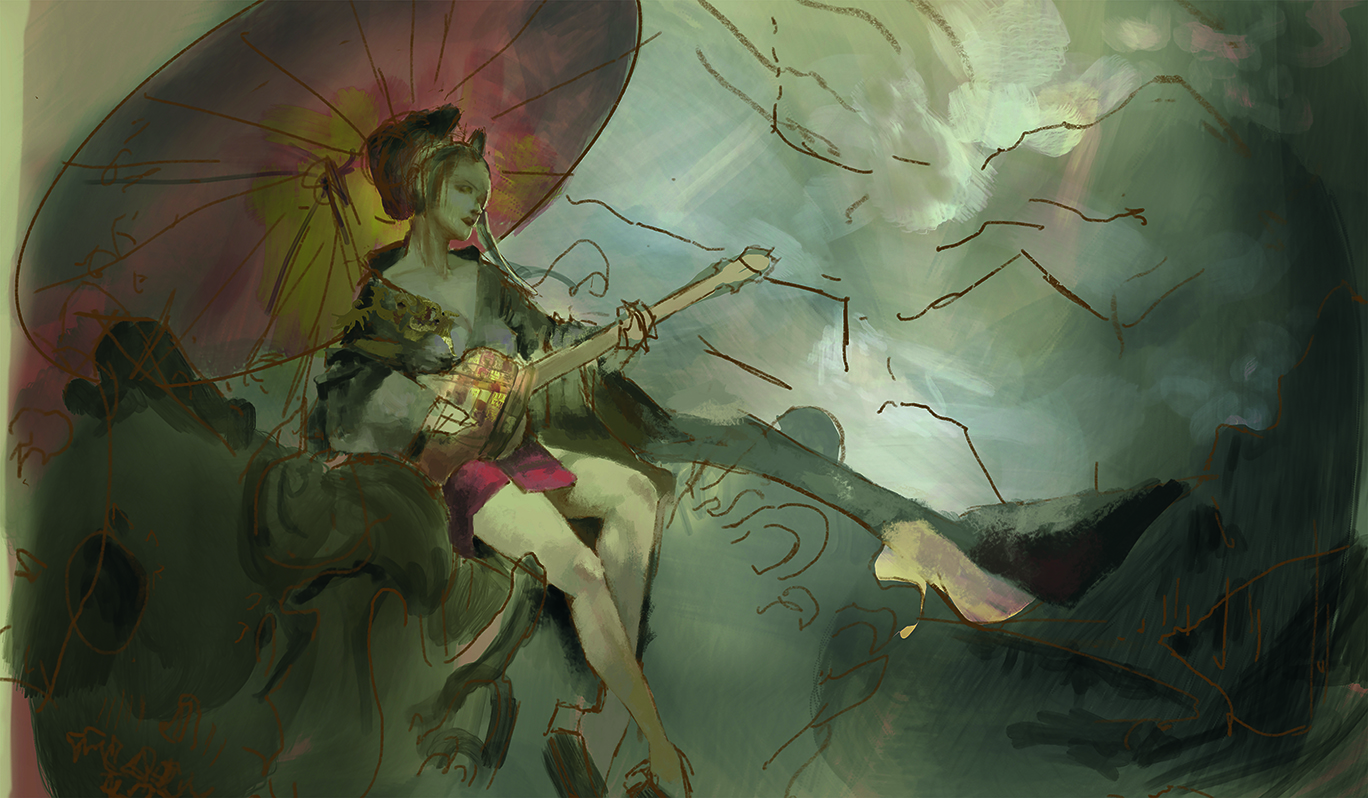
Every great work of fantasy begins with a singular vision. For Angel, the project started with the basic character concept. "After concepting my character, I made a couple of thumbnail sketches and ended up going with this one," Angel explains.
During this initial phase, the priority was not detail, but composition and lighting. Angel identified a specific lighting requirement early on: he wanted the light source to hit the character’s lap rather than her face. This intentional choice allowed for a more dynamic interplay of shadow and texture, ensuring that the viewer’s eye is drawn to the interplay between the character and the instrument she holds, rather than just a portrait-focused composition. This strategic placement of light is vital in character design, as it dictates the flow of the image and highlights the intricacies of the costume’s fabric.
02. Elevating the Fantasy Aesthetic
Once the foundational sketch was established, the project moved into the refinement phase. Angel noted that while the character was structurally sound, it lacked the "high fantasy" punch he envisioned.
"I felt that it was getting way too literal," Angel admits. The initial draft focused too heavily on the reality of the Oiran, lacking the supernatural elements required for a truly immersive fantasy scene. To correct this, he shifted his focus toward the creature the character is riding. By integrating this beast into the composition, he successfully transformed a historical portrait into a high-stakes fantasy narrative, grounding the piece in a world where music and monsters coexist.
03. Polishing the Details
The final stage of development focused on texture and visual storytelling. To distinguish this piece, Angel paid meticulous attention to the "uchikake" (outer robe) and the musical instrument.
"After changing the hair, I wanted her guitar to have a lacquer finish, and for her uchikake outer robe to feature lots of designs," he says. To achieve this, Angel employed a sophisticated technique: he painted custom orbs with subtle color and contrast shifts, then utilized the mixer brush in Photoshop to sample those colors directly onto the fabric. This process allowed him to create the appearance of intricate, hand-stitched embroidery, adding a layer of tactile realism to the digital painting.
Technical Methodology: The Power of the Exclusion Layer
One of the most revealing aspects of Angel’s process is his reliance on the "exclusion layer" in Photoshop. For many digital artists, the exclusion layer is an underutilized tool, but for Angel, it serves as an essential mechanism for experimentation and correction.
The exclusion layer allows an artist to "reset" values and unify colors without destroying the underlying work. In the creation of Oiran Summoner, Angel frequently toggled between layers to test different atmospheric effects. This allowed him to explore diverse moods and lighting scenarios, providing a safety net for his contrast ranges. If the contrast became too aggressive or the color palette too disjointed, the exclusion layer provided the necessary recalibration to bring the piece back into visual harmony.
This method underscores a broader trend in digital art: the move away from rigid, "from-the-ground-up" painting toward a more fluid, modular, and experimental approach that favors iterative refinement over absolute precision from the first stroke.
Supporting Data: The Digital Artist’s Arsenal
The creation of high-fantasy works like Oiran Summoner requires more than just artistic vision; it requires a robust technological infrastructure. As noted in the artist’s own documentation, the choice of hardware is as critical as the software.
For aspiring artists looking to replicate this level of detail, the industry standard has shifted toward professional-grade drawing tablets and high-performance mobile workstations. Whether utilizing a tablet with a high-fidelity display or a laptop capable of handling complex layer stacks and high-resolution brushes, the hardware must be capable of rendering subtle color shifts and fine embroidery-like textures in real-time.
When choosing equipment, artists should look for:
- Color Accuracy: Essential for the subtle "contrast shifts" required for the lacquer and fabric textures mentioned by Angel.
- Pressure Sensitivity: Critical for the mixer brush techniques that define the final, polished look of the garments.
- Software Integration: The ability to move seamlessly between mobile sketching (Procreate) and desktop-class finishing (Photoshop) is the modern standard for professional illustration.
Implications for World-Building
Beyond the individual piece of art, Oiran Summoner represents a significant trend in the "creator-led" content boom. By building an entire universe—a world where musical instruments function as conduits for summoning monsters—Angel is participating in a style of world-building that prioritizes visual storytelling over traditional prose.
This approach has profound implications for the gaming and entertainment industries. Concepts that begin as single-frame illustrations often evolve into broader intellectual properties. By establishing a clear, unique aesthetic—in this case, the fusion of Edo-period fashion with high-fantasy creature design—an artist can define the visual identity of a project long before a single line of game code or script is written.
The "Oiran Summoner" universe is a testament to the fact that modern fantasy is not just about dragons and knights; it is about finding new cultural intersections to explore. By marrying the elegance of the Oiran with the intensity of monster-summoning, Angel has opened the door to a new sub-genre of fantasy that is ripe for expansion into character design for video games, tabletop RPGs, or even animation.
Final Thoughts: The Artist’s Perspective
The journey from a blank canvas to a completed, complex fantasy scene is rarely a straight line. It is a process of constant questioning, re-evaluating, and refining. Christian Angel’s work on Oiran Summoner serves as a reminder that the best art often comes from the constraints we set for ourselves—whether that is a specific lighting scheme, a technical restriction like the exclusion layer, or the desire to make a piece feel more "fantasy-forward."
As digital tools continue to advance, the barrier between an artist’s imagination and the final, rendered image continues to shrink. However, as evidenced by this project, the most important tools remain the artist’s eye for composition and the patience to refine every detail, from the shimmer of a lacquer finish to the intricate patterns on a silk robe.
For those who wish to follow in this path, the advice is clear: experiment, use your tools in unconventional ways, and always maintain a clear vision of the world you are trying to build. As Oiran Summoner proves, when you have a strong concept and the technical patience to see it through, you don’t just draw a character—you summon a new world into existence.
This analysis of the creative process behind "Oiran Summoner" highlights the intersection of technical proficiency and creative vision in the digital age. For more insights into the tools and techniques used by professional illustrators, stay tuned for further breakdowns of industry-leading work.