

The Future of Event Check-In: Why Onsite Label Printing is Replacing Pre-Printed Badges

If you have ever spent the night before a major conference hunched over a folding table, frantically sorting hundreds of plastic badge holders into alphabetical stacks, you are intimately familiar with the "pre-print panic." It is a ritual defined by manual labor, human error, and the persistent anxiety that a last-minute registration update will leave an attendee standing in line with a blank, hand-scrawled name tag.
Fortunately, the event industry has undergone a paradigm shift. Onsite badge label printing has emerged as the definitive solution for modern professional gatherings. By shifting the printing process to the moment of check-in, planners are not just saving time; they are creating a more seamless, professional, and data-driven arrival experience.
The Core Concept: What Is Onsite Label Printing?
At its simplest, onsite badge label printing is a hybrid approach. It utilizes pre-branded badge stock—professional-grade cardstock or plastic already featuring the event’s logo, color scheme, and aesthetic design—combined with a compact thermal label printer.

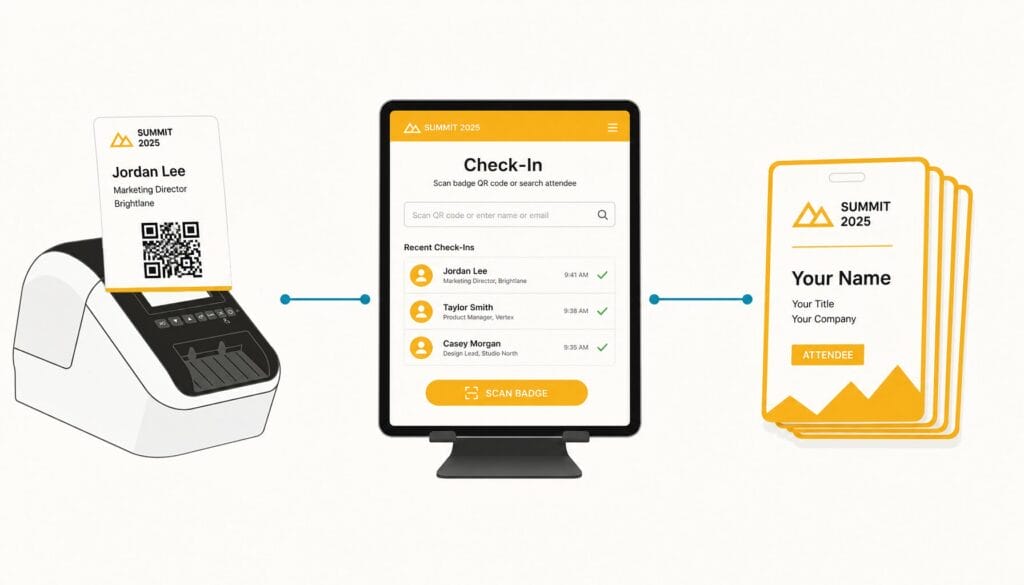
When an attendee arrives, the check-in software retrieves their live registration record. In a matter of seconds, a small, high-quality adhesive label is produced, containing the attendee’s name, title, company, and a unique QR code. This label is then applied to the pre-branded stock, resulting in a badge that looks as though it was professionally printed by a centralized shop, even though it was produced seconds prior.
The Critical Distinction: Label vs. Direct Thermal Printing
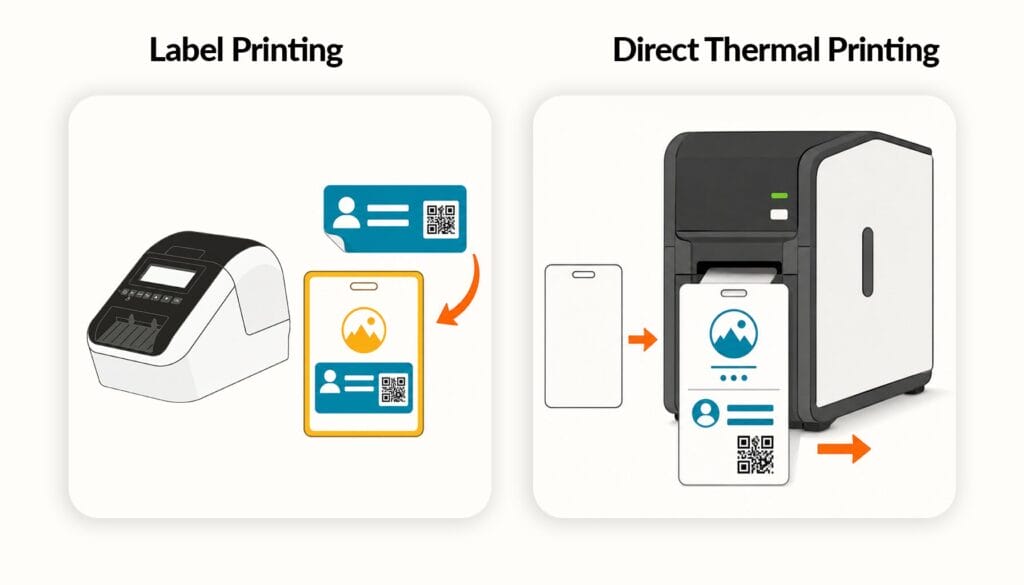
Planners often confuse "label printing" with "direct thermal printing." The distinction is significant:
- Direct Thermal Printing: This method prints the entire badge—branding, logos, and attendee details—from blank stock. It requires specialized, industrial-grade hardware that is often heavy, expensive, and requires a dedicated technician to operate.
- Label Printing: This method separates the "constant" (your event branding) from the "variable" (the attendee data). Because the branding is pre-printed on the cardstock, you only need an affordable, portable thermal printer to handle the text and QR codes. For conferences with fewer than 2,000 attendees, label printing is widely considered the more efficient and cost-effective standard.
The Evolution of the Check-In Chronology
To understand the operational impact of this technology, one must look at the traditional workflow versus the modern onsite printing model.
The Old Way: The "Alphabetical Struggle"
- Exporting Data: A week before the event, registration data is locked.
- Batch Printing: Thousands of badges are printed in a massive, time-consuming run.
- Manual Sorting: Staff spend four to six hours organizing badges into alphabetical stacks.
- The "Fix-It" Phase: On event day, any last-minute registration changes, spelling errors, or walk-ins are handled by hand-writing on blank badges, creating a disjointed, unprofessional look.
The Modern Way: The Onsite Printing Workflow
- Arrival: The attendee approaches the check-in desk or kiosk.
- Verification: They present their QR code or provide their name. The staff member—or the attendee via a self-service kiosk—locates the record instantly.
- The Print Trigger: The moment the registration is confirmed, the thermal printer is signaled. The label prints in approximately two to five seconds.
- Assembly and Hand-off: The staff member peels the label, applies it to the pre-branded stock, and hands the complete, high-quality badge to the attendee.
This entire sequence takes less than a minute per person, allowing for a throughput of roughly 150 attendees per hour, per station.
Supporting Data: Efficiency and ROI
The shift to onsite printing is not merely about aesthetics; it is a calculated business decision supported by operational data.
For a 500-person event, organizers traditionally anticipate between 15 and 25 "exception cases"—people who changed their titles, had their names misspelled, or registered at the eleventh hour. In a pre-printed system, these 25 people create a bottleneck at the registration desk. With onsite label printing, those 25 records are updated in the system, and the "correction" is simply the standard printing process.
Furthermore, the hardware requirements are significantly lower than legacy systems. A professional-grade thermal printer costs between $300 and $500. When compared to the labor costs of hiring staff to sort thousands of badges, the ROI of an onsite printer is realized in a single event cycle. Solutions like EventMobi’s BadgeON™ have further streamlined this by providing all-in-one kits, which include the tablet, printer, and accessories, removing the need for planners to source components individually.
Addressing the Failures: A Preventative Guide
Even with the best technology, events can encounter technical hitches. Understanding these common failure points is essential for every event manager:
1. The Alignment Issue
Labels that print off-center are usually a result of incorrect template settings in the print driver. The fix: Always run a "test batch" of at least five labels before the doors open. Adjust your margins in the software until the text is perfectly centered.

2. The Media Mismatch
Thermal printers require thermal-coated labels. If you accidentally load standard inkjet paper labels, the printer will fail to produce a clean image, or the print will smear instantly. The fix: Always verify your label stock compatibility with your printer manufacturer and keep an extra roll on hand.
3. Connectivity Stability
While Bluetooth is convenient, it can be unstable in large venues crowded with thousands of personal devices competing for the same RF (radio frequency) spectrum. The fix: Use a USB connection as your primary link between the tablet and the printer. Keep Bluetooth as a secondary, emergency backup only.
4. Supply Management
Running out of labels is the "death knell" of a smooth check-in. The fix: Always order 15% more label stock than your projected attendance. This buffer accounts for testing, user error, and the inevitable walk-ins.

Implications for Event Strategy
The integration of badge printing with your registration platform creates a "Single Source of Truth." When your registration platform talks directly to your printer, the implications are profound:
- Real-Time Data: As attendees check in, that data flows back to your event management platform. You gain the ability to track no-shows, monitor attendance numbers, and provide live updates to session coordinators without ever touching a spreadsheet.
- Security and Access Control: If an attendee’s registration status changes (e.g., they upgrade their ticket for VIP access), the system updates immediately. The printer will reflect the correct access level the moment they check in, preventing unauthorized access to restricted sessions.
- The "Human" Element: Because staff no longer spend their time sorting badges or handwriting names, they can focus on the attendee experience. A member of your team can greet a guest with a smile and a warm welcome, rather than a frantic search through a stack of paper.
Conclusion: The Professional Standard
The transition to onsite label printing represents a maturation of the events industry. By moving away from the static, labor-intensive methods of the past and embracing flexible, real-time technology, planners can ensure that their events start with confidence and professionalism.
For conferences of all sizes—but particularly those under 2,000 attendees—the combination of a thermal label printer, a tablet, and pre-branded stock is not just a "nice to have." It is the most practical, cost-effective, and scalable approach to modern event logistics. As the technology continues to advance, the "night-before-sorting" session is rapidly becoming a relic of the past, replaced by an arrival experience that is as efficient as it is welcoming.
Related posts: