Comments Off on The Great Trade Show Leak: How AI Badge Scanners Are Quietly Draining Event Revenue (And How Organizers Can Fight Back)
Main Facts: The Silent Bleeding of Expo Floor Revenue
Picture this familiar scenario on a bustling trade show floor: A high-intent prospect approaches an exhibitor’s booth. The pitch is compelling, the chemistry is right, and a genuine buying signal is flashed. Instead of pulling out the official event-sanctioned app, scanning a Quick Response (QR) code, or utilizing a paid-for lead retrieval system, the exhibitor simply lifts a smartphone, points the camera at the attendee’s lanyard, and taps once.
Within seconds, an AI-powered third-party tool automatically captures the individual’s name, company, and title, populating the rest of the profile with scraped email addresses and corporate telemetry.
From the event organizer’s perspective, this moment represents a silent financial loss. The exhibitor never purchased the lead capture add-on, bypassed the proprietary event app entirely, and effectively stopped funding the lead retrieval technology that organizers have traditionally relied upon as a dependable revenue stream.
This challenge was brought to the forefront during EventMobi’s masterclass, Inside Job: What AI Badge Scanners Are Costing You in Trade Show Revenue (And How to Fight Back). The session dove deep into the hidden economics of exhibitor lead capture, exposing a systemic industry vulnerability. During a live poll conducted during the session, 65% of event organizers admitted they still attempt to sell lead capture as a standalone, paid add-on, while 15% confessed they had no concrete idea what tools their exhibitors were actually using on the floor.
The stakes are far higher than a minor line-item shortfall. When booths bring their own unauthorized scanning tools:
Event revenue vanishes from the operational budget.
Attendee data bypasses the central registration system entirely.
Organizers lose the concrete behavioral proof required to validate sponsor ROI and secure renewals.
Exhibitors frequently inherit flawed, incomplete, or non-compliant data.
Chronology: From Laser Barcodes to Bring-Your-Own AI Scanners
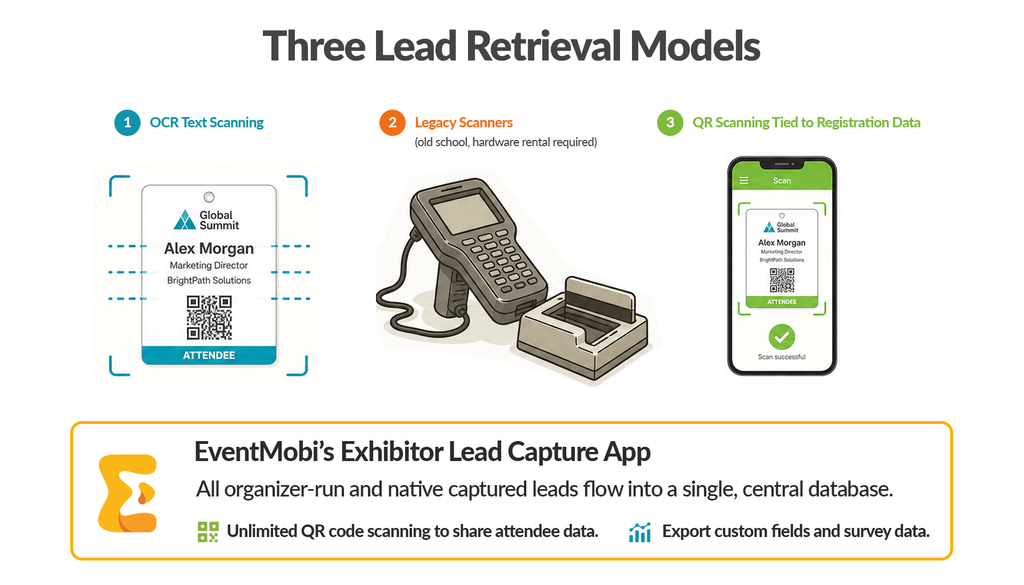
To understand how the modern trade show floor arrived at this tipping point, it is necessary to examine the evolution of lead retrieval technology over the last three decades.
1. The Hardware Rental Era (1990s – 2000s)
Thirty years ago, trade show lead capture was an entirely hardware-dependent affair. Exhibitors rented specialized, bulky equipment—primarily laser barcode scanners and magnetic stripe readers. Because event organizers neither wanted to own nor maintain this costly physical inventory, specialized third-party hardware vendors supplied the gear, processing the rentals on-site and splitting the resulting revenue with the show organizer. This transactional model firmly established lead capture as a distinct, lucrative line of business.
2. The Integrated Mobile App Revolution (2010s)
As smartphones saturated the market and event technology matured, mobile event apps folded lead capture into the broader digital ecosystem. Registration databases, schedule builders, and lead retrieval systems were unified into single platforms. Data flowed seamlessly from registration to the booth, creating a unified user experience.
3. The Unbundling and AI Disruption (Present Day)
Today, three distinct forces have collided to fracture this integrated model:
The rise of affordable SaaS subscriptions: Exhibitors can now purchase generic, cross-event monthly scanning subscriptions that work universally across any conference.
Advanced Optical Character Recognition (OCR) and AI: Modern smartphone cameras can instantly read physical badges, extract text, and cross-reference names without interacting with any event-specific infrastructure.
Data enrichment shortcuts: Third-party applications instantly scrape web data to fill in missing contact fields, making exhibitors feel less dependent on official databases.
For a busy corporate marketing team chasing efficiency across dozens of events annually, these cross-platform workarounds offer undeniable convenience—leaving organizers scrambling to protect their revenue models.
Supporting Data: Why "Bring Your Own App" Solutions Fall Short
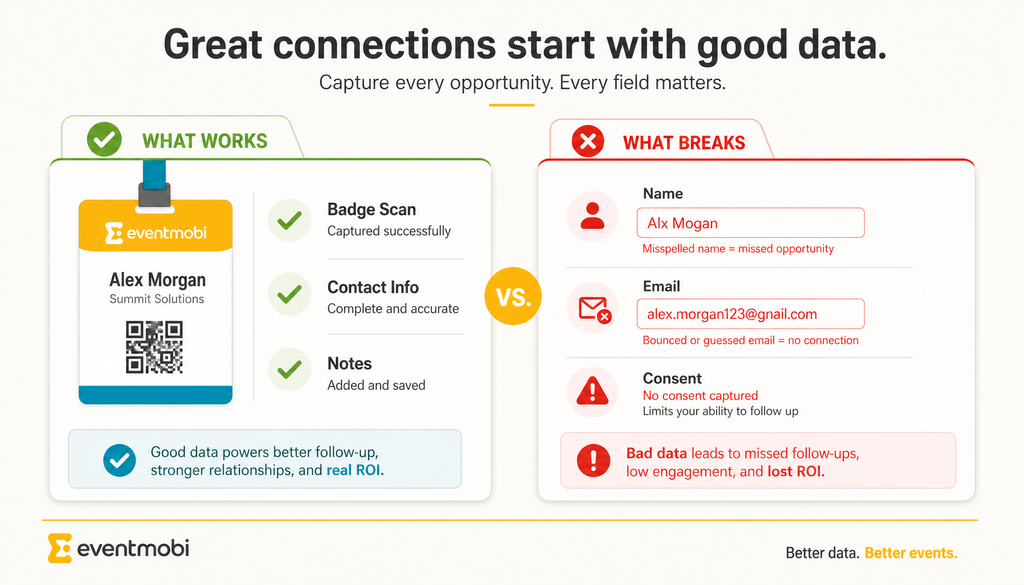
On paper, third-party OCR and badge-scanning apps appear to be formidable competitors to official event tools. They boast feature lists that include badge scanning, contact information fields, and qualitative note-taking capabilities. However, a closer look reveals severe vulnerabilities—particularly in the two metrics exhibitors care about most: verified identity and accurate contact channels.
The Accuracy and Compliance Trap
The Name and Email Deficit: AI-driven text extraction is prone to errors. Misspelled names, outdated corporate titles, and defunct email addresses regularly slip through. More alarmingly, third-party scraping apps frequently pull personal email addresses (e.g., Gmail or Yahoo accounts) rather than business contact details, rendering the leads useless for B2B sales pipelines.
The Consent and GDPR Crisis: Perhaps the greatest risk to organizers is the "consent gap." When an attendee is aggressively spammed at a personal email address following an event, the resulting complaint is directed at the event organizer, not the third-party app developer.
This is not a theoretical hazard. Regulatory authorities are cracking down heavily on unauthorized data harvesting. In December 2024, France’s data protection regulator, the CNIL, slapped data enrichment vendor Kaspr with a €240,000 fine for scraping personal contact details without a valid legal basis under the stringent European General Data Protection Regulation (GDPR).
When exhibitors rely on unauthorized workarounds, both parties ultimately lose: the exhibitor saves a marginal amount of money on unverified data, while the organizer sacrifices both revenue and compliance security.
Official Responses and Industry Perspectives: Rethinking the Business Model
During the EventMobi masterclass, industry leaders argued that the traditional approach of aggressively selling the "scan" as a standalone commodity is officially broken. Because cheap, alternative tools have commoditized the basic act of reading a badge, defending it as a separate line item is a losing strategy.
Adam Parry, founder of Event Tech Live, offered a sharp critique of current event pricing structures during the session:
"Charging a mandatory lead capture fee feels like walking into a restaurant, ordering a steak, but getting asked to pay for the plate for it to sit on in order for you to eat it."
— Adam Parry, Founder, Event Tech Live
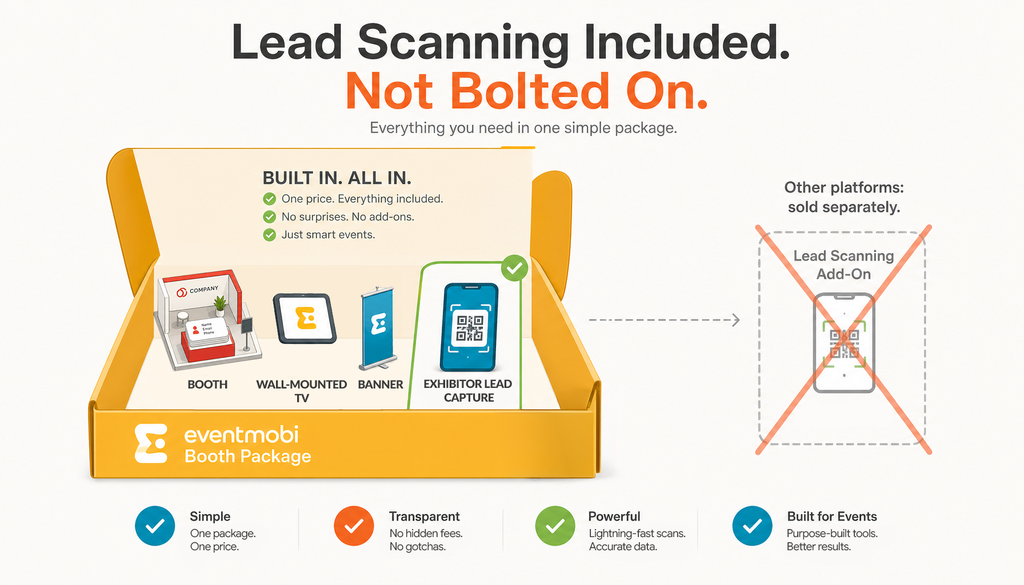
Parry and other event strategists advocate for a fundamental re-architecting of exhibitor packages. Rather than treating lead capture as an expensive bolt-on add-on that incentivizes exhibitors to seek out black-market workarounds, organizers should bundle core lead retrieval capabilities directly into standard booth packages.
For instance, modern platforms like EventMobi offer lead capture apps priced efficiently (such as $50 per pack of ten company licenses). This marginal cost can be easily absorbed into overall booth fees or marked up imperceptibly, effectively eliminating the incentive for exhibitors to search for external shortcuts. By spreading the modest cost across the entire exhibitor base, organizers can stabilize or even increase their overall revenue while eradicating pre-show friction.
Implications: Turning Event Signals into Advanced Monetization
Solving the revenue leak by bundling basic scans is only the first step. The true competitive advantage for modern event organizers lies in offering intelligence that no third-party smartphone app can possibly replicate.
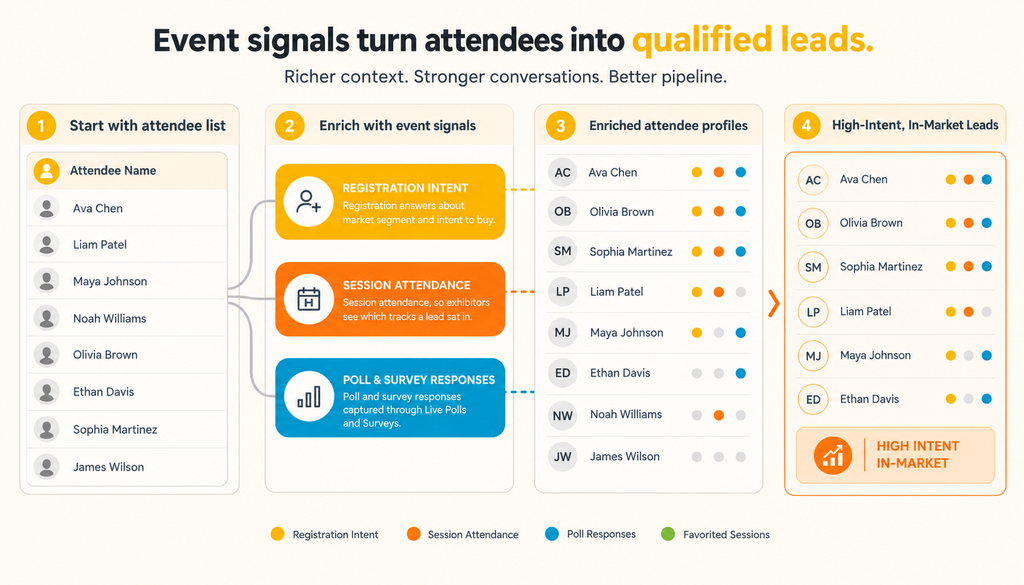
While an external camera app can guess a name and scrape a corporate profile, it is blind to what the attendee actually did during the event. This proprietary data is known in the industry as event signals, and it lives exclusively inside the platform hosting the event:
Session Attendance Tracking: Knowing which workshops or keynotes an attendee sat through.
In-App Engagement: Tracking participation in live polls, Q&A sessions, and gamification challenges.
Exhibitor Directory Activity: Monitoring which digital booths an attendee bookmarked or visited prior to walking onto the physical expo floor.
The Value Proposition for Sponsors
The implications for event sponsorship are profound. A third-party scraper app hands an exhibitor a raw, unverified list of 200 names. In contrast, event signals allow an organizer to present a much more powerful narrative:
"Here are 200 names, and out of those, these 30 attended the cybersecurity keynote, participated in our security poll, and actively indicated they are sourcing new vendor solutions this quarter."
Organizers can package these behavioral insights as premium upsells. For example, post-event email campaigns can be segmented by genuine attendee intent and deployed on behalf of key sponsors, reaching strictly qualified buyers. This transforms raw data into an undeniable proof of ROI, drastically simplifying sponsor renewals for the following year.
Practical Implementation: The Pre-Show Lead Capture Checklist
To reclaim control of the expo floor and protect future revenue streams, event organizers should execute a structured pre-show checklist:
Audit Current Exhibitor Behavior: Survey past exhibitors anonymously to discover what percentage are using third-party apps versus official event tools, and identify their primary cost or usability pain points.
Restructure Booth Packages: Move away from punitive add-on pricing for lead capture. Bundle baseline licenses directly into exhibitor tiers to eliminate friction.
Upgrade Security and Compliance Protocols: Clearly communicate data privacy and GDPR/CCPA compliance standards to exhibitors, emphasizing that official tools guarantee legal data collection.
Package Behavioral Event Signals: Build tiered data packages that highlight session attendance, in-app engagement, and user intent, transforming standard lead lists into high-value marketing intelligence.
Educate Exhibitors Early: Provide pre-show video tutorials and documentation demonstrating how official lead retrieval apps seamlessly integrate with major CRM systems (Salesforce, HubSpot, etc.) better than generic scanning tools.
The Bottom Line
The migration away from official event lead capture apps is a symptom of an outdated economic model. Protecting event revenue, safeguarding attendee trust, and securing long-term sponsor renewals requires a three-pronged pivot:
Stop selling the scan: Recognize that basic badge reading is no longer a scarce commodity.
Bundle to eliminate friction: Incorporate lead capture into standard exhibitor packages to remove the temptation for unauthorized workarounds.
Monetize proprietary signals: Sell the unique behavioral data that only the official event platform can capture, turning raw names into qualified, in-market leads.
By shifting focus from transactional hardware rentals to high-value audience intelligence, event organizers can transform badge scans from a quiet revenue leak into a reliable engine for sustainable growth.