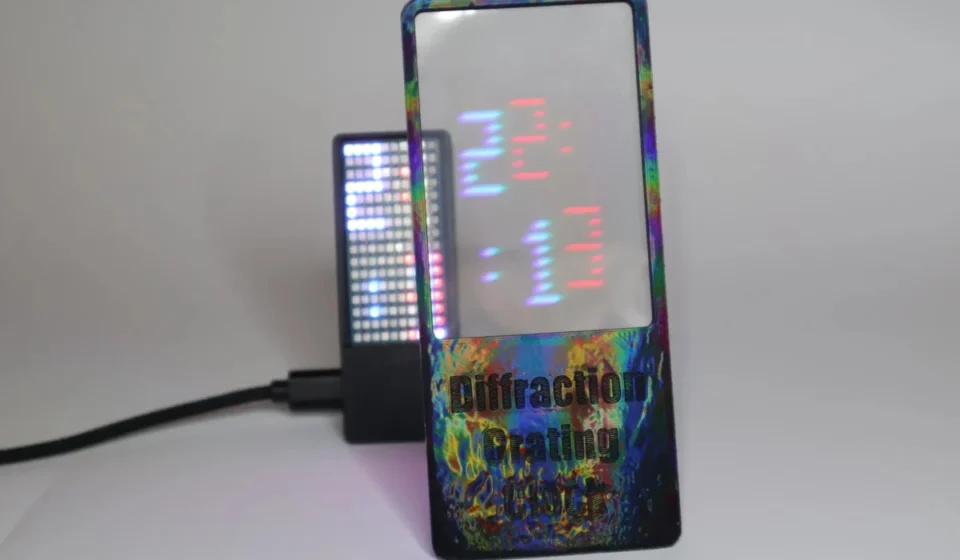

In the intersection of horology, optical physics, and kinetic art, few creators have managed to carve out a niche as distinct as Moritz Von Sivers. A perennial favorite among the global maker community, Von Sivers has long been obsessed with the marriage of mechanical movement and temporal display. His latest endeavor, an innovative clock that utilizes the physical properties of light diffraction to separate time into distinct spectral channels, has once again captivated the DIY community, proving that even the most ancient human invention—the clock—still has room for radical reinvention.
The Convergence of Physics and Horology
At its core, Von Sivers’ latest timepiece is a masterclass in applied physics. While traditional clocks rely on gears, hands, or digital liquid crystal displays to present the passage of time, Von Sivers has opted for an approach that borders on the ethereal. The device overlays blue and red numerical displays atop a singular LED matrix. However, the brilliance of the piece is not found in the LEDs themselves, but in the interface between the light source and the viewer: a diffraction grating screen.
Diffraction, the phenomenon where light waves bend around the corners of an obstacle or through an aperture, is the scientific bedrock of this project. Because red light has a longer wavelength than blue light, it is refracted at a more pronounced angle when passing through a diffraction grating. By calculating the precise geometric distance between the LED source and the screen, Von Sivers has successfully forced the two colors to "split." To the observer, the red minutes appear offset to the right of the blue hours, creating a visual separation that feels less like a machine and more like a parlor trick of light.
A Chronology of Innovation: The Von Sivers Portfolio
To understand the significance of this project, one must look at the trajectory of Von Sivers’ career as a maker. His work is characterized by a relentless curiosity regarding how information is presented to the human eye.
The Foundation (Early Projects)
Von Sivers first gained prominence through his servo-driven word clock. Unlike standard digital clocks that use seven-segment displays, his version utilized individual mechanical servos to physically manipulate panels, effectively turning the clock into a kinetic sculpture. This project established his reputation for "messy" but beautiful mechanical complexity.
The Lenticular Leap
Following the word clock, Von Sivers turned his attention to lenticular technology—the same technique used to create 3D postcards or "flip" images. By applying lenticular lenses over a digital display, he created a clock that changed its appearance based on the viewer’s angle of observation. This marked a pivot from purely mechanical movement to optical manipulation.
The Current Breakthrough: The Diffraction Clock
His latest entry in the Instructables’ "Colors of the Rainbow" contest represents the synthesis of these previous interests. It combines the precise timing of his earlier clocks with a deeper understanding of wave optics. The project is not merely a tool for telling time; it is an exploration of the electromagnetic spectrum, demanding that the viewer engage with the physics of the device to decipher the information it provides.

Technical Execution and Methodology
The construction of the diffraction clock involved several layers of high-level fabrication. Central to the process was the creation of a custom housing that could maintain the necessary alignment between the LED matrix and the diffraction film.
One of the most impressive aspects of the build, as noted by observers, is the integration of the diffraction pattern directly into the hardware. Von Sivers employed a unique technique of transferring the diffraction film onto the print bed during the 3D printing process of the clock’s components. This "in-mold" application ensures that the optical properties are inherent to the structure of the clock itself, rather than being an afterthought or a fragile add-on.
The Physics of the Display
- Wavelength Variance: Red light (approx. 620–750 nm) versus blue light (approx. 450–495 nm).
- The Grating Constant: The density of the diffraction grating lines determines the angular separation of the spectral colors.
- Optical Path Length: The distance between the source and the diffraction screen must be precisely calibrated to ensure the hours and minutes do not overlap, but rather sit in their intended visual positions.
Implications for the Maker Community
Von Sivers’ project is more than just a decorative piece; it serves as a catalyst for a broader conversation within the maker community about the nature of display technology.
Expanding the "DIY" Toolkit
The technique of transferring diffraction patterns to 3D-printed parts is a significant development for hobbyists. Historically, diffraction gratings were seen as expensive, delicate laboratory equipment. By proving that these films can be successfully integrated into consumer-grade 3D prints, Von Sivers has effectively lowered the barrier to entry for creators looking to experiment with light-bending aesthetics.
The Future of "Secret" Displays
The implications for information privacy are also noteworthy. The same technology that allows Von Sivers to display the time clearly can, when manipulated, be used to obscure information from anyone not positioned at the exact correct angle. As the maker notes, this technique could theoretically be used to develop "glasses" that reveal hidden messages, or high-security displays that remain unreadable to bystanders—a concept that has already piqued the interest of security enthusiasts and cryptographers within the community.
Industry and Community Response
The response from the maker community, particularly on platforms like Instructables and the associated Discord channels, has been overwhelmingly positive. Peers have lauded the project for its "clean" execution and the "hypnotic" quality of the final output.
"Moritz has a way of taking complex physics and making it feel like magic," said one community moderator during a discussion on the project’s Discord server. "When you look at this clock, you don’t think about wavelengths or diffraction constants; you think about the beauty of the light. That is the true art of the maker."

The Instructables contest, which focuses on the "Colors of the Rainbow," provided the perfect stage for the project. Judges have noted that while many entrants focused on simple color-changing LED strips, Von Sivers approached the prompt with a structural, scientific rigor that elevated his submission above the competition.
Looking Ahead: What Comes Next?
As Von Sivers continues to refine his craft, the question remains: what is the next frontier for this kinetic artist? His work suggests an ongoing migration toward "invisible" technology—devices that perform complex digital or physical feats without the standard appearance of a computer or a motor.
Whether it be through further exploration of refractive index, liquid optics, or perhaps the integration of advanced materials into home fabrication, one thing is certain: the timekeeping world will be watching. Moritz Von Sivers has proven that the passage of time is not just a digital readout or a sweeping hand; it is a physical, optical experience that, in the right hands, can be manipulated into something truly spectacular.
For those inspired to try their hand at this intersection of science and design, the full documentation of the build is available on the Instructables platform. It is a rigorous project, requiring patience, a steady hand, and a burgeoning interest in the physics of light, but for those who finish, the reward is a piece of art that turns every passing minute into a vibrant, spectrum-shifting event.
As we move toward a future where our devices become more integrated into our physical environment, creators like Von Sivers provide a vital blueprint for how we might blend the digital and the physical—not just to make things that work, but to make things that wonder.