
In the world of contemporary design, few collaborations bridge the gap between hyper-rationalist industrialism and ancestral craftsmanship as poignantly as the latest partnership between lifestyle entrepreneur Armando Cabral and the legendary Swiss modular furniture manufacturer, USM. The recently expanded collection, titled NKYINKYIM A CASA, is far more than a furniture line; it is a profound exploration of identity, memory, and the physical manifestation of cross-cultural heritage.
By wrapping USM’s utilitarian steel frames in vibrant, multi-directional striped fabrics that pay homage to the traditional weaving of Portugal’s Alentejo region, Cabral has transformed the neutral, post-war Swiss aesthetic into a canvas for storytelling. The collection—comprising a daybed, a love chair, a bookshelf, a side table, and a valet wardrobe—challenges the rigid boundaries of modernism, asking us to consider how our personal history can live within the structures we build around us.
The Genesis of the Collection: A Life in Transit
To understand the depth of NKYINKYIM A CASA, one must first examine the life of its creator. Armando Cabral’s biography is a map of global movement. Born in Guinea-Bissau, he spent his formative years in Portugal before pursuing education in London and eventually establishing his professional roots in New York.
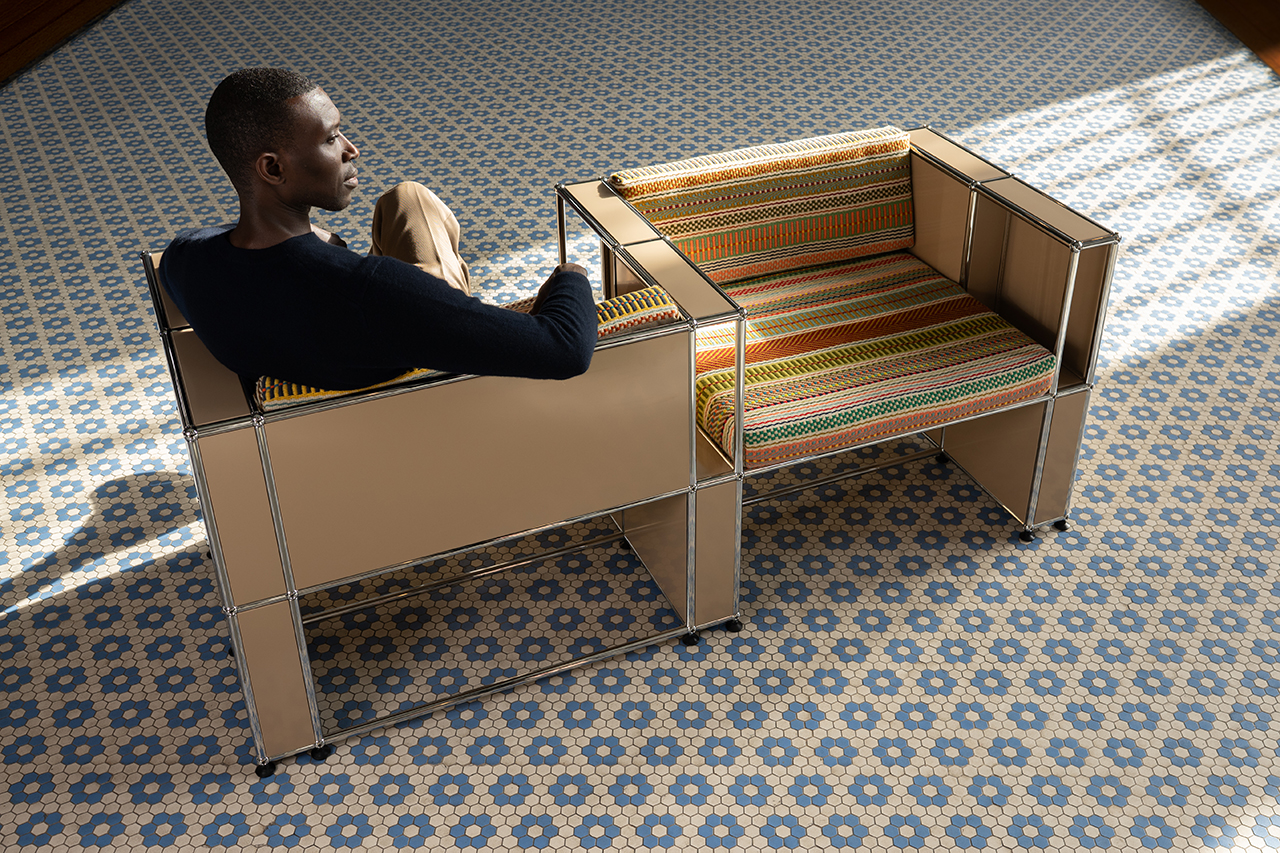
For Cabral, who transitioned from a successful career as an elite fashion model to a design-focused entrepreneur, the concept of "home" has never been static. It is a fluid, evolving entity. This transience informs the very naming of the collection. "NKYINKYIM" is derived from an Adinkra symbol, part of a visual language developed by the Akan people of Ghana and Côte d’Ivoire. The symbol represents the intertwining paths of progress and the necessity of overcoming obstacles—a fitting metaphor for both the individual journey and the collective human experience. "A Casa," meanwhile, is the Portuguese phrase for "at home," rooting the global concepts in the warmth of his Portuguese upbringing.
Chronology of a Collaboration: From Concept to Composition
The trajectory of this project began with a desire to marry the precision of the USM Haller System with the tactile, imperfect beauty of traditional textile art.
- Initial Engagement: Cabral approached USM with a vision to soften the brand’s industrial edges without compromising the integrity of its legendary modularity.
- Design Development: Over several months, the design team experimented with various fabric tensions and color palettes. The challenge was to integrate the soft, woven cushions into the rigid steel-and-ball joint architecture of the Haller System.
- Fabric Selection: Cabral drew deep inspiration from Alentejo weaving—a craft known for its bold geometric patterns and intricate color shifts. The textiles selected were not merely decorative; they were chosen for their structural density, allowing them to withstand the rigors of furniture use while providing a visual counterpoint to the powder-coated steel.
- The Launch: The expansion of the collection saw the inclusion of the Bassarel Love Chair and the Uno Bookcase, items that moved beyond mere storage into the realm of social and intimate furniture.
The Philosophy of the Haller System
The USM Haller System, designed by Fritz Haller and Paul Schärer in the 1960s, is perhaps the pinnacle of the Swiss "form-follows-function" ethos. Developed in the wake of World War I’s modernist movements, the system is intentionally neutral. Its hyper-rationalist design—built on a system of steel tubes and ball joints—is meant to be invisible, acting as a background for life rather than the protagonist of a room.
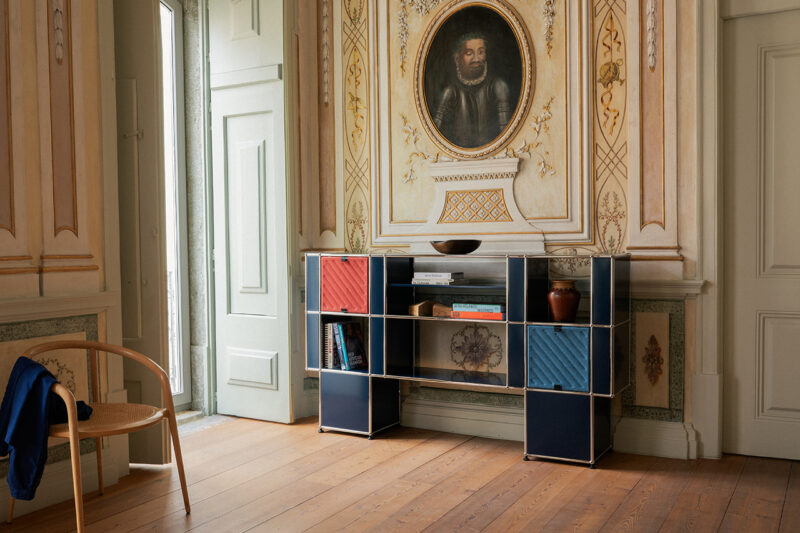
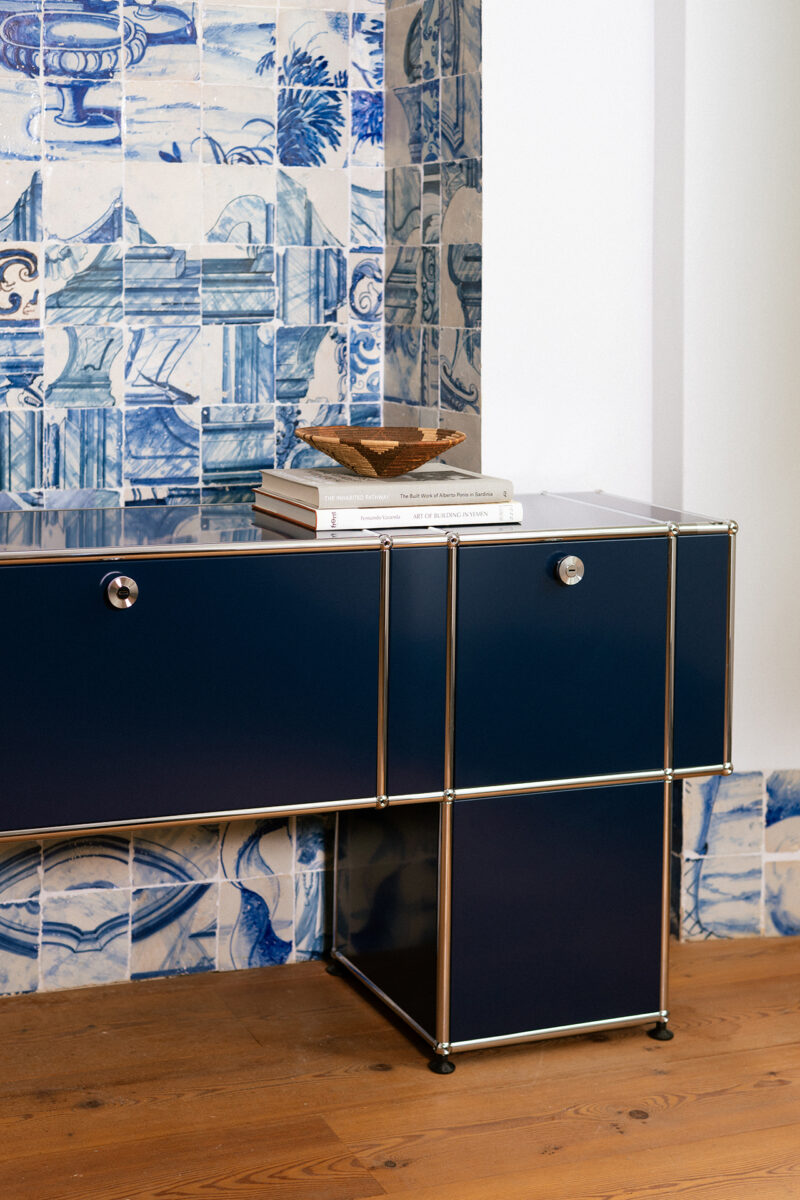
However, in this collaboration, the "background" becomes the "foreground." By introducing the artisanal, colorful textiles of the Alentejo region, Cabral disrupts the neutrality of the Swiss steel. He forces the viewer to engage with the furniture on an emotional level. As Cabral notes, "The modular nature of USM’s designs symbolizes the way each component forms a cohesive, functional structure." By treating these modules as building blocks for cultural expression, he has effectively "humanized" the machine-like efficiency of the Haller system.
Supporting Data: Why Materiality Matters
The success of NKYINKYIM A CASA relies on the interplay between the hard and the soft. The following data points highlight the technical and aesthetic considerations that define the collection:
- Structural Versatility: Each piece utilizes the standard USM Haller dimensions, ensuring that these artistic interventions remain fully compatible with existing USM ecosystems. This reinforces the sustainability of the project; customers can integrate Cabral’s cushions into their existing home setups.
- Ergonomic Integration: The textiles are not merely adhered to the surface; they are engineered as structural cushions. The Bassarel Love Chair, for instance, uses specifically tensioned fabrics to provide lumbar support that mimics traditional upholstery while retaining the sharp, angular silhouette of a USM cube.
- Color Theory: The palette—a mixture of deep blues, ochres, and crisp whites—is a deliberate nod to the architecture of the Alentejo region, where whitewashed walls meet the deep, rugged earth of the interior landscape.
Official Responses and Creative Implications
The reception from the design community has been largely centered on the "provocation" inherent in the work. By taking a brand as established and rigid as USM and layering it with deeply personal, cultural signifiers, Cabral has opened a dialogue about the future of interior design.
"We are seeing a move away from the ‘anonymous’ home," says industry analyst and design critic Adrian Madlener. "Consumers are increasingly seeking furniture that reflects their own complex, often multinational identities. Cabral’s work with USM is a masterclass in how to use mass-produced, modular luxury as a medium for authentic personal storytelling."
USM, known for its rigorous adherence to brand standards, has allowed this collaboration to push the limits of their system. In official statements, representatives have emphasized that the partnership reflects the brand’s commitment to evolving with its users. The "provocation," as Cabral describes it, is a question aimed at the consumer: If your furniture is a reflection of your identity, how would you assemble your home?
Implications: A New Era for Modular Design
The implications of the NKYINKYIM A CASA collection are far-reaching. It signals a shift in the high-end furniture market toward "curated modularity." For decades, modular systems were viewed through the lens of pure efficiency—how much can I store? How much space can I save? Cabral pivots this to: How can I live better?
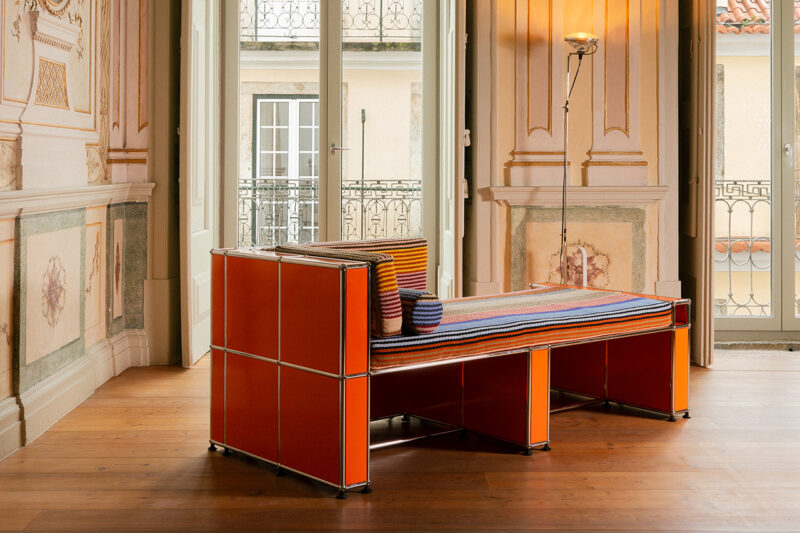
By incorporating the "tête-à-tête" typology in the Bassarel Love Chair—a design that forces two people to sit side-by-side while facing opposite directions to encourage intimate, non-confrontational conversation—Cabral proves that modularity can be social, even poetic.
This collection represents a vital intersection in the modern landscape: the marriage of the global and the local, the machine and the hand-woven, the Swiss-rational and the African-ancestral. As we look toward the future of residential design, the work of Armando Cabral serves as a reminder that even the most rigid structures are capable of containing the warmth, history, and complexity of the human spirit.
In the end, NKYINKYIM A CASA is an invitation to inhabit our own histories. Whether through the geometry of a bookshelf or the comfort of a daybed, Cabral has shown that by rearranging the modules of our environment, we are ultimately rearranging the pieces of our own narratives. The collection remains a testament to the fact that home is not a place we find; it is a place we build, one module—and one thread—at a time.