Where Art Meets Action: Sharmistha Ray Transforms Pittsburgh’s Pickleball Courts into a Living Canvas

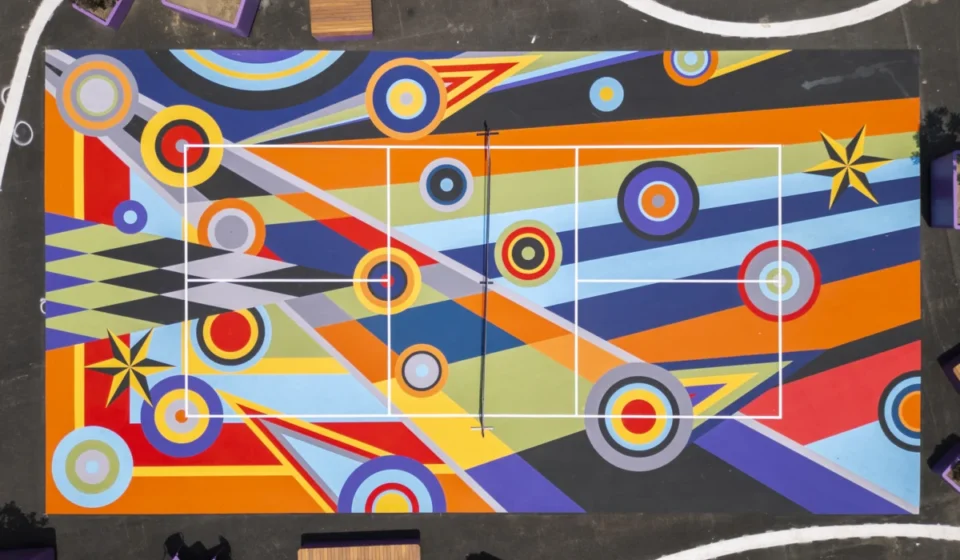
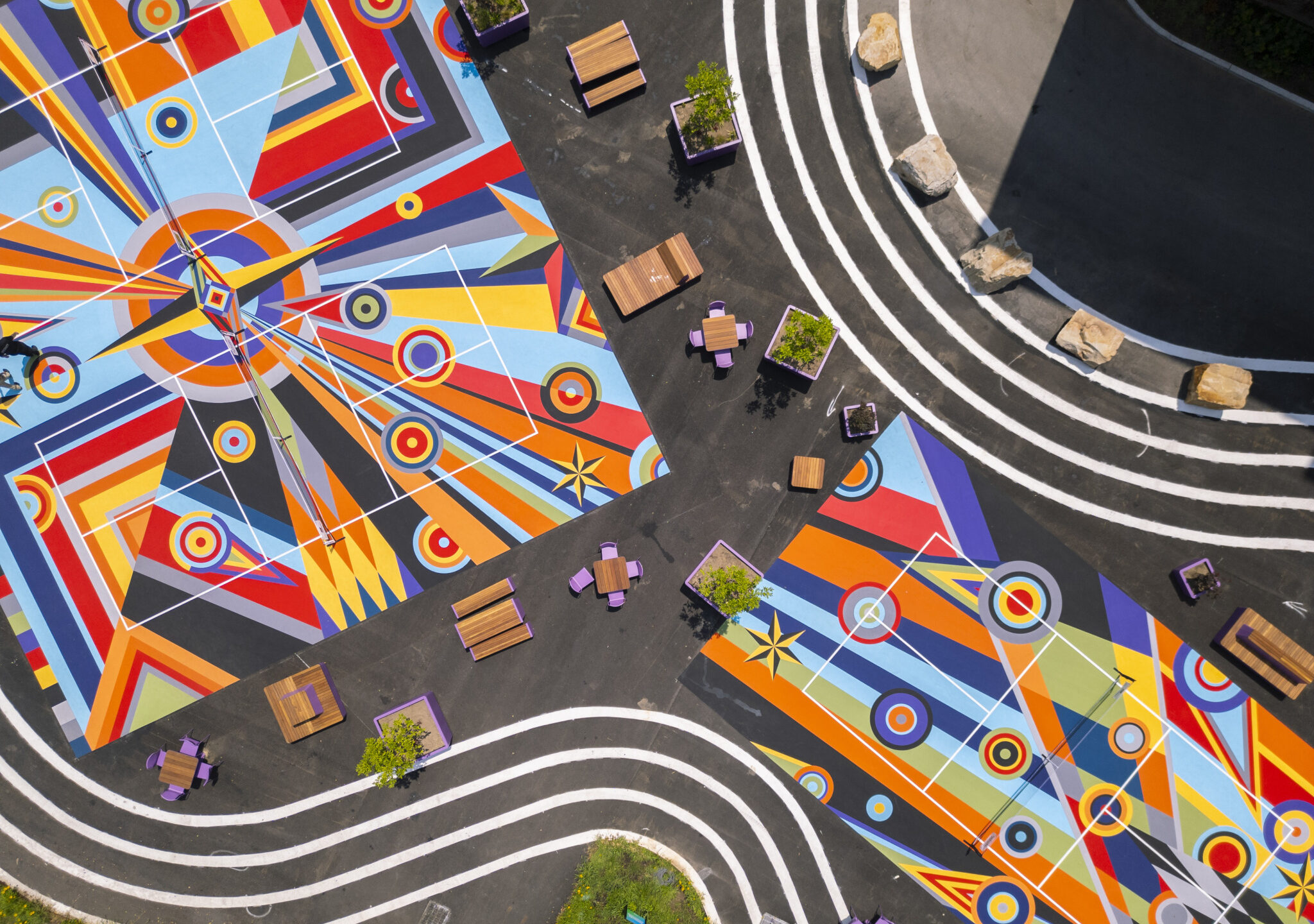
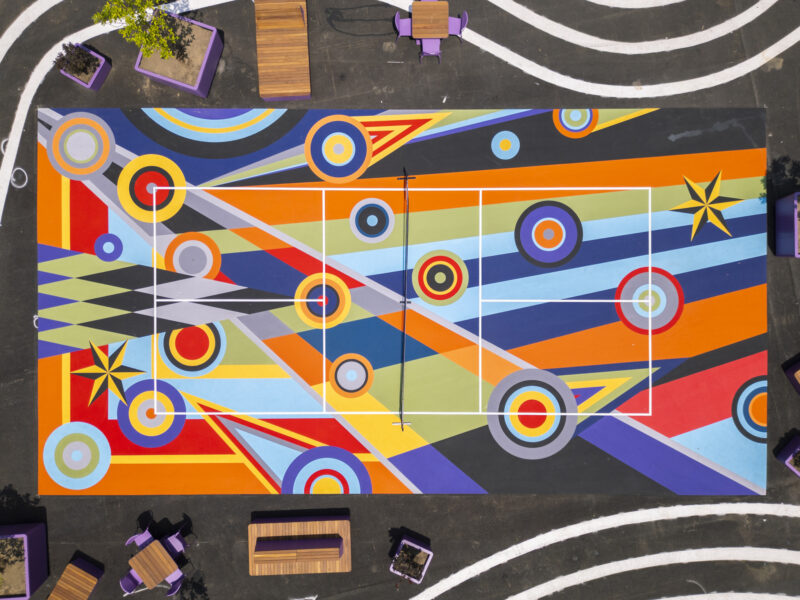
In the heart of Pittsburgh’s revitalized Cultural District, a new civic experiment is unfolding. At Arts Landing, a $31 million, state-of-the-art public space designed by the renowned landscape architecture firm Field Operations, the traditional boundaries between spectator and participant are being blurred. Here, artist Sharmistha Ray has unveiled Geometry of Play, a transformative installation that reimagines a pair of standard pickleball courts as a vibrant, kaleidoscopic mural.
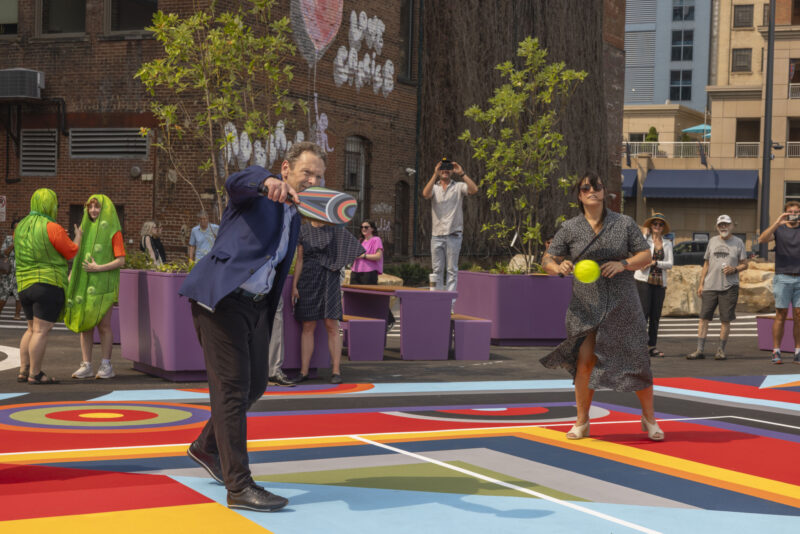
By inviting the public to step directly onto the composition, Ray has created an environment where the act of play—the serve, the volley, the pursuit of the ball—becomes an intrinsic part of the artwork itself.
Main Facts: The Intersection of Sport and Abstraction
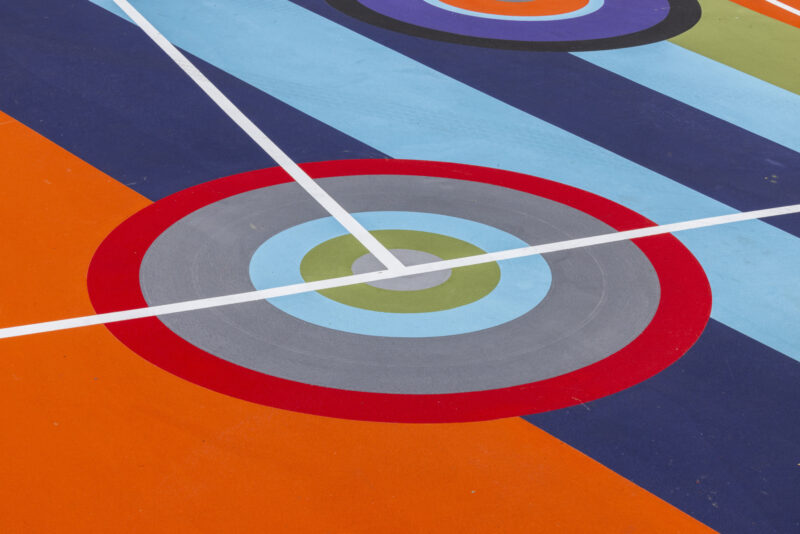
Geometry of Play serves as more than just a colorful backdrop for a match; it is a conceptual integration of history, geography, and social movement. Inspired by the visual logic of ancient game boards, the mural features a complex layering of interlocking circles, grids, and pathways.
The color palette is a deliberate homage to the ROYGBIV spectrum. Beyond its aesthetic appeal, the rainbow motif serves as a poignant symbol of inclusion and unity, designed to shift and evolve in the viewer’s eye as players move across the surface. The installation marks a milestone for the city: these are Pittsburgh’s first artist-designed pickleball courts, setting a new precedent for how urban infrastructure can be leveraged to foster community engagement through the lens of contemporary art.
The Chronology of a Civic Transformation
The journey to Geometry of Play is rooted in the broader development of Arts Landing, a project commissioned by the Pittsburgh Cultural Trust to breathe new life into the city’s urban landscape.
- Conceptualization (2025): As Field Operations began drafting the master plan for Arts Landing, the Pittsburgh Cultural Trust sought artists capable of bridging the gap between high-concept public art and high-utility community spaces. Sharmistha Ray, known for her interdisciplinary practice and ability to scale abstract concepts to urban environments, was tapped for the project.
- Design Development (Early 2026): Ray drew inspiration from the Indian game Pachisi—a precursor to the Western game Parcheesi—to develop the court’s underlying geometry. The design process focused on ensuring that the vibrant colors and geometric complexity would not impede the technical requirements of competitive pickleball.
- The Unveiling (June 16, 2026): The courts were officially opened to the public, accompanied by community events that demonstrated the dual-purpose nature of the space.
- Ongoing Residency (2026–2027): As one of eight inaugural commissions at Arts Landing, the work will remain on public display for at least one year, allowing the wear and tear of daily play to contribute to the "life" of the artwork.
Supporting Data: An Interdisciplinary Practice
Sharmistha Ray’s career has been defined by a restless exploration of identity, belonging, and cultural synthesis. Born in Kolkata and raised in the cosmopolitan environment of Kuwait before migrating to the United States, Ray’s visual language is heavily influenced by the intersections of South Asian heritage and Western geometric abstraction.
Her body of work demonstrates a remarkable versatility:
- Large-Scale Installations: Her 2025 installation at New York’s Grand Central Terminal demonstrated her ability to command high-traffic, historic environments.
- Aviation and Public Transit: Her commission for the new terminal at Pittsburgh International Airport underscores her commitment to making art accessible to the transient public.
- Technological Integration: Ray has increasingly incorporated animation and sound into her work, notably collaborating with Grammy-winning musician Arooj Aftab to create immersive, multi-sensory experiences.
The Geometry of Play project is the latest iteration of this interdisciplinary approach, proving that Ray’s work is not confined to the sterile walls of a gallery, but is instead designed to withstand the physical pressures of an active, public environment.
Official Responses and Curatorial Vision
The Pittsburgh Cultural Trust has lauded Geometry of Play as a flagship example of its mission to foster "artistic democracy." By embedding art into the very fabric of the city’s recreational facilities, the Trust aims to make high-level contemporary art a daily encounter rather than a destination-based chore.
"The goal of Arts Landing was to create a space that feels both intimate and expansive," noted a representative from the Cultural Trust. "Sharmistha Ray’s work captures the spirit of the district—a place where the history of global games meets the future of American urbanism."
For Ray, the response has been overwhelmingly positive. The artist has frequently emphasized that the work is "incomplete" without the presence of the players. "The artwork is activated by the movement of bodies," Ray stated during the project’s development phase. "It is a performance piece that lasts as long as the game continues."
Implications for Public Art and Urban Design
The success of Geometry of Play signals a significant shift in urban planning. Traditionally, municipal recreation departments and arts commissions have operated in siloes, with sports facilities often relegated to strictly functional, aesthetic-neutral designs.
1. The Democratization of Art
By placing art on the ground—literally under the feet of the public—the barrier to entry is dismantled. One does not need to understand art history or visit a museum to participate in the experience; one only needs to play. This "passive engagement" model is increasingly viewed as the gold standard for modern urban centers.
2. Longevity and "Wabi-Sabi"
Unlike a mural on a wall, which is protected from touch, a court-based mural is meant to be scuffed, worn, and weathered. There is a "wabi-sabi" quality to Geometry of Play—a beauty in the imperfection that will accumulate over time. As the paint fades in the high-traffic zones and the lines are obscured by the tread of athletic shoes, the artwork will essentially record the history of every match played, making the community the co-authors of the piece.
3. Economic and Social Revitalization
The $31 million investment into Arts Landing is not merely an aesthetic upgrade; it is an economic strategy. By turning a standard park into a destination, the city encourages foot traffic, increases the dwell time of visitors in the Cultural District, and boosts the visibility of local businesses. The inclusion of other artists—such as Vanessa German, Thaddeus Mosley, and Shikeith—creates a "curated neighborhood" effect that distinguishes Pittsburgh’s downtown from other major metropolitan areas.
Conclusion: A Living Legacy
As of the summer of 2026, Arts Landing stands as a testament to the power of creative collaboration. For the residents of Pittsburgh, Geometry of Play offers a unique opportunity to engage with high-concept art while enjoying one of the fastest-growing sports in the nation.
The installation serves as a reminder that public art need not be static to be significant. By inviting the community to walk, run, and play upon the canvas, Sharmistha Ray has elevated the act of recreation to an act of creation. As players gather daily from 7 a.m. to 10 p.m., they are not just playing pickleball; they are participating in a vibrant, living, and ever-changing installation that reflects the diverse, colorful, and energetic spirit of the city itself.
Arts Landing is located in the heart of the Pittsburgh Cultural District. The space is free and open to the public daily. Visitors are encouraged to bring their own paddles and balls to experience the installation firsthand.