The Nostalgia Playbook: Why Experiential Marketers are Looking Backward to Move Forward in a Digital-First Era

Main Facts: The Resurgence of Retro in a Hyper-Digital World
In an era dominated by hyper-personalized algorithms, artificial intelligence, and relentless digital notifications, modern consumers are experiencing an unprecedented level of screen fatigue. Amid this digital saturation, experiential marketing has emerged as a vital channel for brands seeking to establish authentic human connections. Surprisingly, the cutting edge of this physical marketing revolution is not looking to the future, but rather deep into the past.
According to industry data, nostalgia-driven experiential activations are delivering some of the highest engagement metrics, brand recall scores, and social media amplification rates in the industry. By evoking the promise of "a simpler time," brands are successfully bypassing traditional consumer skepticism. This strategic retreat from digital complexity toward historical romanticism is not a temporary fad; rather, it has become a foundational pillar of modern brand activation.
Experiential agencies, such as the Chicago-based shop Turnkey, are demonstrating that nostalgia is a highly effective tool for driving measurable business outcomes. From recreating long-retired 1980s fast-food playgrounds to reviving the classic mid-century American road trip, brands are discovering that the past is an incredibly fertile ground for future growth.
Chronology: The Evolution of Nostalgia in Modern Marketing
To understand the current dominance of retro-experiential activations, it is necessary to trace how brands have utilized the past over the last two decades.
[Early 2010s: Visual & Packaging Nostalgia]
       │
       ▼ (Example: "Share a Coke" campaign / Retro logos)
[Late 2010s: The Pop-Up Boom & Pop-Culture Tie-ins]
       │
       ▼ (Example: Stranger Things-themed retail / Retro arcades)
[Mid-2020s: Immersive, Tactile World-Building]
         (Example: Turnkey’s McDonaldland / Verizon's SXSW 1994 Soccer Bedroom)
Phase 1: Visual and Packaging Nostalgia (Early 2010s)
Initially, nostalgia marketing was primarily flat and visual. Brands relied on retro packaging, vintage logo revivals, and old-school television advertisements. A prime example from this era was Coca-Cola’s iconic "Share a Coke" campaign, which, while highly personalized, leveraged the simple, analog joy of recognizing a familiar name on a classic, physical bottle—evoking the communal, low-tech feelings of childhood summers and old advertising jingles.
Phase 2: The Pop-Up Boom and Pop-Culture Tie-ins (Late 2010s)
As experiential marketing matured, brands realized that consumers wanted to step inside their memories. This phase was heavily accelerated by pop-culture phenomena like Netflix’s Stranger Things, which proved that Gen Z and Millennial audiences possessed an insatiable appetite for the aesthetics of the 1980s. Brands began creating temporary pop-up retail environments, vintage arcades, and roller rinks to capture this demographic.
Phase 3: Immersive, Tactile World-Building (Mid-2020s to Present)
Today, nostalgia marketing has evolved into a highly sophisticated, multi-sensory discipline. It is no longer enough to display retro imagery; brands must build fully realized, tactile environments where consumers can touch, taste, smell, and physically interact with the past. Modern activations—such as Turnkey’s 2026 McDonaldland recreation and Verizon’s 1994-themed SXSW showcase—represent the pinnacle of this evolution, blending historical sentimentality with sophisticated modern event technology.
Supporting Data: The Five Pillars of Nostalgic Experiential Marketing
The success of these retro-focused campaigns is grounded in psychological, sociological, and economic factors. Industry analysts have identified five core pillars that explain why nostalgia continues to deliver outstanding experiential results.
1. Cross-Generational Appeal and "Vicarious Nostalgia"
One of the most powerful aspects of nostalgia-based marketing is its broad demographic reach. A well-executed historical activation appeals equally to older generations who lived through the era and younger consumers who did not.
┌─────────────────────────────────────────────────────────────────────────┐
│                           Vicarious Nostalgia                           │
├────────────────────────────────────────────────────────┬────────────────┤
│ Gen X / Boomers (Direct Experience)                    │ Gen Z / Gen A  │
│ • Seek comfort, validation, and memory recall.         │ • Seek identity│
│ • Value historical accuracy and authentic details.     │   and "vibes." │
└────────────────────────────────────────────────────────┴────────────────┘
For younger demographics, researchers use the term vicarious nostalgia to describe a yearning for an era they never personally witnessed. Gen Z and Generation Alpha are less concerned with historical exactitude and more focused on the aesthetic and cultural "vibes." This allows brands to lean into romanticized, stylized interpretations of the past.
- Case Study: McDonaldland by Turnkey
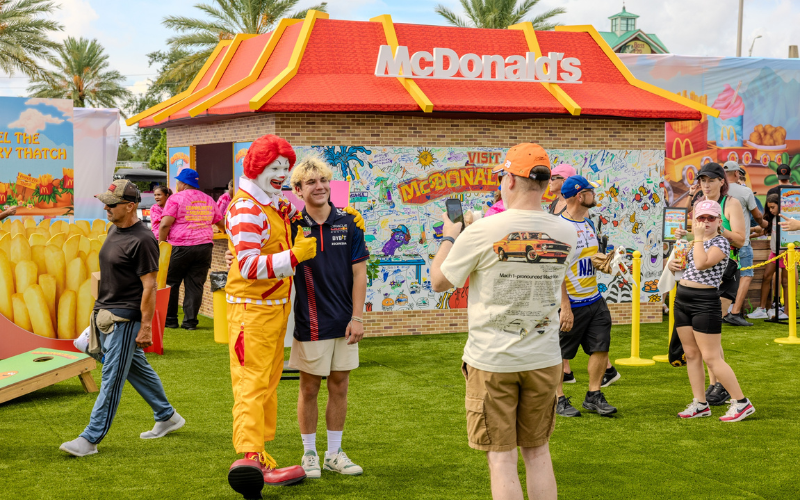
When McDonald’s sought to distribute samples of its new Mt. McDonaldland milkshake, they partnered with experiential agency Turnkey to recreate the whimsical "McDonaldland" universe of the 1980s and ’90s. The activation featured a 15-foot Mt. McDonaldland slide, Birdie’s treehouse, a Hamburger patch, and live appearances by retro costumed characters like the Hamburglar and Ronald McDonald. While parents smiled at memories of their own childhoods, children enthusiastically engaged with the colorful environment, sometimes playfully mistaking the purple mascot Grimace for Barney the dinosaur. The activation successfully bridged the generational gap, creating a shared family experience.
2. Emotional Resonance and Psychological Safety
Nostalgia acts as a psychological buffer during times of socio-economic volatility. In a world characterized by geopolitical shifts, economic uncertainty, and the rapid rise of artificial intelligence, the past represents a safe, predictable, and comforting sanctuary.
Psychological studies indicate that nostalgia counteracts feelings of loneliness, anxiety, and alienation. When an experiential activation successfully triggers these warm, familiar feelings, consumers subconsciously transfer those positive emotions—such as safety, stability, and trust—directly onto the host brand.
3. Tactile and Multi-Sensory Engagement
In a digital economy where assets are stored in the cloud, physical touch has become a luxury. Experiential marketers leverage this by introducing tangible, analog elements that engage all five senses.
- The Analog Revival: The massive resurgence of physical Polaroid cameras among teenagers and the booming vinyl record market are clear indicators of this trend. Consumers crave objects they can physically hold.
- Physical Anchors: On-site activations that feature physical interactions—such as sliding down a giant replica slide, sitting in a vintage race car like the Marmon Wasp (the historic first winner of the Indianapolis 500), or shaking hands with a legendary sports icon—create deep cognitive impressions that digital advertisements simply cannot replicate.
4. Location-Based and Community-Driven Benefits
Many of the physical locations chosen for experiential activations carry inherent nostalgic weight, such as historic sports stadiums, retro theaters, or long-standing music festival grounds. Marketers can tap into these pre-existing emotional geographies to amplify their message.
-
Case Study: MINI Takes the States
To foster brand loyalty, MINI utilizes Turnkey to help manage its bi-annual owner road trip, "MINI Takes the States." This massive loyalty program recreates the classic American road trip, guiding thousands of MINI owners along scenic, historic highways and through small-town main streets.In a deliberate nod to the community hubs of the mid-20th century, the route bypasses modern, sterile highway drive-thrus in favor of vintage, 1960s-style drive-in locations. This gives participants a physical space and time to gather, converse, and celebrate their shared passion, transforming a corporate brand activation into a deeply personal community pilgrimage.
5. Social Media Amplification and Shareability
While nostalgia activations are grounded in the physical past, they are highly optimized for the digital present. The highly visual, tactile, and quirky nature of retro design makes it ideal for organic social media distribution.
┌─────────────────────────────────────────────────────────────────────────┐
│                  Anatomy of a Shareable Nostalgia Asset                 │
├─────────────────────────────────────────────────────────────────────────┤
│ [Vintage Aesthetic] ──> Curated color palettes, neon, and warm tones    │
│ [Tactile Props]     ──> Corded phones, tube TVs, retro furniture        │
│ [High Contrast]     ──> Distinctly different from modern digital life   │
│                                                                         │
│ Result: High-volume, organic user-generated content (TikTok/Instagram)  │
└─────────────────────────────────────────────────────────────────────────┘-
Case Study: Verizon at SXSW
To promote its documentary Soccer Meets America, Verizon constructed a highly detailed activation at the SXSW festival. Designed to resemble a mid-1990s teenage soccer fan’s bedroom, the installation transported visitors back to 1994—the landmark year the United States first hosted the FIFA World Cup.The bedroom was meticulously styled with a corded telephone, a plush beanbag chair, a low-definition tube television set, and vintage soccer posters. The activation served as an irresistible photo opportunity. Gen Xers and Millennials shared photos of the nostalgic setup with their networks, showcasing the enduring appeal of the sport.
Official Responses and Expert Perspectives
Industry leaders and marketing scholars agree that the success of nostalgia in experiential marketing lies in its ability to build deep consumer trust.
In a recent industry panel on experiential trends, strategists at Turnkey highlighted the operational philosophy behind these campaigns:
"In a highly competitive marketplace, consumers do not just buy products; they buy how a brand makes them feel. Recreating historical environments like McDonaldland or organizing classic American road trips isn’t just about retro aesthetics. It is about constructing high-touch, low-stress environments where consumers can let their guard down and form genuine, lasting relationships with a brand."
Furthermore, consumer psychologists point to empirical studies showing that nostalgia directly influences consumer behavior. According to research published in the Journal of Consumer Research, feelings of nostalgia weaken a consumer’s desire to hold onto their money, rendering them more willing to spend on products, services, and charitable causes associated with the experience. This psychological shift provides a clear economic justification for brands to invest in highly immersive, retro-themed experiential designs.
Implications: Balancing the Past with the Future
As brands continue to invest in nostalgia-based experiential marketing, several key strategic implications emerge for the future of the industry:
- Vibes Over Validity: For younger demographics, strict historical accuracy is secondary to emotional resonance. Marketers should focus on capturing the general "feeling" and aesthetic of an era rather than getting bogged down in minute historical details.
- The Hybrid "Phygital" Model: The most successful activations use analog environments to capture attention, but integrate modern, friction-free digital backends (such as QR-code scanning, RFID wristbands, or augmented reality filters) to gather valuable consumer data and track return on investment (ROI).
- Preventing "Nostalgia Fatigue": As more brands turn to retro themes, there is a risk of market saturation. To stand out, agencies must dig deeper than generic retro tropes, identifying highly specific, niche cultural touchstones that resonate deeply with their target audiences.
- Ethical and Inclusive Nostalgia: Marketers must recognize that the "good old days" were not experienced equally by everyone. Modern nostalgia activations must be culturally sensitive, inclusive, and welcoming to diverse audiences, ensuring that the romanticized past is an inviting space for all participants.
Ultimately, the enduring power of nostalgia in experiential marketing proves that no matter how advanced our digital tools become, the human desire for tactile comfort, community, and simple, analog joy remains unchanged. By looking backward, forward-thinking brands are discovering the most effective path to building long-term consumer loyalty and trust.