The Architecture of Light: How Jordan Soderberg Mills Transformed a 15th-Century Brussels Chapel into a Living Lens

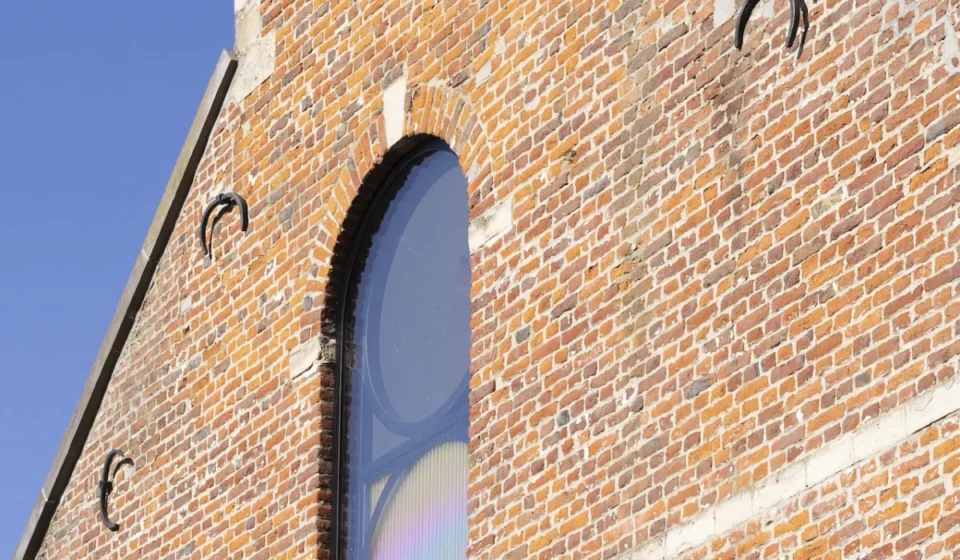
In the quiet, historic district of Boondael in Brussels, a 15th-century chapel has undergone a radical, luminous transformation. No longer merely a relic of stone and mortar, the Boondael Chapel—now a repurposed arts venue—has become a site-specific installation that challenges the boundaries between architecture, physics, and spiritual experience. At the center of this metamorphosis is Canadian artist Jordan Soderberg Mills, whose work consistently treats light not as a byproduct of space, but as the primary building material.
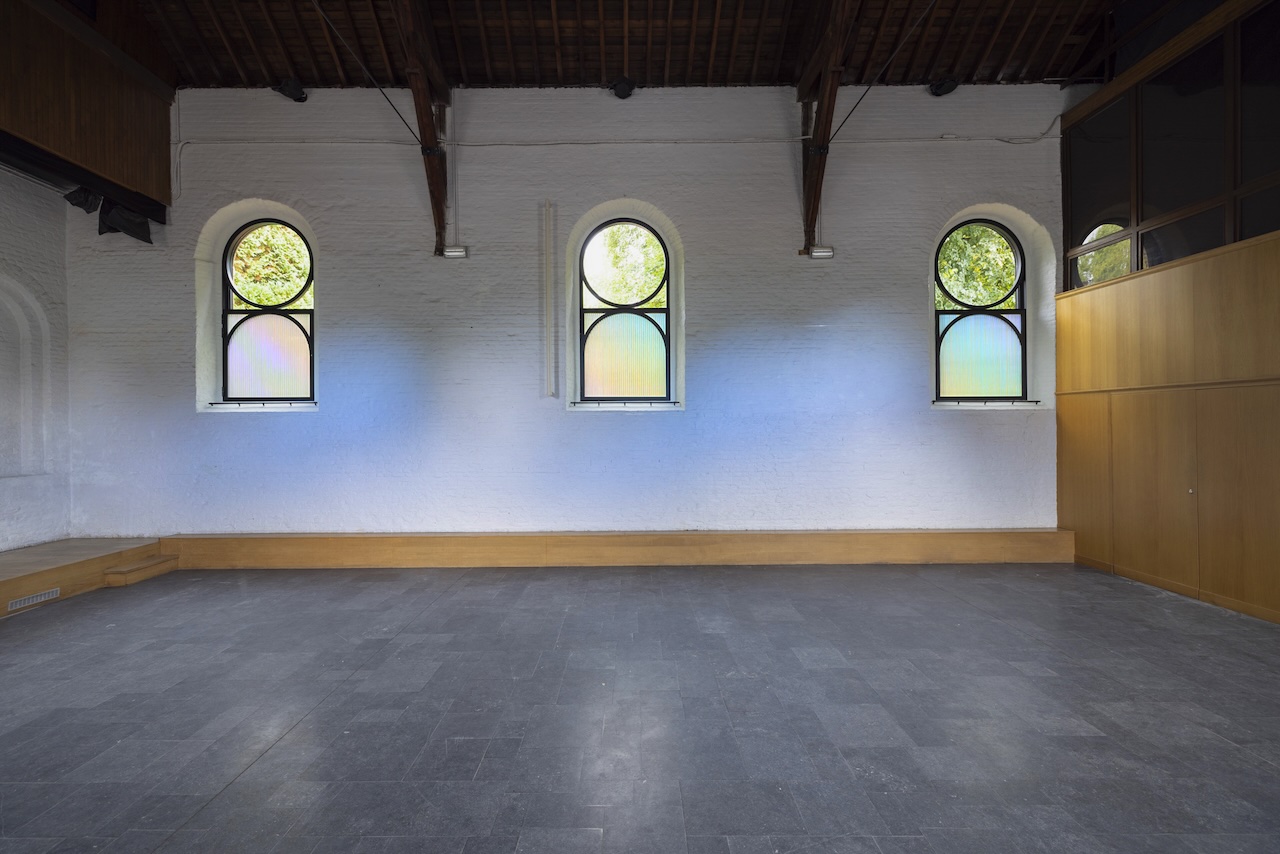
Through the installation of fourteen black-iron-framed windows, Soderberg Mills has invited the cosmos into the sanctuary. By utilizing advanced optical engineering, these windows do not merely admit daylight; they curate it, refracting the sun’s rays into shifting prismatic spectrums that dance across the interior walls, evolving with the time of day and the changing seasons.
The Genesis of an Optical Obsession
The path to the Boondael Chapel project was paved by Soderberg Mills’ long-standing fascination with the history of light in art. Based in Europe, the Canadian artist first garnered significant regional attention during a Design Museum Ghent exhibition dedicated to the legacy of Jan Van Eyck.
Van Eyck, a master of the Northern Renaissance, famously pioneered the use of layered, transparent glazes to achieve a luminous depth that seemed to emanate from within the canvas. This technique, which allowed light to penetrate multiple layers of pigment before reflecting back to the viewer, provided the conceptual blueprint for Soderberg Mills’ artistic evolution.
“There was a very specific altar piece in Ghent,” Soderberg Mills recalls, “with an inscription stating that the Virgin Mary is the reflection of eternal light. I began to ask myself: How can I represent eternal light? How can I create something that uses this idea of multiple layers and glazes that the Renaissance painter used?”
This inquiry culminated in his work Eternal Light + a Spotless Mirror (2020). While the piece solidified his reputation in the Belgian art scene, the project’s debut was hampered by the restrictive atmosphere of the COVID-19 lockdowns. This period of isolation fostered a deep desire within the artist to create works that were not only visually arresting but physically immersive—art that could be "felt" in the space it occupied.
A Challenge of Transparency: The Design Constraints
When the call went out for proposals to revitalize the Boondael Chapel, the requirements were stringent. The venue, which serves as a secular arts space, mandated that any modifications to the windows must remain colorless and completely transparent. For an artist whose entire practice is predicated on the manipulation of color and perception, this presented a deliberate, almost "cheeky" paradox.
“My practice is an exploration of color and light,” Soderberg Mills notes. “The challenge became: how can I cheat the system? How can I be a little bit subversive to produce glass that is ostensibly colorless but fundamentally transmits a full spectrum of color?”
To solve this, he turned toward the history of Belgian architecture. His research led him to the chapels lining the North Sea coast, where the architecture of the divine often intersected with the practical utility of the maritime. In these coastal structures, bell towers frequently doubled as lighthouses. This synthesis of the "mystical" and the "functional" inspired Soderberg Mills to create an installation that was both magical-realist and grounded in the secular reality of the building’s current use.
The Engineering of the Ethereal: Materials and Collaboration
The execution of the Boondael Chapel project required a multidisciplinary approach, necessitating collaborations with Belgian industrial fabricators. The final design relies on a marriage of high-end laboratory technology and traditional ironwork.
The Role of Borosilicate Canes
The primary component of the installation is a series of long borosilicate glass tubes—commonly used in laboratory settings for beakers and test tubes. These canes are extruded with a star-shaped cross-section, creating a ribbed surface that serves as the foundation for light manipulation.
Microscopic Apertures and Spectral Scattering
The secret to the windows’ prismatic effect lies in the etching process. Each glass cane is internally etched with billions of microscopic apertures. These apertures act as diffraction gratings, scattering incoming daylight into its constituent spectral bands. This is where physics meets the ethereal: the glass remains transparent to the eye, yet it effectively "unpacks" white light into the full rainbow.
The Spectrographic Film
Adding another layer of complexity, Soderberg Mills incorporated a specialized film produced by a laboratory in California. This film is typically used in the field of spectrography—the science of analyzing the chemical composition of stars by studying their light signatures. By embedding this film within the glass extrusions, the artist has essentially created a "star-mapping" device for the chapel.
“Anything that reflects light will have a chromatic signature,” Soderberg Mills explains. “The composition of the rainbow will tell you what a star is made of. We are using that same principle to turn the chapel into both a sanctuary and a living lens.”
Implications: A Cosmological Dance
The final effect of the installation is one of perpetual motion. Because the light is curved and refracted through the star-shaped geometry of the borosilicate canes, the interior of the chapel experiences a rhythmic shifting of color.
Soderberg Mills likens the experience to a high-precision sundial. Just as a sundial marks the passage of time through the shadow it casts, the Boondael Chapel marks the passage of the earth through the solar system.

“It’s about creating something that is fixed that also gives this sense of motion,” he says. “It is really the motion of the planet through space—a cosmological dance.”
The Shift from Sacred to Secular
The project serves as a profound meditation on the "adaptive reuse" of religious architecture. In the Gothic era, light was the primary theological tool, meant to represent the presence of the divine. By stripping the windows of traditional iconography and replacing them with purely optical, prismatic phenomena, Soderberg Mills has successfully navigated the transition from religious sanctuary to secular arts space. He has preserved the "mystical" quality of the architecture while updating its narrative for a modern, scientific age.
Future Outlook
The Boondael Chapel installation stands as a testament to the potential of art-science collaborations. By pushing the limits of glass fabrication and spectrographic film, Soderberg Mills has demonstrated that "colorless" materials can be the most vibrant tools in an artist’s kit.
For the visitors of the Boondael Chapel, the experience is never the same twice. A cloudy Tuesday in November will yield a different chromatic atmosphere than a clear, mid-summer afternoon in June. This unpredictability is intentional, forcing the viewer to engage with the environment in real-time.
As cities across the globe continue to grapple with the fate of decommissioned religious structures, the work of Jordan Soderberg Mills offers a compelling model for how to honor the past while embracing the complexities of the future. The chapel, once a place for the contemplation of the afterlife, has been repurposed into a space for the contemplation of the universe itself—a living, breathing, and ever-changing monument to the light that surrounds us all.
Whether one views the installation through the lens of a physics student analyzing diffraction or a local resident simply looking for a moment of quiet reflection, the Boondael Chapel provides a rare opportunity to witness the invisible forces that govern our physical world, rendered in brilliant, ephemeral color.