The IMAX Divide: Why Christopher Nolan’s ‘The Odyssey’ Has Sparked a Global Debate on Cinematic Equity

In the landscape of modern cinema, few filmmakers command the same level of reverence—or controversy—as Christopher Nolan. With the release of his latest epic, The Odyssey, a sprawling adaptation of Homer’s ancient text, Nolan has once again pushed the technical boundaries of the medium. By shooting the entire feature on IMAX 70mm film cameras, Nolan has achieved a level of visual fidelity that is, by all technical accounts, unprecedented in Hollywood history.
However, this pursuit of technical perfection has collided head-first with the realities of modern movie distribution. As The Odyssey dominates the cultural conversation, a burgeoning movement of cinemagoers, led largely by Gen Z critics on social media, has begun to question the ethics of a viewing experience that feels increasingly like a luxury commodity. The central argument? That by prioritizing an ultra-niche format available to only a fraction of the global population, Nolan has effectively created a “two-tier” cinematic experience, where the “haves” enjoy a sprawling, immersive masterpiece, and the “have-nots” are left watching a cropped, truncated version of the film.
The Technical Genesis: A Vision Uncompromised
To understand the frustration, one must first understand the ambition. The Odyssey is the first major motion picture to be filmed entirely using IMAX 70mm cameras. Unlike standard digital cinema, which typically utilizes a 2.39:1 aspect ratio, IMAX 70mm film provides a massive 1.43:1 aspect ratio, capturing significantly more visual information at the top and bottom of the frame.
For months, the film’s stars—including Matt Damon and Anne Hathaway—alongside Nolan himself, have engaged in a relentless promotional campaign urging audiences to seek out the “true” version of the film. They argue that to watch The Odyssey on anything less than a 70mm IMAX screen is to witness a diminished product.
This marketing strategy, while artistically sound, has inadvertently highlighted a staggering logistical bottleneck. Currently, there are only 41 theaters worldwide capable of projecting the film in its native 15-perforation, 70mm format. This scarcity has turned these screenings into digital-age relics, with tickets for prime seats fetching as much as $1,500 on secondary markets like eBay, effectively pricing out the average consumer.
A Chronology of the Controversy
The backlash began in early July 2026, shortly after the film’s global premiere. While initial reviews were glowing regarding the film’s scale, the tone shifted when users on X (formerly Twitter) began posting side-by-side comparisons of scenes as they appeared in IMAX versus standard theaters.
- July 14, 2026: The account @TheCineprism sparked a viral firestorm by pointing out that only 40 cinemas on Earth could display what Nolan actually filmed. The post served as a catalyst, shifting the conversation from a critique of the film’s content to a critique of its accessibility.
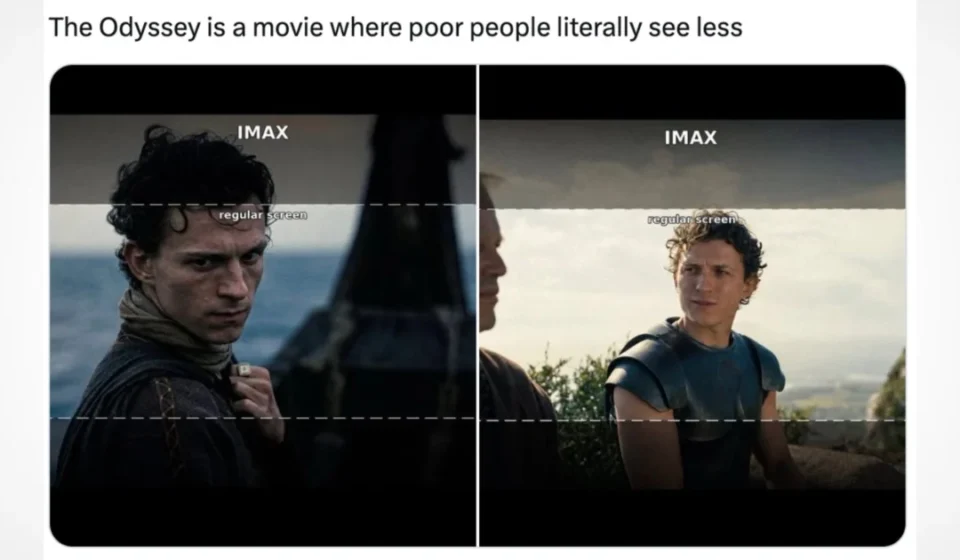
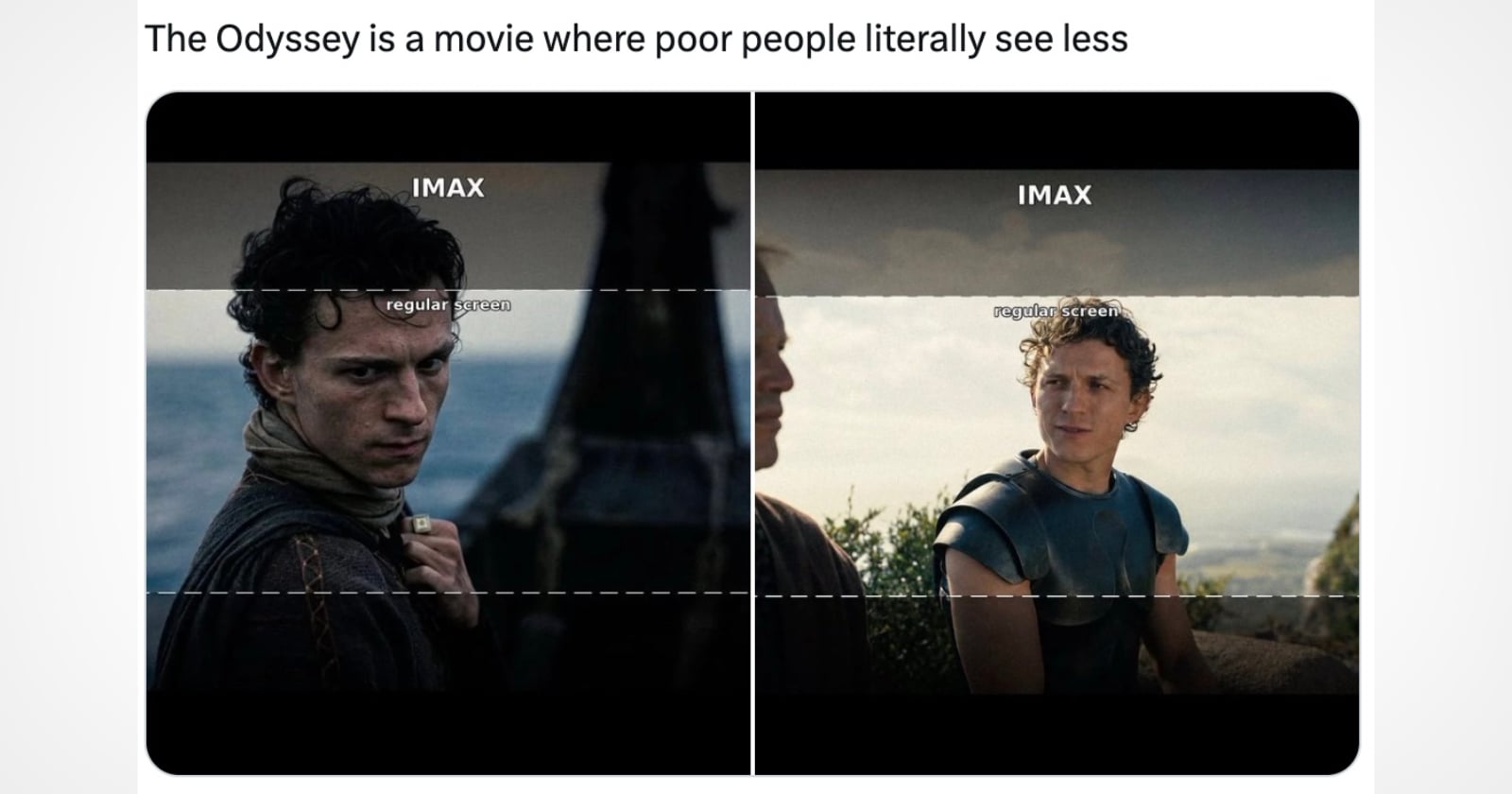
- July 15, 2026: User @arkavx posted the now-infamous meme comparing the two formats with the caption, “The Odyssey is a movie where poor people literally see less.” The post garnered over 26 million views, crystallizing the sentiment that the format was inherently elitist.
- July 16-17, 2026: The discourse reached a fever pitch. Social media users began labeling the strategy as “anti-art,” arguing that filmmakers should be responsible for ensuring their work is equally accessible to all audiences, regardless of their geographic location or socio-economic status.
- July 18, 2026: Industry analysts and trade publications began weighing in, highlighting the geographical disparities. For instance, the IMAX Melbourne theater in Australia became a focal point of the debate, as it serves as the only 70mm projection site for the entire Southern Hemisphere, forcing fans in the region to consider cross-country travel just to see the film as intended.
The Anatomy of the “Visual Gap”
The core of the frustration lies in the crop factor. Because standard theater projectors and home televisions cannot handle the 1.43:1 aspect ratio, the image is physically cut. In many scenes, this means the top and bottom of the frame—often containing crucial environmental details or dramatic vertical staging—are simply removed.
For the average viewer, this creates a sense of “missing out.” If a film is framed for a specific visual scope, cropping it does not merely change the size of the image; it alters the cinematography itself. When critics argue that “poor people see less,” they are speaking to the literal loss of pixels and composition that occurs when the film is downscaled for wider, non-IMAX distribution.
The Industrial Reality: Why Not More Screens?
The demand for these screenings is undeniable, yet the industry remains at a standstill. The issue is not a lack of desire, but a lack of hardware. IMAX 70mm projectors are mechanical marvels that have not been manufactured in over 50 years.
Richard Gelfond, the CEO of IMAX, addressed the frustration in a recent interview with Variety. “There’s certainly more demand,” Gelfond acknowledged. “The problem is they haven’t made new IMAX film projectors in about 50 years. We retrofit them, we rebuild them, and part of our strategy is to see how far we can take it. But certainly, demand-driven, I’d like to see more.”
For the average moviegoer, this explanation offers little comfort. The logistical hurdle of maintaining a 50-year-old projector requires specialized technicians and massive, heavy film reels that are a nightmare to transport and store. Consequently, the “IMAX 70mm experience” is reserved for a handful of prestigious, legacy theaters in major metropolitan hubs, leaving rural and suburban populations entirely excluded.
Implications: The Future of “Prestige” Cinema
The Odyssey controversy is not just about a movie; it is a microcosm of a broader tension in the entertainment industry. As cinema attempts to lure audiences away from the convenience of home streaming, directors are turning to “event cinema”—films that promise an experience impossible to replicate on a couch.
However, this strategy creates a dangerous precedent. If “event cinema” becomes synonymous with “exclusive cinema,” it risks alienating the very audience it relies on for box-office success. The democratization of film, a hallmark of the 20th century, is currently being challenged by a return to high-cost, high-barrier-to-entry experiences.
Furthermore, the “class dimension” of this debate cannot be ignored. When access to the “true” version of a piece of art is gated by thousands of dollars in travel or ticket costs, the cultural conversation itself becomes stratified. Those who can afford the IMAX 70mm experience participate in a different discourse than those who watch the cropped, standard version.
Conclusion: A Turning Point for Filmmakers?
Christopher Nolan is a champion of the theatrical experience, and his dedication to celluloid film is arguably what has kept the medium alive for a new generation. Yet, the viral outcry surrounding The Odyssey suggests that his audience expects a level of accessibility that matches his ambition.
The debate serves as a warning to major studios and auteur directors: while technical innovation is the lifeblood of cinema, it must be balanced with the social reality of the audience. As The Odyssey continues its run, it will be remembered not only for its Homeric scale but for the fiery, necessary debate it ignited about what it means to truly “see” a film in the 21st century.
Whether this leads to a resurgence in interest for analog film preservation or a move toward more equitable distribution remains to be seen. What is clear, however, is that the era of passive consumption is over; audiences today are hyper-aware of what they are—and are not—seeing, and they are no longer content to accept a truncated vision without a fight.