Data Security for Creators: Why the New ‘Stow’ App is Changing the Offload Workflow

In the high-stakes world of professional video production, the most terrifying moment of a shoot day is not a technical malfunction on set, but the agonizing uncertainty that follows it: Are my files actually safe?
As memory cards—CFexpress, SD, and CFAST—continue to command premium prices, videographers and photographers are often forced to operate with minimal inventories. This requires a rapid, high-pressure turnaround where cards must be cleared and reused on the same day. However, the standard operating procedure for moving data—the simple "drag and drop" method—is fraught with hidden dangers.
A new, free software utility called Stow has emerged to solve this critical industry pain point, offering a robust, verified offloading solution that prioritizes data integrity over convenience. Developed by the UK-based production studio lümira, Stow aims to eliminate the anxiety of "the wipe" by ensuring every byte is accounted for before a card is ever reformatted.
The Technical Problem: The "Drag-and-Drop" Fallacy
To understand why Stow is necessary, one must first understand the limitations of modern operating systems. When a user copies files from a camera card to a computer or an external hard drive using the native Windows Explorer or macOS Finder, the operating system executes a basic file transfer protocol. Crucially, this protocol does not perform a "checksum" or a bit-by-bit verification.
The computer essentially "hopes" the data arrived intact. While file corruption during transfer is relatively rare, it is statistically inevitable over a long enough timeline. When a file is corrupted during a standard copy, the OS rarely reports an error; the file simply sits on your drive, broken, while you proceed to wipe your only source of truth: the memory card.
For a production crew, this realization often comes weeks later during the edit, when a file fails to import or shows artifacts. By then, the original footage is long gone, overwritten by the next shoot. This "silent corruption" is the primary target of Stow’s architecture.
Chronology of Development: From Studio Necessity to Public Utility
The genesis of Stow lies in the pragmatic needs of lümira, a professional video production studio based in the UK. Luke Lv, the founder of lümira, found himself increasingly frustrated by the current market landscape for data management software.
"I run a video production studio in the UK, and like everyone working on a shoot, we know the question that matters most at the end of the day: have the cards been backed up properly, and is it actually safe to wipe them?" Lv explains.
His team reached a breaking point regarding the cost-to-value ratio of existing industry-standard software. Many of the professional tools on the market operate on a per-user subscription model or carry high one-time license fees that can become prohibitive for smaller production houses or independent freelancers.
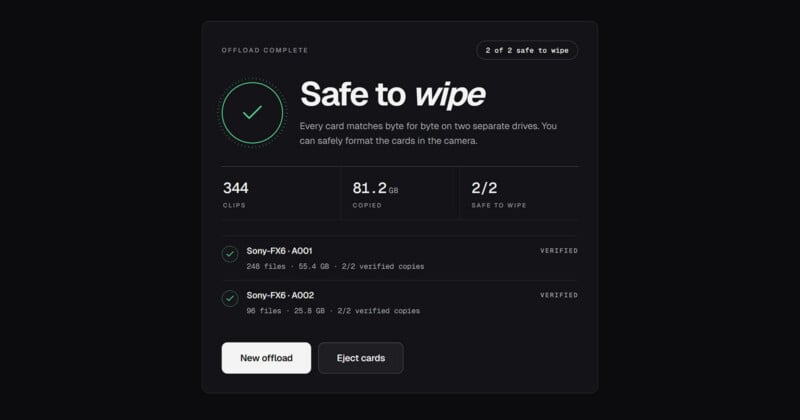
Rather than continuing to pay for features they felt were unnecessarily complex or bundled into expensive tiers, the lümira team decided to pivot. They began development on a proprietary tool that would do exactly what they needed and nothing more: copy to two locations simultaneously, verify the integrity of the data against the source, and provide an unambiguous "Safe to Wipe" indicator. After internal testing proved the workflow saved significant time and mental energy, the team decided to release Stow as a free, public utility.
Core Features and Workflow: How Stow Functions
Stow is designed around the "3-2-1 backup rule," a gold standard in data management that dictates having three copies of your data, on two different types of media, with at least one copy stored off-site.
1. Dual-Destination Offloading
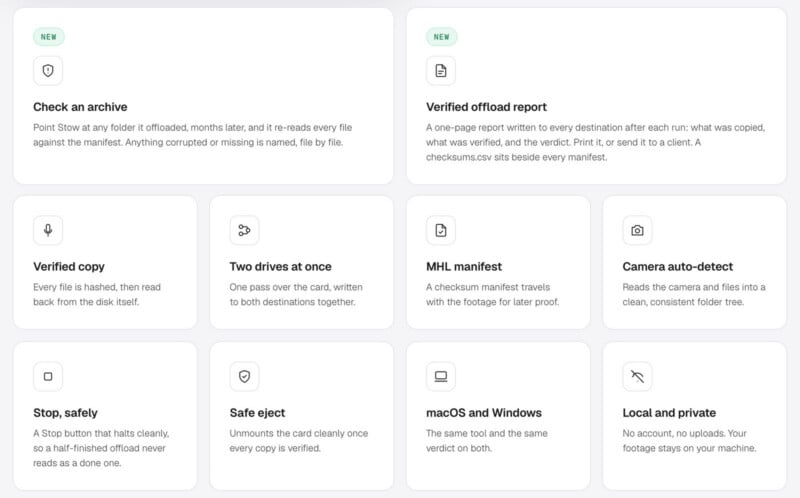
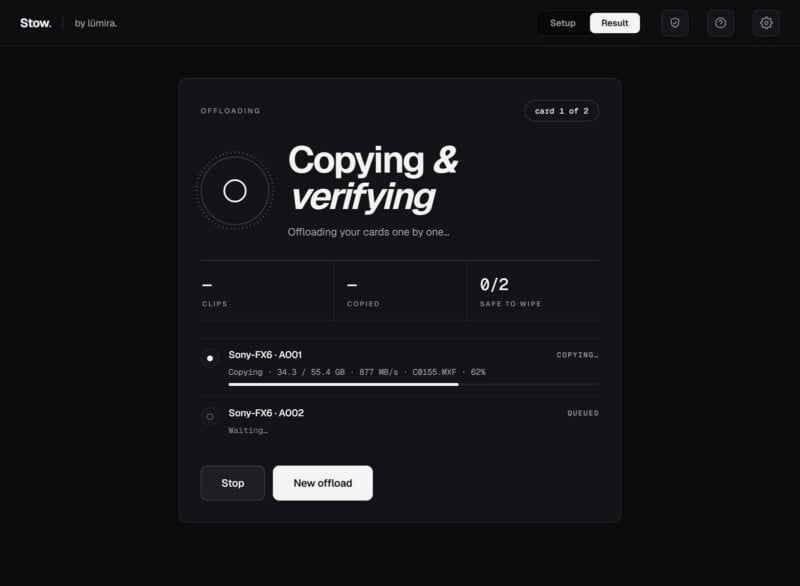
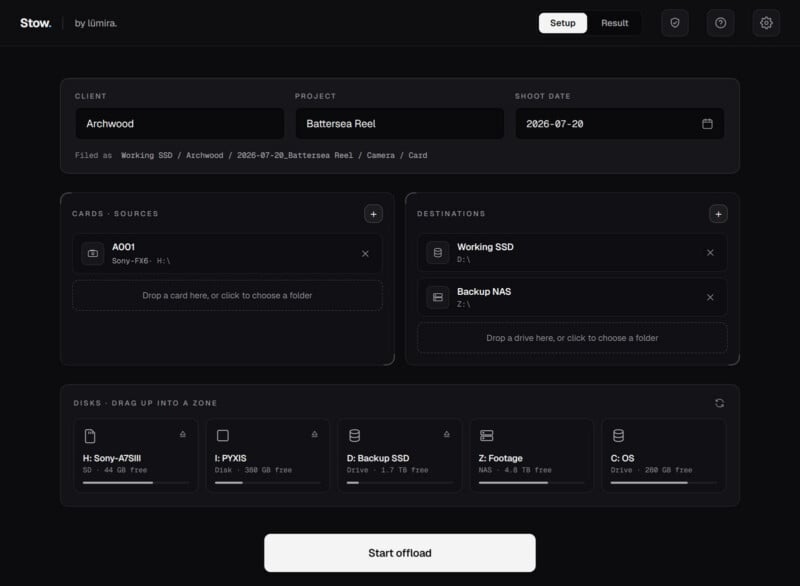
When a user inserts a memory card, Stow prompts the selection of two destination drives—typically a fast working drive and a secondary backup drive. The software initiates the copy process to both simultaneously. By handling both copies at once, it cuts the transfer time in half compared to manual sequential backups.
2. Byte-Level Verification
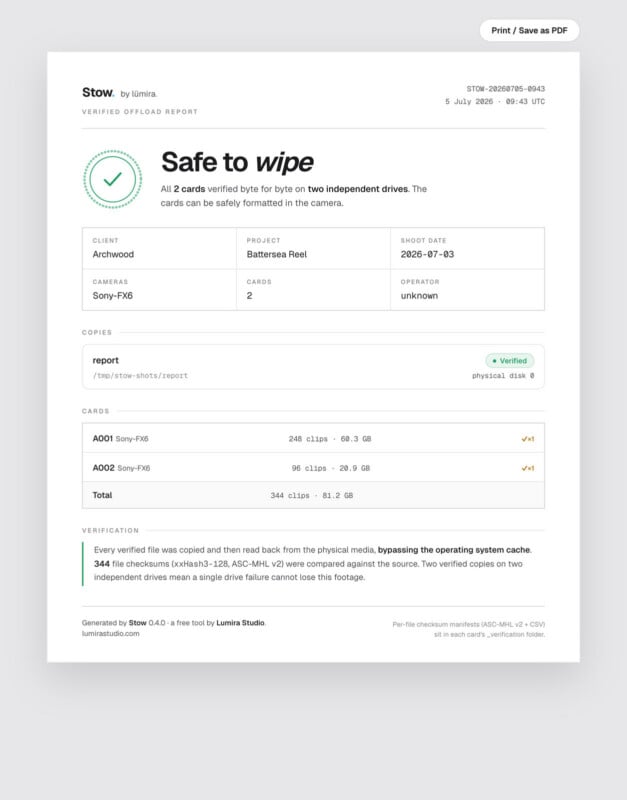
The "secret sauce" of Stow is its verification engine. Once the copy process finishes, the app performs a deep-level checksum analysis. It reads every file from the destination drives and compares them against the source card. It does this without ever writing to the memory card itself, ensuring the integrity of the original media is never compromised.
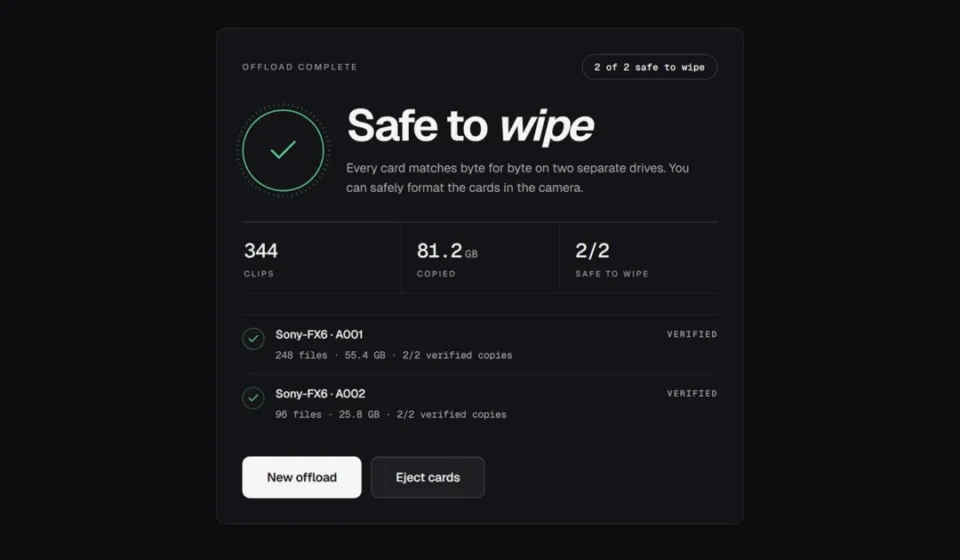
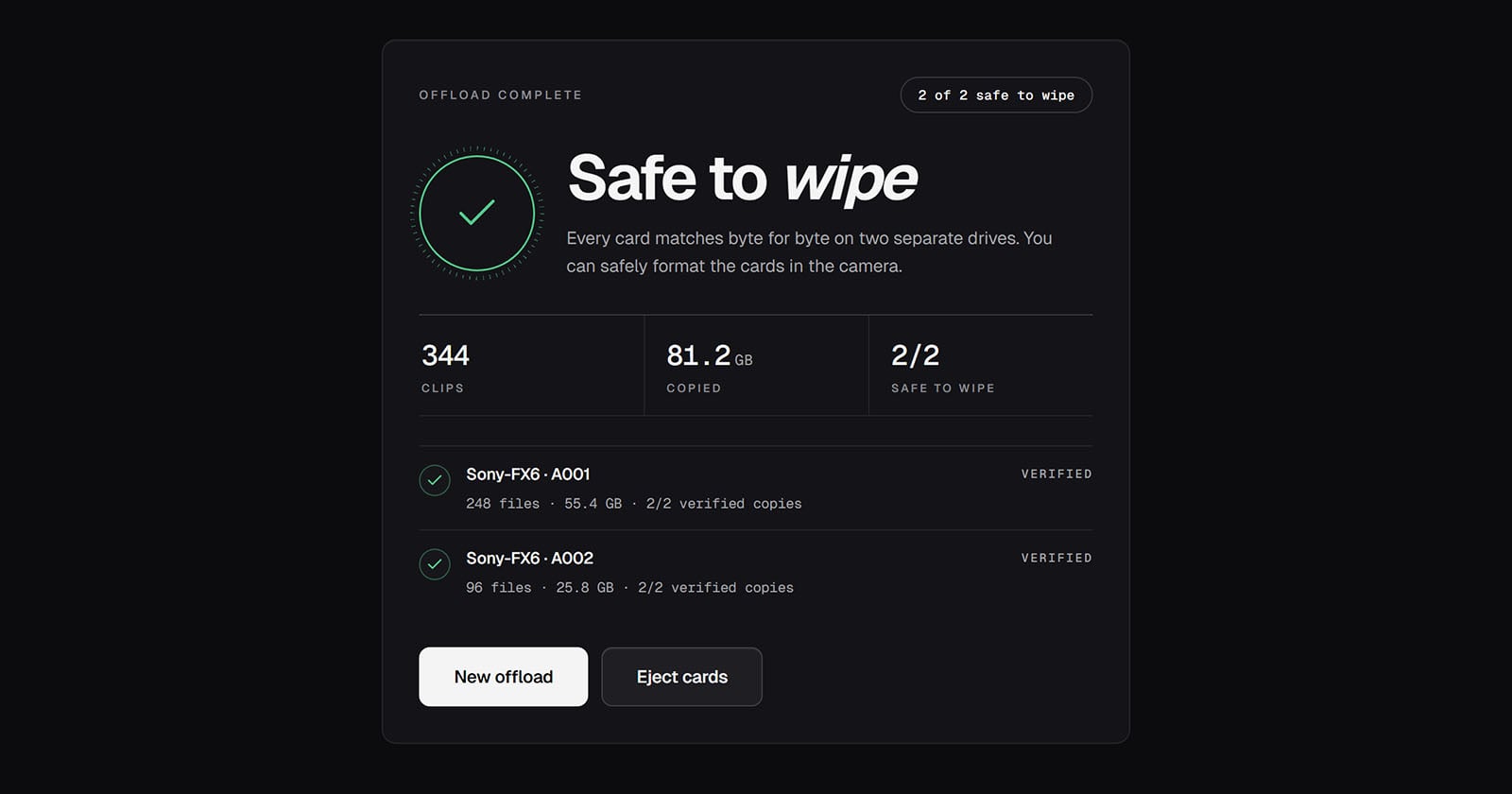
3. The "Safe to Wipe" Verdict
The most user-friendly aspect of the interface is the final output. Instead of forcing the user to interpret logs or checksum hashes, the app presents a clear "Safe to Wipe" green light. This binary feedback loop removes the human element of doubt from the equation, allowing for immediate re-formatting and redeployment of the camera card.
Supporting Data and Market Comparison
When compared against established players like Hedge’s OffShoot, ShotPut Pro, or Pomfort’s Silverstack, Stow occupies a unique niche. While enterprise-level solutions offer features like MHL (Media Hash List) generation, cloud integration, and automated project logging, these features are often overkill for the average creator.
Stow provides the essential "safety net" features—verified copies and MHL manifests—without the complex UI overhead or the subscription cost. In the current market, this is a disruptive move. By providing a professional-grade verification tool for free, lümira is challenging the necessity of paid software for standard daily offloading tasks.
| Feature | Stow | Standard Copy | Pro Software |
|---|---|---|---|
| Verification | Yes (Checksum) | No | Yes |
| Dual Copy | Yes | Manual | Yes |
| Cost | Free | Free | $100–$500+ |
| Ease of Use | High | Low | Medium |
Official Responses and Installation Hurdles
The transition from an internal tool to a public application has come with specific technical challenges. Because Stow is currently in its early public release phase, it has not yet undergone the expensive and rigorous "code signing" verification process with Apple or Microsoft.
This means that when users download the application, their operating system may flag the file as "unidentified" or potentially unsafe. Luke Lv has been transparent about this, noting that getting the app certified is the immediate next step for the development team.
"Getting it certified is our next step," Lv says. "In the meantime, we have put together a simple installation guide for both Mac and Windows to help users navigate the security settings."
The existence of these guides is a testament to the community-driven approach of the project. While it may require a few extra clicks to bypass system security, the trade-off is a high-performance, cost-free tool that provides peace of mind that is otherwise locked behind expensive paywalls.
The Broader Implications for the Industry
The release of Stow highlights a shift in how creative tools are being developed. We are entering an era where "workflow infrastructure"—the software that doesn’t necessarily create the art but makes the art possible—is being democratized.
Impact on Freelancers
For the independent videographer, the barrier to entry for professional data security just dropped to zero. This allows smaller creators to operate with the same level of confidence as large-scale production houses.
Future of Data Management
As cameras continue to push higher resolutions—8K, 12K, and RAW workflows—the amount of data generated per shoot is exploding. The likelihood of a bit-flip or a transfer error increases proportionally with the volume of data. Tools like Stow are not just "nice to have"; they are becoming essential components of the modern digital cinematographer’s kit.
Looking Ahead
The success of Stow will likely depend on the developer’s ability to maintain the software as new OS updates are released. Should lümira continue to support the tool, it has the potential to become the "VLC Media Player" of the offloading world: a ubiquitous, free, and essential piece of software that every creator has installed on their workstation.
Conclusion: A New Standard for Offloading
In an industry where "time is money" and "data is everything," the release of Stow is a significant development. It addresses a fundamental flaw in the way we handle digital assets, providing a safety net that is both accessible and technically rigorous.
By removing the financial barrier to professional-grade data verification, Luke Lv and the team at lümira have provided a valuable service to the creator community. Whether you are a solo shooter or part of a larger production team, the ability to confirm that your work is safe—before you wipe that card—is worth its weight in gold.
For those ready to integrate a more secure workflow into their daily routine, Stow is currently available for download, with the only "price" being a few moments spent configuring your OS security settings. As the industry continues to evolve, tools that prioritize data integrity and user empowerment will undoubtedly define the next generation of creative production.