The Legendary Sonnabend Collection Headed to Christie’s in a Landmark $50 Million+ Auction Series

LONDON, PARIS, NEW YORK — In what is shaping up to be one of the most anticipated market events of the art world calendar, the storied Antonio Homem Sonnabend Collection is heading to Christie’s this fall. Estimated to achieve in excess of $50 million, the multi-city auction series will disperse an extraordinary trove of postwar and contemporary masterpieces, photographs, prints, multiples, and avant-garde design objects.
The collection is deeply tethered to the history of modern art curation, carrying the legacy of legendary dealers Ileana and Michael Sonnabend, and later, their adopted son and steward, Antonio Homem Sonnabend, who passed away in March. The upcoming sales will unfold during Christie’s prestigious 20th/21st Century Evening Sales, traversing major cultural capitals: London, Paris, and New York. Featuring heavyweights of 20th-century art—including Jeff Koons, Jasper Johns, Robert Rauschenberg, Roy Lichtenstein, and Andy Warhol—the dispersal offers collectors a rare window into a private inventory assembled with peerless curatorial vision.
Main Facts: The Sale, The Scope, and The Masterpieces
The auction highlights a golden era of artistic production, with the core of the private collection concentrating on works forged between the late 1950s and the 1960s—a volatile, electrifying period that rewrote the rules of visual culture on both sides of the Atlantic.
Among the standout museum-quality lots heading to the auction block are:
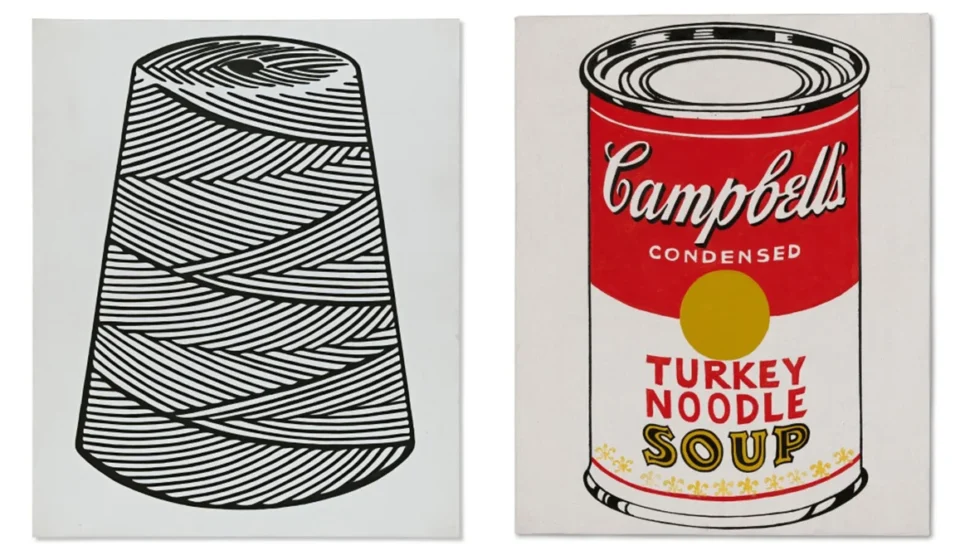
- Andy Warhol’s Campbell’s Soup Can (Turkey Noodle) (1962): A quintessential Pop Art icon that encapsulates Warhol’s elevation of mass-produced consumer goods into high art.
- Jasper Johns’s Numbers (1957): A seminal early painting showcasing Johns’s revolutionary use of familiar symbols and textural encaustic techniques.
- Robert Rauschenberg’s Triple Rauschenberg [Bob Rauschenberg #2] (1962) and Untitled (Collage with Cuff) (1957): Powerful testaments to Rauschenberg’s pioneering Combine paintings and multimedia explorations.
- Mario Schifano’s A de Chirico (1962): An essential bridge between American Pop and the Italian avant-garde.
- Jeff Koons’s Ode to Love (2010–17): A monumental, hyper-polished contemporary anchor that proves the collection’s lineage extended well into the 21st century.
While individual pre-sale estimates were not disclosed by Christie’s at the time of press, the aggregate low estimate exceeding $50 million reflects the pristine provenance, historical weight, and exceptional quality of the works. Furthermore, two significant pieces by Roy Lichtenstein and Andy Warhol originating from the Sonnabend Collection Mantova—a museum in northern Italy that Antonio helped open—will also be sold. Proceeds from these specific lots will be directly funneled into establishing a foundational endowment for the Italian institution.
Chronology: A Century of Collecting and Transatlantic Vision
To understand the magnitude of the Antonio Homem Sonnabend Collection, one must trace the footsteps of the family that curated it. The trajectory of the Sonnabend name is synonymous with the globalization of contemporary art.
The Foundation and European Vanguard (1960s)
Ileana Sonnabend (born Ileana Schapira) and her first husband, Michael Sonnabend, established themselves as titans of the international art scene. In the early 1960s, Ileana acted as a cultural ambassador in reverse. While American audiences were just beginning to wake up to Pop Art and Minimalism, Ileana was instrumental in introducing Europe to the seismic shifts happening in New York. She championed Andy Warhol, Jasper Johns, Roy Lichtenstein, and Robert Rauschenberg to skeptical European crowds.
Simultaneously, the Sonnabends brought groundbreaking European movements to the United States, championing Arte Povera and Conceptual art. They introduced American collectors to visionaries such as Michelangelo Pistoletto, Mario Schifano, Giovanni Anselmo, and Gilbert & George.
The Soho Era and the Gallery’s Golden Age (1971–2000)
In 1971, with the critical assistance and partnership of Antonio Homem, Ileana opened the legendary Sonnabend Gallery in New York’s burgeoning Soho neighborhood, located at 420 West Broadway. The address quickly became the epicorner of the downtown art world. The Sonnabend Gallery shared a building with other monumental dealerships run by Leo Castelli, John Weber, and André Emmerich, creating a powerhouse ecosystem that dictated the global pulse of contemporary art.
During these decades, Antonio worked hand-in-hand with Ileana, overseeing the daily operations, managing relationships with notoriously eccentric artists, and cultivating a magnificent private holding that reflected the gallery’s museum-caliber programming.
The Chelsea Move and Preservation (2000–2025)
As the center of gravity in New York art shifted northward, the Sonnabend Gallery relocated to Chelsea in 2000. Following Ileana’s death in 2007, Antonio seamlessly stepped into the role of gallery director, safeguarding his adoptive parents’ formidable legacy.
Realizing the necessity of institutional preservation, Antonio established the Sonnabend Collection Foundation in 2009 to protect, exhibit, and research the family’s expansive holdings. His dedication culminated in the establishment of the Sonnabend Collection Mantova in northern Italy, opened in 2025 to permanently house selections of the family’s collection for the European public. Antonio’s passing in March marked the end of an era, setting the stage for this autumn’s historic liquidation and endowment fortification.
Supporting Data: Market Context and Christie’s Perspective
The decision to bring a collection of this caliber to auction comes at a fascinating inflection point for the high-end art market. Global auction houses have experienced a recalibration toward "flight-to-quality" consignments—meaning that when premier collections with flawless provenance hit the block, they consistently shatter expectations, even amidst broader macroeconomic caution.
Sara Friedlander, Chairman of Post-War and Contemporary Art at Christie’s, emphasized the historic gravity of the offering. "Ileana Sonnabend’s role in the trajectory of Post-War and Contemporary art cannot be overstated," Friedlander remarked. "This collection exemplifies the very finest in post-war artistic movements across Europe and the U.S., tracing a lineage of curatorial genius that defined how the world looks at modern art today."
The multi-location rollout—exhibiting and auctioning the works across London, Paris, and New York—is a deliberate strategy by Christie’s. It mimics the transatlantic ethos of the Sonnabends themselves, ensuring that collectors from every major global financial and cultural hub have physical access to the material before bidding commences.
Official Responses: Family Sentiment and Cultural Legacy
Parting with family heirlooms that have lined private walls for decades is never a simple transaction. Antonio Phokion Potamianos-Homem, Antonio’s son, released an evocative statement addressing the upcoming auctions and the delicate balance between preservation and letting go.
"My father spent his life among these works, and parting with them is not done lightly," Potamianos-Homem stated. However, he framed the sale not as a dissolution of his family’s footprint, but as an evolution of their lifelong mission.
By earmarking proceeds from specific institutional pieces to fund an endowment for the Sonnabend Collection Mantova, the family is actively future-proofing their cultural footprint. The Mantova museum currently safeguards treasures by Lichtenstein, Warhol, and Koons, serving as a permanent European sanctuary for American Pop and Conceptual masterworks.
"We proudly carry on Ileana and Antonio’s transatlantic vision," Potamianos-Homem added, "ensuring a vital exchange of artists and artworks between Europe and America, and ensuring the eye that assembled this collection continues to be seen by the public."
Implications: What This Means for the Art Market and Museums
The dispersal of the Antonio Homem Sonnabend Collection carries several profound implications for the global art ecosystem:
1. Market Validation for Blue-Chip Postwar Material
Surpassing the $50 million threshold is practically guaranteed given the art-historical pedigree, but the real metric to watch will be how aggressive institutional and private bidders are for works by secondary-market staples like Schifano and Rauschenberg. A strong sale will reinforce confidence in the 20th-century blue-chip sector, signaling to other estate executors that prime-provenance material remains a fiercely contested commodity.
2. Institutional Sustainability Through Deaccessioning and Endowments
The model utilized here—selling select non-core works to build a sustainable financial endowment for a public-facing museum (Sonnabend Collection Mantova)—highlights a growing trend in philanthropic art stewardship. Rather than relying solely on fluctuating visitor revenues or unpredictable government subsidies, private museum foundations are increasingly leveraging their secondary holdings to guarantee long-term operational health.
3. Cementing a Dynastic Legacy
While the physical collection will be scattered among new private and institutional hands across the globe, the overarching narrative of the Sonnabend family will be permanently etched into auction lore. For decades, Ileana and Antonio operated not merely as merchants of luxury objects, but as ideological partners to the artists who changed the visual vocabulary of the 20th century. This autumn, as the hammer falls in London, Paris, and New York, that legacy will transition from private walls into the annals of art history once more.