
Streamlining Purpose: How Nonprofits Are Overhauling Event Registration to Protect Mission-Critical Funds

WASHINGTON — In the modern philanthropic landscape, few operations rival the logistical gymnastics required to execute a successful nonprofit event. Whether orchestrating a high-stakes annual gala featuring corporate sponsor tables, complimentary board passes, and live auctions, or maintaining a steady cadence of community awareness walks and educational workshops, nonprofit teams consistently achieve the impossible. They do so, however, against steep odds.
Typically managed by lean administrative teams of just two or three individuals—who simultaneously juggle donor relations, marketing, and daily program execution—these organizations face an administrative burden that can easily swallow precious human resources. At the heart of this operational bottleneck lies event registration.
As the demand for multi-event calendars grows across the sector, the limitations of generic, out-of-the-box ticketing tools have become glaringly apparent. Standard corporate platforms are rarely built to accommodate the nuanced architecture of charitable giving. Consequently, leaders in the nonprofit technology sector are sounding the alarm: finding and implementing specialized nonprofit event registration software is no longer a luxury; it is a financial and operational imperative designed to keep fundraising revenue where it belongs—directly supporting the mission.
The Unique Registration Challenges Nonprofits Face
Unlike corporate product launches or commercial conferences, nonprofit events operate under a distinct set of operational parameters. The primary friction points center around managing disparate attendee types with complex pricing structures, integrating volunteer coordination alongside donor data collection, and doing so within rigid budget constraints.

Managing Multiple Attendee Types and Access Tiers
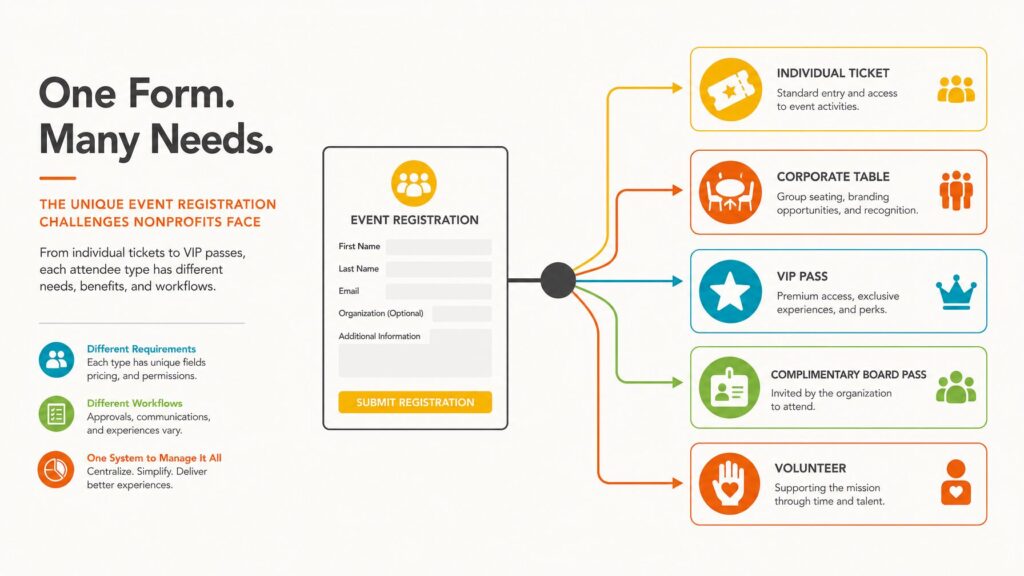
A typical nonprofit fundraiser does not feature a simple, uniform ticket price. Instead, a standard gala inventory might include individual donor tickets, corporate sponsored tables, VIP packages, complimentary passes for board members, and specialized registrations for volunteers. Each tier carries unique pricing matrices, access conditions, and data collection mandates.
Attempting to force this complex ecosystem into a basic commercial ticketing tool often results in fractured data or a clunky user experience. Furthermore, many of these ticket types must remain hidden from the general public. For instance, a complimentary board pass or a high-tier corporate table package has no business appearing on an open-access registration page. Advanced platforms solve this through promo-code-gated visibility, allowing organizers to securely route different audiences to their appropriate registration paths without maintaining multiple, disjointed forms.
The Volunteer and Attendee Convergence
Few corporate events rely on a dual-workforce of paying attendees and unpaid volunteers. Nonprofits, however, routinely manage both simultaneously. When a platform requires a completely separate software process for volunteer sign-ups, data becomes fragmented, increasing administrative overhead. The ideal solution unifies these workflows within a single database, tracking shift availability, role assignments, and attendee metrics in one place.
Donor Recognition and Stewardship Data
For charities, registration data serves as the foundation for future donor cultivation. Capturing precise contribution amounts, recognition preferences, and table seating assignments during the initial registration phase feeds directly into event programs, seating charts, and post-event stewardship campaigns. When registration forms lack robust custom data fields, staff are forced into hours of manual data entry and spreadsheet reconciliation.
Operational Lean-ness vs. High Event Volume
Nonprofit event staffs are notoriously under-resourced. Every hour spent chasing down registration errors, manually sorting spreadsheets, or answering repetitive pre-event logistical questions is an hour stolen from mission-critical programming. Operational efficiency is therefore exponentially more vital for a charity than for a well-funded enterprise with dedicated event departments.
Budget Constraints and Fee Sensitivity
Operating under strict fiduciary accountability, nonprofits are acutely sensitive to transaction costs. Standard commercial ticketing platforms often levy punishing per-ticket percentage fees that can severely erode profit margins on tightly budgeted community events. Transitioning to transparent fee structures—such as subscription-based models or platforms offering nonprofit-friendly pricing that avoids per-ticket surcharges—is essential for maximizing net fundraising revenue.
Essential Features to Evaluate in Nonprofit Registration Software
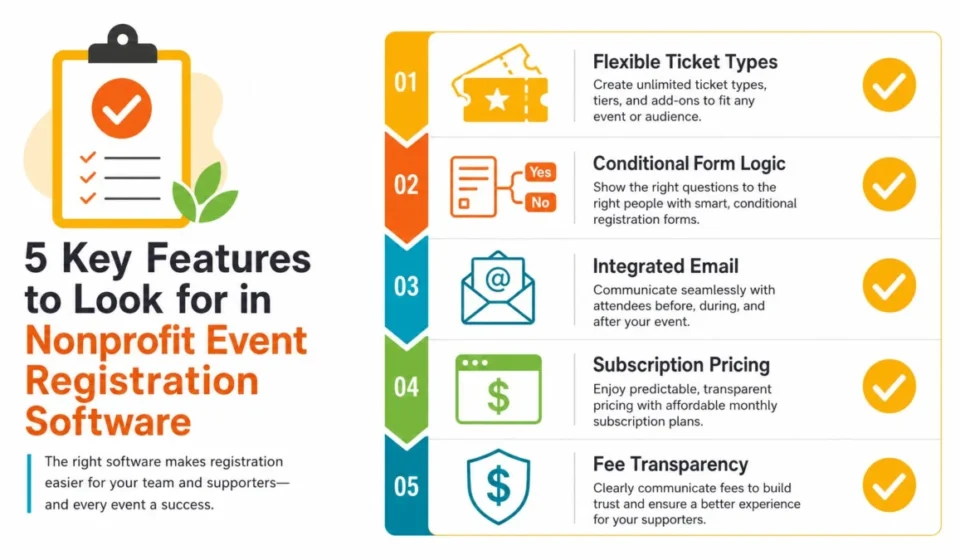
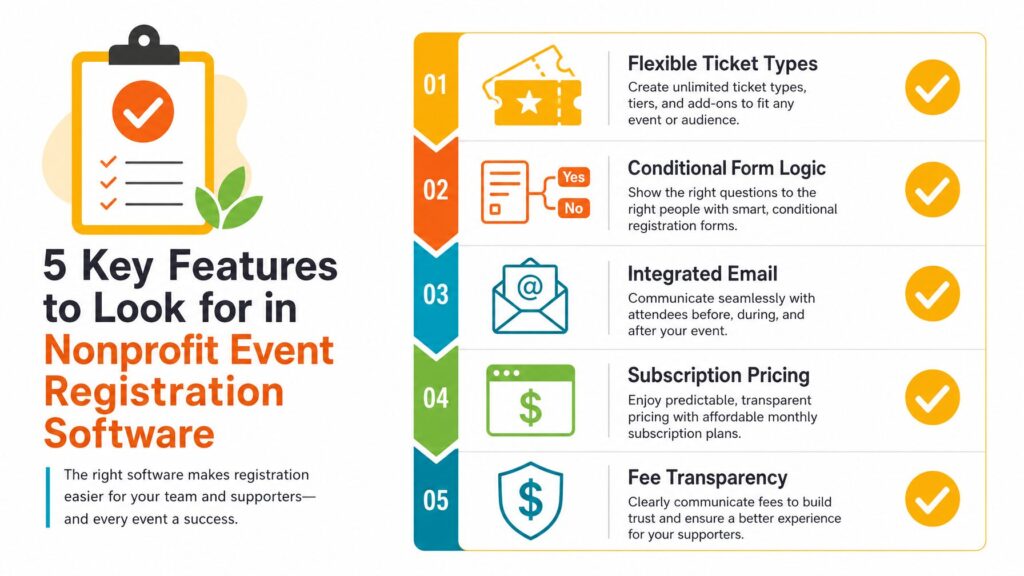
Industry veterans emphasize that evaluating event technology requires looking past flashy user interfaces to focus on core capabilities designed for social-impact organizations.
+-----------------------------------------------------------------+
|               KEY PLATFORM EVALUATION CHECKLIST                 |
+--------------------------+--------------------------------------+
| Feature                  | Nonprofit Impact                     |
+--------------------------+--------------------------------------+
| Hidden Pricing Tiers     | Secures VIP/Board/Sponsor workflows  |
| Conditional Logic Forms  | Eliminates irrelevant data entry     |
| Multi-Event Subscriptions| Protects budgets across annual event |
| Fee Transparency         | Retains maximum fundraising revenue  |
| Integrated Email Tools   | Prevents cross-platform data errors  |
+--------------------------+--------------------------------------+
Flexible Ticket Types and Gated Access
Platforms must natively support multi-tiered ticket architecture. Organizers should look for robust promo-code functionality that automatically reveals hidden registration tiers to specific stakeholders, such as major donors, corporate partners, or board leadership, maintaining exclusivity without increasing administrative complexity.
Custom Forms Powered by Conditional Logic
Asking a volunteer the same operational questions as a VIP corporate donor creates unnecessary friction. Modern registration builders utilize conditional logic to dynamically alter form fields based on prior user selections. If a user selects "Volunteer," the form automatically requests shift preferences and availability; if they select "Table Sponsor," it prompts for corporate recognition names and dietary requirements.
Integrated Email Communications
Data silos are the enemy of efficiency. When registration databases and email communication tools live on separate platforms, the risk of miscommunication skyrockets—such as sending a "complete your registration" prompt to someone who has already paid. Integrated email engines that pull live data directly from the registration roster streamline targeted messaging for incomplete registrants, confirmed attendees, and post-event donors.
Multi-Event Subscriptions
Because many nonprofits run a dynamic calendar featuring high-attendance flagship galas alongside smaller, low-cost community workshops, per-event fee models can become prohibitively expensive. Multi-event subscription pricing models allow organizations to run an unlimited number of minor community events under a single annual cost structure, making grassroots engagement financially viable.
AI-Powered Attendee Support
With international donor bases and supporters operating across diverse time zones, pre-event inquiries can overwhelm small teams. Emerging solutions incorporate AI-powered registration concierges embedded directly into event websites, providing 24/7 automated responses to common visitor questions and dramatically reducing inbound email volume.
Mapping Common Nonprofit Event Scenarios
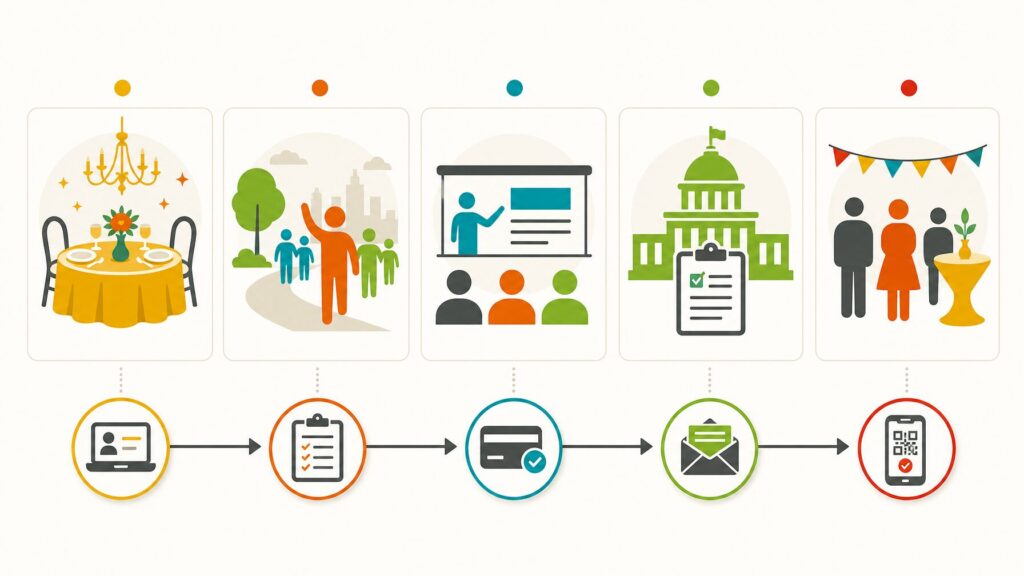
To understand why specialized software is necessary, one must examine the diverse operational environments nonprofits navigate throughout an annual calendar.
- The Annual Gala / Fundraising Dinner: The pinnacle of complexity. These events require managing multi-tiered tickets, early-bird pricing structures, checkout donation add-ons, volunteer deployment, and complex table-seating arrangements within a single unified database.
- Awareness Walks and Community Runs: High-volume, lower-complexity events focused on community engagement. The primary requirement here is high-capacity processing power that can handle team sign-ups and bulk registrations without crashing or creating administrative bottlenecks.
- Educational Workshops and Professional Training: Events requiring moderate complexity, including multi-track session selections, continuing education credit tracking, and tiered pricing structures for members versus non-members.
- Advocacy Days and Government Relations: Highly sensitive, invite-only gatherings requiring stringent private access controls, careful invitation list management, and custom logistic fields for travel and accommodation coordination.
- Donor Cultivation and Stewardship Events: Intimate, high-touch gatherings for major contributors. Success relies on seamless RSVP tracking and capturing precise preferences to ensure high-net-worth supporters feel personally valued.
Key Questions to Ask Technology Vendors
When nonprofit leadership sits down with software vendors, experts advise posing targeted questions to protect both the organization’s budget and its operational sanity:
- What is the total cost of ownership, inclusive of transaction fees and merchant processing? Demand a comprehensive breakdown to ensure hidden fees won’t eat into net fundraising totals.
- Does the subscription cover multiple events annually? Verify whether the pricing model scales logically with a busy, multi-event organizational calendar.
- Can diverse audiences be managed within a single unified form? Ensure donors, volunteers, board members, and general attendees can register through a centralized portal rather than fractured, standalone forms.
- How seamlessly does registration data sync with onsite check-in, badge printing, and mobile app tools? Confirm that data flows automatically to day-of-event hardware to eliminate manual importing errors.
- What level of onboarding and customer support is included? Assess whether the vendor provides dedicated training resources suited for non-technical staff and volunteers.
The Bottom Line
For nonprofit event professionals, doing more with less is an enduring professional reality. The administrative friction of managing multi-audience events can either drain an organization’s creative energy or, when managed with the right technological infrastructure, fuel its mission. By prioritizing total cost transparency, multi-event subscription value, and intelligent automation over superficial feature lists, nonprofits can reclaim countless hours of staff time. Ultimately, the right event registration platform is one that quietly fades into the background—protecting operational budgets, honoring supporters, and allowing staff to refocus their passion where it belongs: driving meaningful social change.