
Mastering the Complexities of Educational Event Registration: A Comprehensive Industry Guide

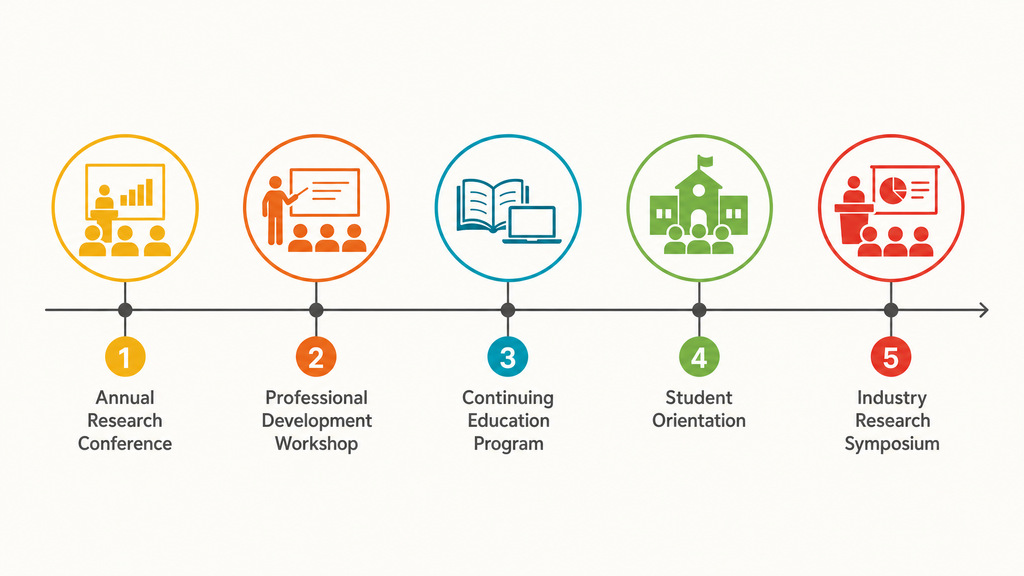
In the modern landscape of academia, professional development, and workforce training, organizing an educational event is rarely as simple as selling a ticket and opening a door. Whether you are coordinating a massive annual research conference for a global academic society, managing a multi-day leadership summit for a public school district, or running certification workshops for a specialized licensing body, your registration needs far exceed the capabilities of off-the-shelf, generic event software.
Educational events require an intricate blend of audience segmentation, session-level tracking, credential verification, and nuanced pricing models. According to the UPCEA State of Continuing Education 2025 report, demand for continuous learning continues to climb rapidly, with institutions increasingly prioritizing workforce-aligned education, corporate training, and strategic employer partnerships. As the scope and scale of these programs expand, the technological infrastructure supporting them must evolve.
This comprehensive guide explores the unique challenges faced by educational event planners, outlines the critical features to look for in a specialized registration platform, breaks down core event workflows, and provides essential questions to ask technology vendors before signing a contract.
1. Main Facts: The Registration Dilemma in Academic and Professional Learning
At its core, the primary challenge of educational event management is the sheer diversity of stakeholder groups involved. Unlike corporate product launches or consumer entertainment events—where attendees generally fall into a single tier—educational programs must effortlessly cater to a multifaceted ecosystem of participants.
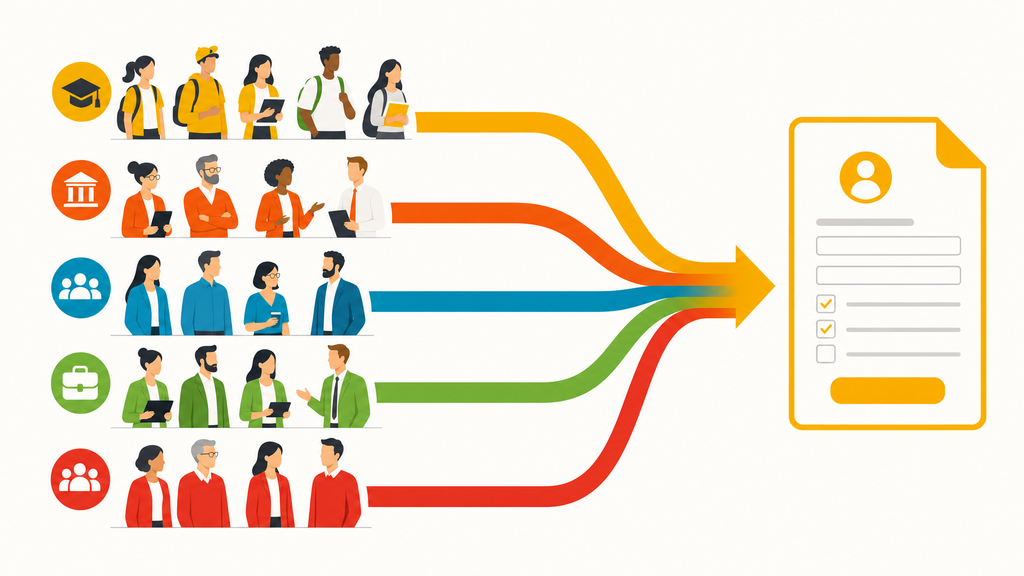
Consider the typical roster for a university continuing education department or a professional certification body. A single event may draw undergraduate and graduate students, tenured faculty members, independent researchers, corporate sponsors, industry practitioners, and guest speakers. Each of these categories demands a completely different registration experience, customized form fields, distinct pricing structures, and varying levels of access to specific sessions or event zones.
Furthermore, educational events are fundamentally content-heavy. Attendees do not simply register to network; they register to consume dense, multi-track academic programming, earn professional credentials, or present original research. When generic event software is forced to handle these complex requirements, planners often find themselves stitching together makeshift workarounds, running multiple disconnected forms, or resorting to manual data entry—all of which increase the risk of administrative error and frustrate attendees.

2. Chronology & Evolution: How Educational Event Needs Have Shifted
To understand why modern educational organizations are moving away from legacy administrative tools and basic ticketing apps, it is helpful to look at how event technology has evolved over the past decade.
Phase 1: The Paper and Spreadsheet Era (Pre-2010s)
Historically, academic societies and school districts managed events using paper registration forms, physical mail-in checks, and basic spreadsheet software. While functional for small gatherings, this approach was painfully slow, prone to human error, and offered zero real-time visibility into attendance caps or revenue streams.
Phase 2: The Rise of Generic Ticketing Software (2010–2020)
As the event tech market boomed, organizations adopted generic ticketing platforms designed primarily for concerts, festivals, and simple corporate webinars. While these tools digitized payments and streamlined check-ins, they failed to accommodate the structural nuances of education. Planners struggled with rigid ticket structures, inability to capture session-level preferences, and a complete lack of support for academic abstract submissions or continuing education unit (CEU) tracking.
Phase 3: The Integrated, Multi-Audience Platform Era (Present Day)
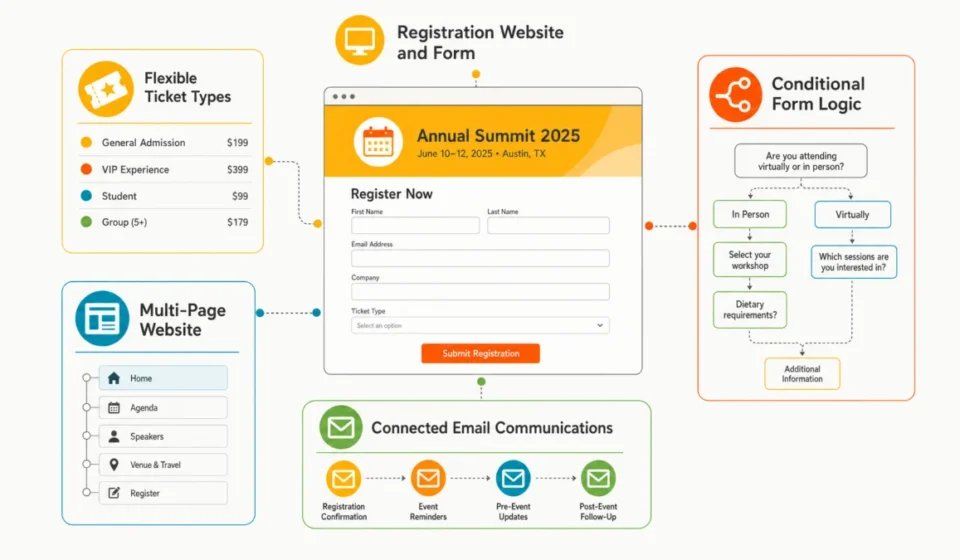
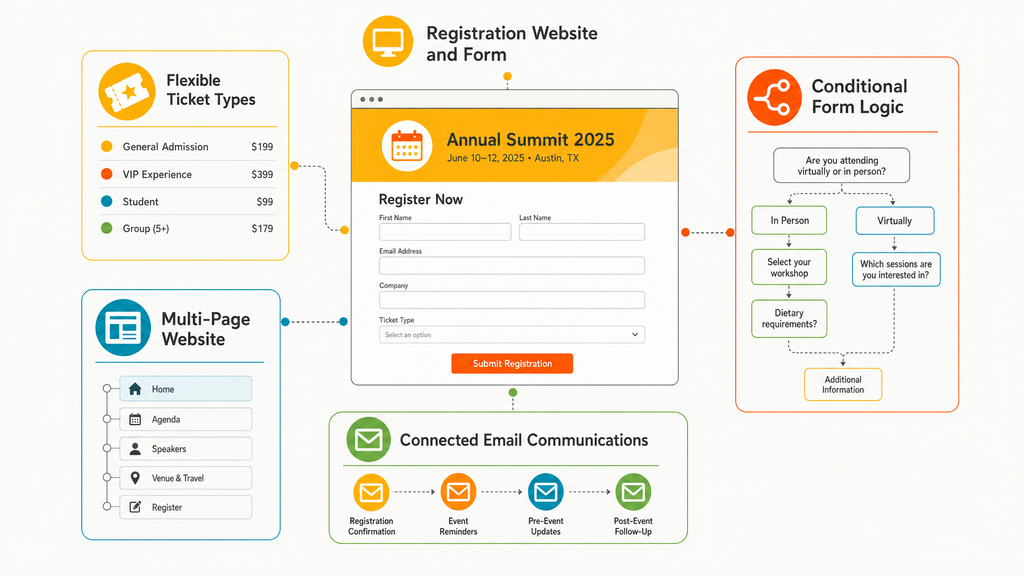
Today, educational event planners require specialized platforms that act as an all-in-one hub. Modern software bridges the gap between public-facing registration, multi-page website building, AI-driven language translation, and downstream mobile app integration. The focus has shifted from mere ticket sales to creating a seamless digital journey that respects the unique constraints of academic and professional learning environments.
3. Supporting Data & Key Challenges Faced by Educational Organizations
Data from the events and education sectors highlights a clear mismatch between standard registration tools and the realities of modern academic programming. Educational event management stretches basic software across several distinct operational fault lines:
Multiple Attendee Categories and Dynamic Pricing
Educational events must accommodate diverse cohorts simultaneously. Students often require heavily discounted or free access; faculty members may attend under institutional subsidy; and industry guests pay full market rate. Managing these variations requires advanced ticket logic without cluttering the public-facing storefront.
Continuing Education and Professional Development Credits
For events offering Continuing Education Units (CEUs) or Professional Development Units (PDUs), basic registration is insufficient. Planners must capture session-level data during the registration process. Attendees need to declare which workshops they plan to attend, and the system must output structured data that seamlessly feeds into post-event certification and compliance reporting.
Abstract Submissions and Speaker Workflows
Academic conferences operate on a dual-track registration model. General attendees follow a standard checkout process, while presenting authors, keynote speakers, and poster session coordinators must submit abstracts, adhere to strict peer-review deadlines, and access specialized pricing tiers or complimentary registration codes.
International and Multilingual Reach
Global research conferences naturally attract international attendees. Language barriers can severely hinder registration conversion rates. Implementing intelligent solutions, such as AI-powered registration concierges that automatically detect a visitor’s language and respond in kind, ensures a frictionless experience without requiring planners to build and maintain entirely separate, fully translated multi-page websites.
4. Official Perspectives & Industry Insights
Industry leaders and association executives consistently emphasize that data integrity and user experience are paramount when selecting event technology.
According to insights published in association management and continuing education studies, the primary friction point in event operations is not the point of sale, but the data reconciliation phase that follows. When registration systems fail to integrate smoothly with onsite check-in tools, badge printing hardware, and mobile event applications, administrative teams spend countless hours manually cross-referencing spreadsheets.
Furthermore, educational institutions operate under strict institutional compliance, audit requirements, and accreditation standards. Consequently, official perspectives from procurement officers stress that event software must guarantee secure data handling, robust export capabilities, and clear audit trails for every credit issued and fee collected.
5. Implications for Planners: Choosing the Right Software
Failing to invest in education-specific event software has direct operational and financial implications. Clunky registration forms lead to high cart abandonment rates among busy educators and researchers. Manual data reconciliation increases labor costs and introduces errors into credit reporting.
When evaluating potential platforms—such as comprehensive solutions offered by industry leaders like EventMobi—planners should look for a robust suite of purpose-built features:
- Conditional Form Logic: Using if/then rules to dynamically show or hide form fields based on ticket type (e.g., hiding faculty-only credentials from students while displaying abstract upload fields exclusively to presenters).
- Access Codes: Utilizing secret codes to reveal hidden ticket tiers for students, board members, or VIP speakers without muddying public pricing.
- Multi-Page Website Builders: Providing rich, drag-and-drop website capabilities with dedicated, sticky-navigated pages for detailed agendas, speaker bios, and sponsor showcases—critical elements that drive academic conversion.
- Integrated Email Communications Hubs: Segmenting communications to target incomplete registrants, early-bird deadlines, and confirmed attendees directly from centralized registration data.
- Onsite and Mobile Sync: Ensuring that registration data flows instantaneously into event apps, badge printers, and check-in kiosks to eliminate human bottlenecks at the registration desk.
Frequently Asked Questions (FAQ)
Why can’t I just use standard, generic event registration software for my university conference?
Generic software is built for straightforward ticket sales. Educational events require session-level tracking for continuing education credits, complex multi-tier pricing for students and faculty, abstract submission workflows, and rigorous attendee segmentation that generic forms simply cannot support.
How do I handle different ticket prices for students and faculty without cluttering the main registration page?
The industry-standard approach is to use Access Codes. Planners can set up hidden ticket tiers that only unlock when a user enters a verified institutional code or email domain, keeping the public registration flow clean and straightforward.
What is conditional form logic, and why is it important for academic events?
Conditional form logic allows your registration form to adapt dynamically. If a user selects "Presenting Author," the form instantly displays abstract upload fields. If a user selects "General Attendee," those fields remain hidden. This keeps forms concise and drastically improves completion rates.
What is the most complex educational event to manage?
The annual academic or research conference is widely considered the most challenging. It combines multiple attendee types, early-bird pricing deadlines, abstract reviews, parallel session tracks, international audiences, and content-heavy multi-page websites into a single operational workflow.
The Bottom Line
Educational event registration is inherently content-rich, audience-diverse, and closely tied to professional outcomes that demand structured data from the moment a participant clicks "Register." By prioritizing platforms that offer advanced form flexibility, seamless session handling, robust credential tracking, and integrated downstream reporting, educational institutions can transform event management from a stressful manual grind into a streamlined, professional operation.
When evaluating your next software investment, always test vendors against real-world scenarios from your own academic calendar to ensure the technology can truly meet the rigorous demands of modern education.