Comments Off on The Broken Handoff: Why More Event Tech is Making Conferences Harder to Run—and How Unified Ecosystems Are Fixing the Fracture
By The Industry Insights Desk Published: October 2026
Main Facts: The Modern Event Paradox
Modern event organizers are living through a technological paradox. Never before has the market offered such a staggering variety of specialized software tools designed to optimize conferences, trade shows, and corporate gatherings. Yet, despite utilizing more digital solutions than ever, event planners report that running a successful conference feels more exhausting, fragmented, and prone to friction than it did a decade ago.
According to industry leaders and recent workflow analyses, the root cause of this operational burnout is not a lack of technological capability. Rather, it is a structural failure at the handoff points between disparate software systems. When an attendee transitions from the registration page to the mobile app, or when a speaker’s proposal is accepted and needs to be ported into the master schedule, data frequently gets lost, corrupted, or left behind.
Instead of an integrated ecosystem, organizers are left managing a brittle "tech stack"—a collection of standalone applications that refuse to speak to one another. The consequences are cascading: abandoned registration carts, frantic last-minute spreadsheet reconciliations, out-of-sync badge printers at the door, and sponsors who are forced to measure return on investment (ROI) using gut feelings rather than hard analytics.
Chronology: The Event Lifecycle and Where the Frictions Form
To understand how an event tech stack collapses under its own weight, industry analysts suggest walking step-by-step through the modern event lifecycle. At every stage, a break in data continuity creates measurable friction for organizers, speakers, and attendees alike.
Phase 1: The Registration Drop-Off
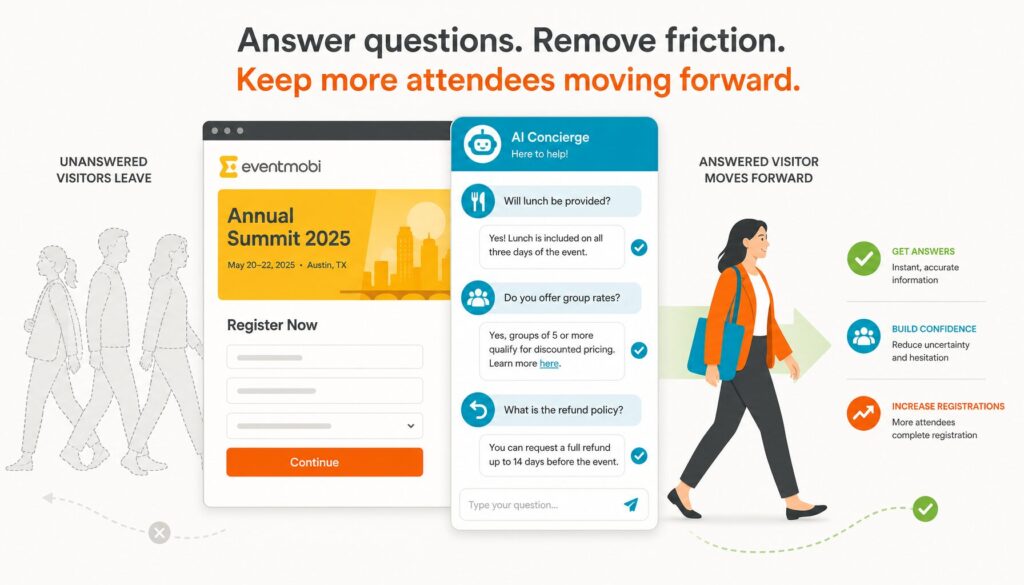
The friction begins long before the event doors open, starting on the registration page. Data shows that the average prospective attendee visits a registration landing page three to four times before committing to purchase a ticket. During these exploratory visits, potential delegates arrive with fundamental logistical questions: Is lunch included in the ticket price? Can our organization secure a group discount? What is the strict refund policy?
Historically, if a static website or a poorly designed FAQ page failed to answer these questions instantly, visitors abandoned the page. Every unanswered query permanently lowered conversion rates. Meanwhile, those exact same repetitive questions flooded event planners’ inboxes during the high-stress weeks leading up to the conference.
Phase 2: Speaker Management and the Spreadsheet Nightmare
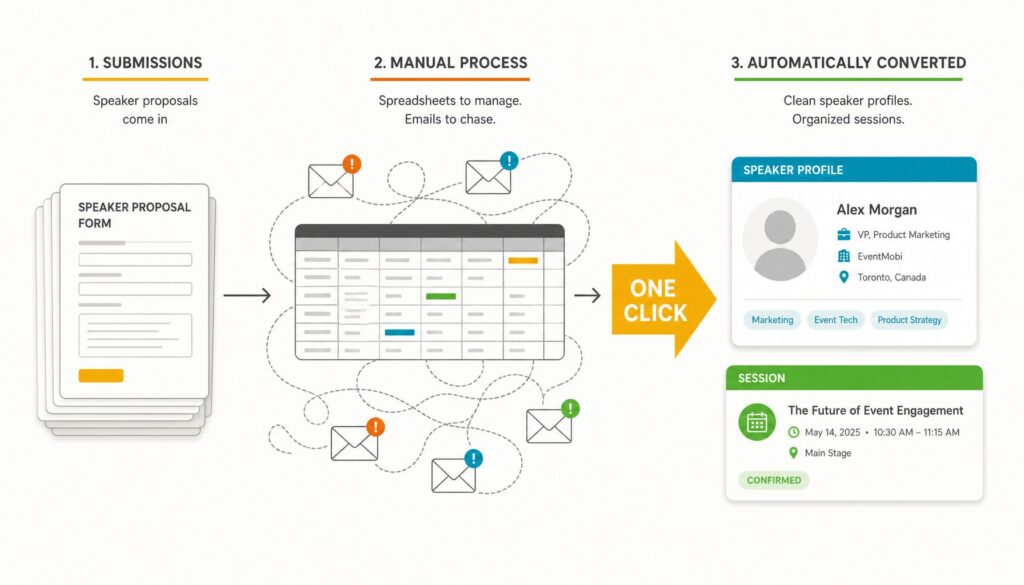
Once registration is underway, organizers must coordinate speakers and content. In many organizations, the speaker program remains a relic of administrative inefficiency. Proposals arrive via disparate intake forms, while decisions are tracked in isolated spreadsheets.
Once a speaker accepts an invitation, a coordinator is often forced to manually re-type their biography, headshot, and session title into the primary event management platform. Multiply this manual entry across a roster of 150-plus speakers, and event teams find themselves chasing missing assets days before the event opens. Acceptance emails trickle out individually, leaving teams without a unified, real-time dashboard of who is confirmed versus who is pending.
Phase 3: The Check-In Bottleneck and Dead Badges
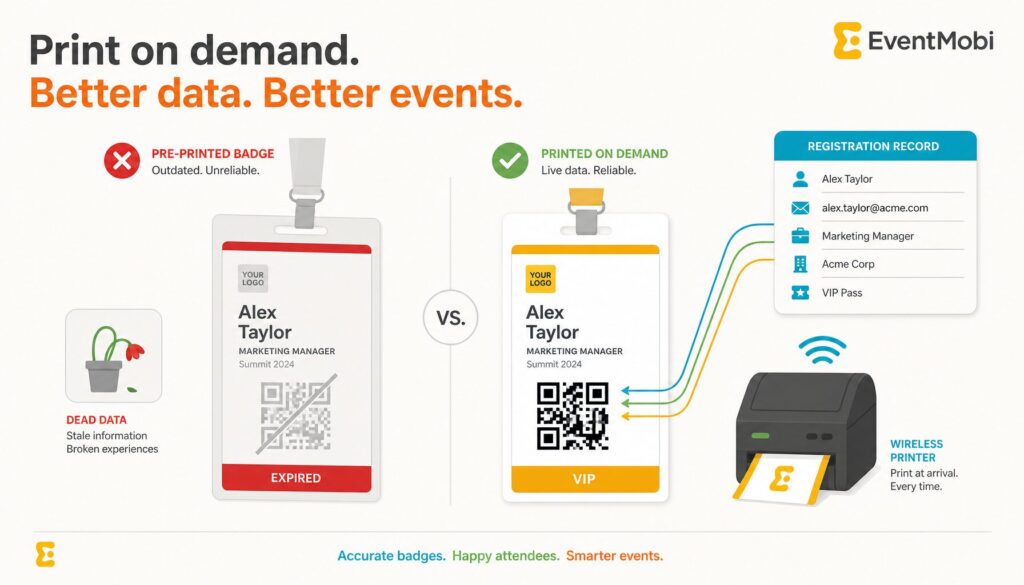
When event week finally arrives, operational bottlenecks shift to the physical venue. Traditionally, events relied on pre-printed badges generated weeks in advance. This static approach freezes the attendee list prematurely, rendering walk-ins, name changes, and last-minute cancellations into chaotic on-site emergencies.
Volunteers are often forced to look up late registrants in separate apps, occasionally resorting to handwriting replacement badges with markers. Furthermore, badges that lack synced, dynamic QR codes function as little more than paper name tags. Without digital integration, they cannot track real-time session attendance, capture exhibitor leads, or feed useful analytics back into the organizer’s reporting suite.
Phase 4: Exhibitor ROI and the Guesswork Trap
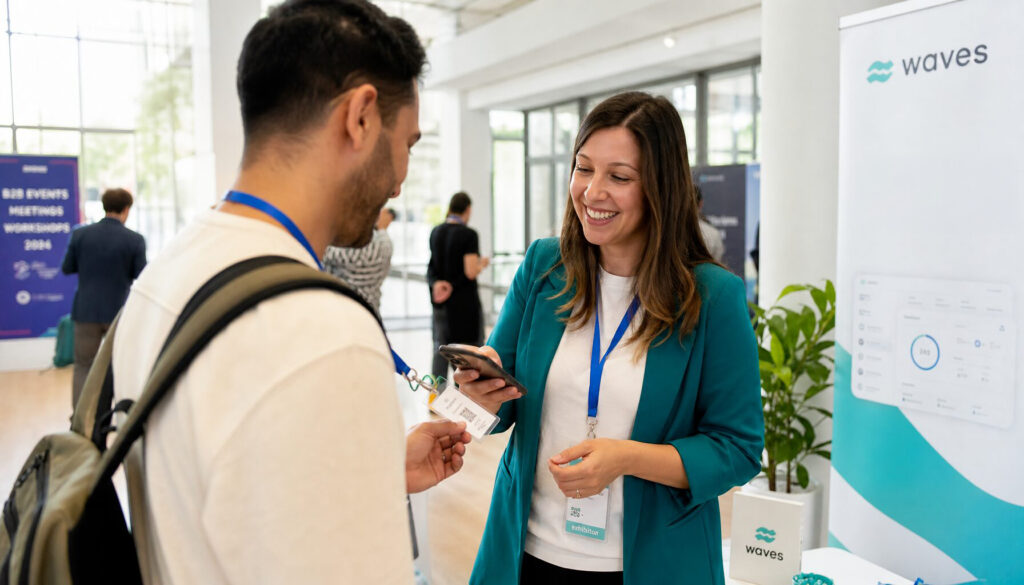
On the trade show floor, sponsors and exhibitors face their own data desert. Despite multi-thousand-dollar investments, many exhibitors are still forced to rely on collecting physical business cards dropped in fishbowls or scribbling qualitative notes on paper pads.
Because exhibitor management tools are frequently the last to be integrated into the core event software, follow-up depends entirely on human memory and post-event data entry. When a corporate sponsor asks whether their financial investment was worthwhile, organizers are left offering qualitative stories rather than concrete, verifiable metrics.
Supporting Data and Industry Insights
The structural flaws of fragmented software stacks are not just theoretical inconveniences; they represent significant financial drains and operational roadblocks for organizations of all sizes. Industry veterans have begun speaking out about the urgent need for architectural consolidation.
The Cost of Disconnection
The Communication Gap: Prospective attendees who encounter friction on registration pages rarely reach out via contact forms; they simply bounce. Industry benchmarks indicate that unassisted registration sites lose up to 30% of hesitant buyers who cannot immediately get answers to logistical questions.
The Manual Re-Keying Tax: Event teams spend an estimated 20% to 35% of their pre-event work hours on data re-entry—transferring information from Google Forms to spreadsheets, and from spreadsheets to event apps.
The On-Site Scramble: Without wireless, on-demand badge printing linked directly to live registration databases, lines at check-in swell, increasing registration desk staffing costs and degrading the initial attendee experience.
Official Responses: What Industry Leaders Are Saying
As the event technology sector matures, top executives are pointing away from single-point solutions and toward unified, end-to-end architectures.
"Sometimes the badge simply isn’t there at all because the attendee registered three days ago and didn’t make the final print run… now your volunteer’s looking up the registration in a separate app, you’re maybe even handwriting a badge with a Sharpie…" — Brandt Krueger, Director, Industry Relations & Partnerships, EventMobi
Krueger highlights the human cost of disjointed hardware and software systems on-site. When the physical environment and the digital database are disconnected, volunteers bear the brunt of the administrative failure.
Addressing the onboarding and check-in bottleneck, Bob Vaez, CEO of EventMobi, emphasizes the necessity of automation:
"One thing that makes onsite badge printing a lot easier is just getting rid of that crossing the line and automating that, knowing who has actually picked up the badge, who’s checked in… a lot of events have to wait till lunch to figure out which badges are leftover."
Vaez also points out that attendee engagement cannot be treated as an afterthought or a standalone app downloaded at the door:
"Why can I not see who else is coming to the event so I can actually plan my day? Reach out to a few people that would be awesome to meet. And that was the other thing around networking… without an event app that was very, very difficult."
Behind the scenes, integration architects face the grueling task of connecting niche systems, particularly within the association management space. Thorben Grosser, Head of AI & Automation at EventMobi, notes:
"One of the major problems is obviously that everybody is using different systems… especially when we’re talking, for example, about CRM systems or also in the association space, you have very niche systems and having every connection pair pretty tough."
Grosser stresses that modern platforms must bridge these gaps proactively through intelligent automation rather than expecting human planners to act as data couriers. Yichi Chen, Product Manager at EventMobi, echoes this sentiment regarding the evolution of integration hubs:
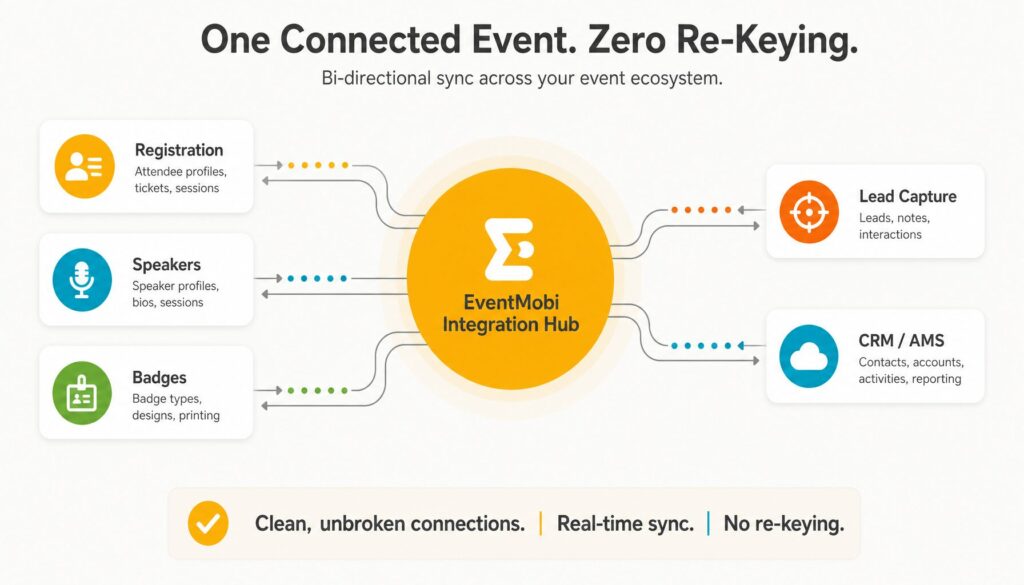
"The integration hub that we offer does not just transfer data from one place to the other, but it also automates things for you, imagining you’re hiring an assistant, doing lots of manual work for you…"
Implications: The Shift Toward Unified Ecosystems
The ultimate takeaway for event professionals is clear: adding a tenth or eleventh specialized app to a fractured tech stack only exacerbates the problem. Every breakdown—whether it is an abandoned registration form, a lost speaker bio, a dead paper badge, or an unprovable exhibitor ROI—is simply the same underlying data failure manifesting at a different stage of the event lifecycle.
The Solution: One Connected Flow
To survive and thrive in an increasingly competitive conference market, event organizers must demand unified platforms where data survives the handoff. The future of event management relies on ecosystems designed from the ground up to operate as a single, cohesive unit:
AI-Powered Registration Concierge: Integrating conversational artificial intelligence directly onto registration pages allows prospective attendees to get instant, accurate answers to questions about pricing, logistics, and schedules around the clock, drastically reducing drop-offs and freeing up staff inboxes.
One-Click Speaker Conversion: Streamlining the transition from proposal approval to program scheduling ensures that a speaker’s accepted submission instantly generates their profile and session record without manual re-keying.
On-Demand Wireless Badge Printing: Linking check-in stations directly to real-time registration databases eliminates the need for pre-printed badge stockpiles, allowing seamless handling of walk-ins, name changes, and instant attendance tracking.
Integrated Lead Capture: Providing exhibitors with digital lead-retrieval tools synced directly to attendee badges transforms casual scans into verified, CRM-ready records instantly, cementing sponsor renewals through undeniable ROI metrics.
Centralized Integration Hubs: Utilizing robust integration frameworks allows legacy CRM and Association Management Systems (AMS) to communicate effortlessly with the core event platform, ensuring that data modified in one system updates universally across all touchpoints.
Conclusion
Running a successful event should not require fighting your own software. By recognizing that integrations are not a "nice-to-have" feature but rather the foundational point of modern event management, planners can eliminate administrative friction, elevate the attendee experience, and finally secure the verifiable data needed to prove event success.
The path forward is no longer about collecting more tools; it is about building a smarter, fully connected event lifecycle.