
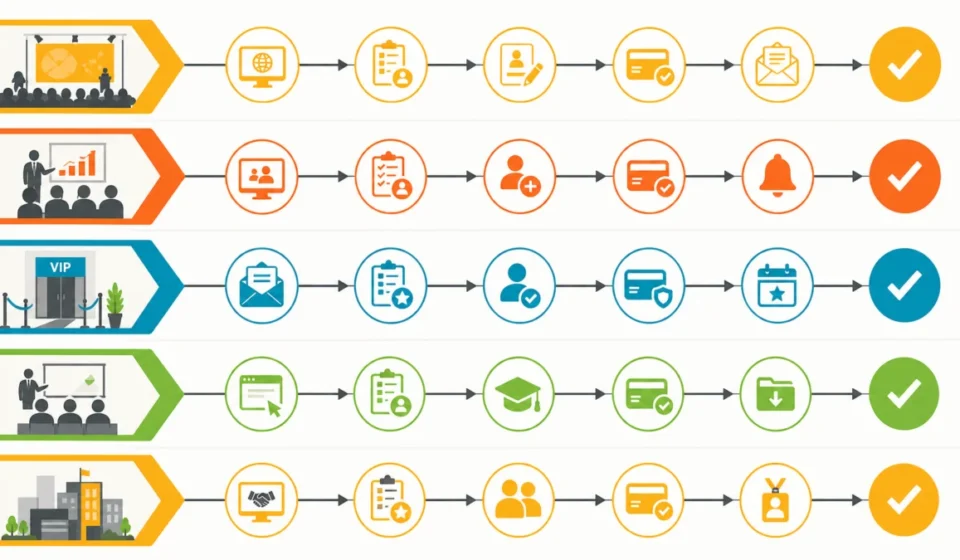
Bridging the Gap: Why Generic Software Fails Corporate Event Teams—And How to Choose the Right Registration Platform

For corporate event planners, the annual calendar is a high-stakes juggling act. Teams are routinely tasked with executing executive summits, high-energy sales kickoffs, massive customer conferences, internal town halls, and specialized partner events. Yet, these ambitious portfolios are frequently managed by lean teams whose headcount accounts for a mere fraction of the workload.
Compounding this operational strain is a persistent technological mismatch: the event registration software traditionally used for public consumer events simply was not built for corporate needs. Standard ticketing tools stumble when asked to securely gate an internal town hall exclusively to verified employees, while simultaneously lacking the sophisticated enterprise features required to manage a paid, multi-track customer conference under a unified login.
As businesses increasingly recognize corporate events as critical revenue drivers and culture-building touchpoints, selecting the right registration platform has transformed from a back-office administrative choice into a strategic imperative.
The Main Facts: The Enterprise Event Management Dilemma
Modern corporate event teams operate in a unique nexus between internal human resources management and external revenue-generating marketing. Consequently, their software requirements diverge sharply from those of festival organizers, indie concert promoters, or public webinar hosts.

At the core of the dilemma is a fundamental software design flaw. Consumer-focused tools optimize for friction-free, open-market ticket sales. In contrast, corporate events require nuanced security, ironclad compliance protocols, deep integration into existing corporate tech stacks, and multi-tier stakeholder management.
Industry research underscores the urgency of upgrading these digital infrastructure components. According to data from Marq’s State of Brand Consistency report, 68% of businesses attribute 10% or more of their overall revenue growth directly to consistent brand presentation. When registration pages, confirmation emails, badges, and mobile event applications look disjointed or amateurish, it directly impacts attendee trust and corporate reputation.
Chronology and Evolution: The Shift Toward Unified Corporate Platforms
Historically, corporate event teams relied on a patchwork of disparate tools. Internal meetings were managed via corporate intranets or basic survey forms; external customer conferences utilized outsourced, third-party ticketing platforms; and executive retreats were tracked manually through spreadsheets and email threads.
The Breaking Point
By the early 2020s, this fractured approach reached a breaking point. As organizations scaled their hybrid and in-person event strategies post-pandemic, the administrative overhead of reconciling data across multiple systems became unsustainable. Maintaining separate databases led to fragmented attendee histories, duplicate data entry errors, and compliance blind spots.

The Rise of the All-in-One Solution
The industry has since shifted toward unified event management software. Platforms like EventMobi pioneered this transition by engineering systems capable of handling both internal and external events within a single interface. This evolution eliminated the need for teams to switch between consumer-grade ticketing tools and enterprise HR portals, allowing organizations to streamline operations, cut software sprawl, and dramatically reduce the time spent on manual data reconciliation.
Supporting Data & Core Challenges Faced by Corporate Teams
A granular examination of corporate event operations reveals six distinct structural challenges that generic registration software consistently fails to address:
- Internal vs. External Dualism: Managing employee-only town halls alongside public customer summits requires a platform that can seamlessly transition between domain-restricted access gating and public-facing marketing funnels.
- Brand Fragmentation: Corporate events are elite brand touchpoints. Without centralized template management, maintaining consistent fonts, colors, and logos across multi-page event websites becomes an exhausting manual chore.
- Multi-Stakeholder Complexity: Customer conferences must simultaneously accommodate attendees, speakers, sponsors, exhibitors, press, and internal staff—each requiring distinct data collection fields and access permissions.
- Tech Stack Isolation: Registration data that fails to sync natively with corporate Customer Relationship Management (CRM) systems like Salesforce and HubSpot, or Human Resources Information Systems (HRIS), creates severe administrative bottlenecks.
- Regulatory Compliance: Financial services, healthcare, and government-facing enterprises operate under stringent data privacy laws (such as GDPR) and security benchmarks (such as SOC 2 Type II), demanding audit trails and encrypted data handling.
- Elevated Attendee Expectations: Modern business travelers and digital-native executives expect seamless, responsive registration workflows, instant digital support, and intuitive check-in procedures.
Technological Innovation: The Arrival of AI Concierges and Advanced Architecture
To combat the friction inherent in event planning, modern enterprise registration platforms have introduced advanced architectural capabilities designed specifically to alleviate team burnout.
AI-Powered Attendee Support
In the past, pre-event customer support queues routinely bogged down event teams, with response times stretching to 48 hours. Unanswered questions frequently caused prospective attendees to abandon the registration page entirely.

Today, solutions like EventMobi’s Registration AI Concierge are shifting the paradigm. Embedded directly onto the registration website, this AI-driven assistant operates around the clock to answer nuanced questions from attendees, speakers, and sponsors. Unlike generalized chatbots that require exhaustive script-writing and IT intervention, modern event AI learns natively from the event’s own hosted content—including ticket tiers, agendas, and uploaded policy documents. Organizers can easily review and supplement suggested responses, deploying a fully functional concierge in 15 to 30 minutes. Furthermore, its backend analytics provide organizers with deep insights into what visitors are asking, instantly exposing content gaps on the registration site before they impact conversion rates.
Flexible Financial and Group Workflows
Corporate registration platforms must also account for complex financial transactions. For large customer conferences, corporate buyers frequently need to register entire delegations in a single checkout flow. Platforms offering unified group registration—where a single invoice covers multiple attendees regardless of who is paying, complete with bundle pricing and caps on early-bird inventory—dramatically reduce friction. Additionally, enterprise-grade platforms avoid adding hidden percentage fees on top of every paid ticket, ensuring event budgets remain predictable.
Implications for Enterprise Buyers: How to Evaluate Software
For organizations looking to upgrade their event technology stack, asking the right questions during the vendor evaluation phase is vital. Procurement teams should challenge software providers with the following core inquiries:
- Access Control: Can the platform simultaneously support public-facing ticket sales and domain-restricted, employee-only event gating under the same administrative dashboard?
- Data Integration: Does the platform offer native, real-time synchronization with major CRMs and marketing automation platforms, or will it require fragile third-party connectors like Zapier for basic data hygiene?
- Financial Flexibility: How many payment gateways does the system support (e.g., Stripe, PayPal, Authorize.net), and does the vendor charge any hidden fees per ticket transaction?
- Compliance Standards: Can the vendor provide documented proof of SOC 2 Type II compliance, robust data encryption at rest, and GDPR adherence for international attendees?
- Onsite and App Connectivity: Does registration data flow instantaneously into the mobile Event App and onsite badge-printing hardware without requiring manual CSV exports and imports?
- Support Scalability: What automated support tools (such as AI concierges) are built into the platform to handle pre-event inquiries without increasing headcount?
Official Responses and Industry Outlook
Industry analysts note that as corporate budgets face heightened scrutiny, operational efficiency is paramount. Event teams are no longer measuring success solely by top-line attendance figures, but by return on investment (ROI), data security compliance, and staff resource allocation.

"The metric that matters most to corporate leadership today isn’t just how many people showed up to an event, but how frictionless the journey was for both the attendee and the planning team," notes an enterprise event technology strategist. "Platforms that bridge the gap between secure internal meetings and polished external conferences are rapidly becoming the gold standard for modern enterprises."
The Bottom Line
Choosing the right event registration software is no longer a peripheral operational decision; it is a core pillar of enterprise marketing and internal communications strategy. The ideal platform does not need to be the loudest or most feature-bloated tool on the market. Rather, it must be the one comprehensive solution capable of handling the entire spectrum of the corporate calendar—from internal town halls to global customer summits—while integrating flawlessly with existing enterprise tech stacks.
By investing in robust, secure, and technologically advanced registration platforms, corporate event teams can eliminate administrative bloat, elevate their brand standards, and successfully execute high-volume event programs without requiring a proportional increase in headcount.