
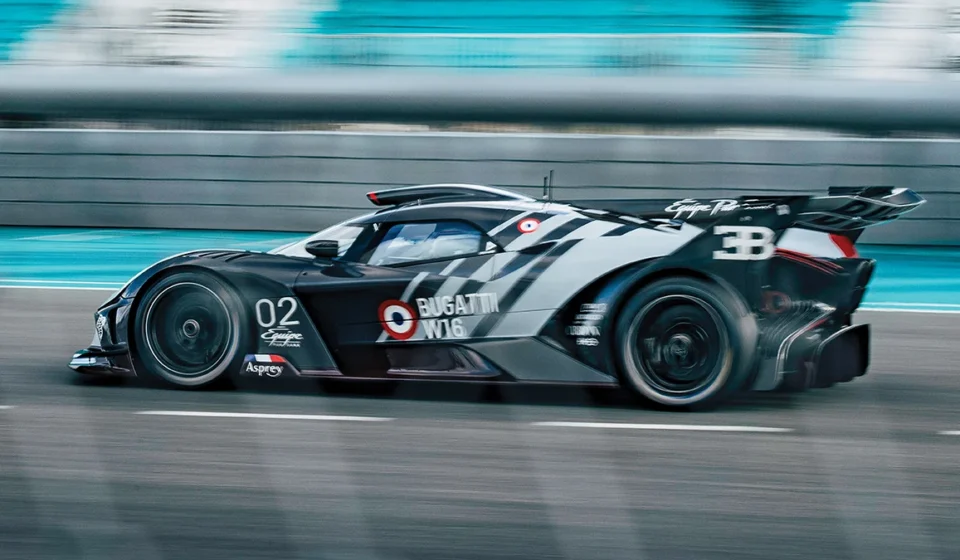
Taming the Fireball: Putting Bugatti’s $4.8 Million Track-Only Bolide Through Its Paces at the Miami International Autodrome

Main Facts
In the rarefied air of hypercar manufacturing, the Bugatti Bolide represents an unprecedented exercise in unadulterated performance. Limited to just 40 examples globally—all of which have already been spoken for—the track-only machine commands a staggering $4.8 million price tag. Named appropriately after the French word for a fireball or meteor, the Bolide is the most extreme vehicle ever forged in Molsheim.
At the heart of this carbon-fiber ballistic weapon sits Bugatti’s legendary 8.0-liter, quad-turbocharged W16 engine. Running on standard gasoline, the powerhouse churns out a monumental 1,578 horsepower and 1,180 ft-lbs of torque. When fed specialized race fuel, those figures scale to a mind-bending 1,826 horsepower and 1,475 ft-lbs of torque.
Despite its intimidating output, the Bolide is engineered to deliver its performance with surprising approachability. It features a bespoke aerodynamic package capable of generating over 6,000 pounds of downforce—double that of a contemporary Formula 1 race car—allowing it to corner with ferocious, glue-like adhesion. With a dry weight kept remarkably lean for such a mechanical titan, the Bolide rockets from zero to 62 mph in a blistering 2.2 seconds on its way to a top speed of 236 mph.

Chronology of the Experience
The journey to taming the Bolide began inside the high-stakes environment of the Miami International Autodrome, the celebrated home of the Formula 1 Miami Grand Prix.
The Briefing and the Storm
The morning commenced with a rigorous driver’s briefing heavy on safety warnings, dynamic limitations, and track etiquette. As I stood beside the $4.8 million machine, Bugatti’s head driving instructor offered a calming, if contradictory, mantra that would echo through my mind all day: “It’s just a car.” He paused with a smirk, adding, “Actually, it’s a gun. But it’s just a car.”
With a pack of newly delivered Bolides idling in the paddock—a sight so rare it instantly induced goosebumps—I contorted my frame to slide into the passenger seat beside Le Mans winner and Bugatti chief test driver Andy Wallace. Our mission: a reconnaissance lap to learn the intricacies of the circuit. Just as we prepared to roll, the South Florida sky darkened and unleashed a torrential downpour. Wallace calmly noted that the Bolide handles wonderfully in the wet. Easy for him to say.

High-Speed Reconnaissance
Once the storm front swept past, leaving behind a slick, reflective asphalt canvas, Wallace wasted no time. Within seconds of leaving the pit lane, he matted the accelerator.
“Get on the brakes early and much harder than you think,” Wallace yelled over the ferocious mechanical symphony of the quad-turbo W16 as we accelerated past 200 mph on the straightaway. To demonstrate, he stomped on the brake pedal with extreme prejudice, instantly burying me deep into the six-point safety harness.
Taking the Wheel
Later, the time arrived for me to occupy the driver’s seat. Sinking into the carbon-fiber monocoque, my initial surprise was the remarkable forward visibility through the windshield. My gaze quickly shifted to the minimalist, X-shaped steering wheel—a geometric motif that mirrors the car’s aggressive rear fascia and X-shaped tail-light design.

As I buried my foot into the throttle, the acceleration was nearly overwhelming. The red-and-white circuit curbing blurred into a solid pink hue, and the edges of my vision narrowed into tunnel vision. Yet, despite the violence of the acceleration, the chassis fought back with zero resistance. The electronic stability control worked harmoniously behind the scenes, keeping the car entirely planted. By turn six, all pre-drive apprehension had completely evaporated.
Supporting Data and Engineering Marvels
The engineering metrics behind the Bugatti Bolide read more like aerospace specifications than automotive achievements.
- Power-to-Weight Dynamics: The W16 engine is housed in a featherweight carbon-fiber monocoque chassis, allowing the Bolide to achieve an astonishing power-to-weight ratio that pushes close to a 1:1 ratio when fueled with race gas.
- Aerodynamic Downforce: At high velocities, the multi-element aerodynamic elements generate upwards of 6,000 pounds of downforce. This immense downward pressure presses the car into the asphalt, allowing for cornering G-forces that defy conventional track-driving physics.
- Braking Innovation: The stopping power of the Bolide is perhaps its most discussed engineering triumph. Brembo spent two years developing the largest carbon-carbon braking system in its history specifically for this vehicle. Utilizing technology adapted from supersonic aircraft like the Concorde and premier Formula 1 racing, the brakes are capable of generating deceleration forces of up to -2.5 G.
Official Responses and Perspectives
Bugatti’s leadership and driving team have been remarkably candid about the duality of the Bolide—balancing its terrifying capabilities with an unexpected level of driver-friendly engineering.

Bugatti’s chief test driver, Andy Wallace, emphasized that the car’s extreme capabilities do not require an active racing background to exploit safely. “The car communicates so transparently through the seat and the steering wheel that drivers quickly build trust in its limits,” Wallace notes.
The rationale behind the strict limitation of 40 units stems from Bugatti’s desire to maintain absolute exclusivity while ensuring that each owner receives personalized, white-glove trackside support during official Bugatti-sanctioned driving events. As the head driving instructor summarized during the Miami briefing, the machine is designed to behave like a lethal weapon in expert hands, yet remain remarkably docile when treated with baseline respect: "It’s just a car."
Implications for the Hypercar Market
The successful delivery and operational debut of all 40 Bolide units mark a significant milestone for Bugatti, particularly as the automotive world navigates the twilight of pure, unhybridized combustion engines of this scale.
- The Final Chapter of the W16: The Bolide, alongside sister models like the Chiron, represents the pinnacle of Bugatti’s quad-turbocharged W16 era. As emissions regulations tighten globally, track-only specials like the Bolide allow manufacturers to stretch internal combustion engine technology to its absolute thermodynamic and mechanical limits without road-legal compromise.
- The Rise of Track-Only Club Culture: With public roads becoming increasingly hostile to hypercar performance, ultra-wealthy collectors are shifting their investments toward track-exclusive toys. Events like the Bolide track day at the Miami International Autodrome highlight a growing market segment: exclusive, manufacturer-hosted club circuits where owners can safely unlock the true potential of multi-million-dollar investments.
- Setting a New Benchmark: By proving that a car producing over 1,800 horsepower can be driven with the intuitive straightforwardness of a standard commuter vehicle—albeit at triple-digit speeds—Bugatti has redefined the threshold of human-machine integration in hypercar design.