Tracing Roots and Real Estate: The History, Architecture, and Market Journey of Gavin Newsom’s San Francisco Childhood Home

Long before his name became a permanent fixture in California political discourse, spanning his tenures as mayor of San Francisco, lieutenant governor, and ultimately governor of the Golden State, Gavin Newsom’s life story was rooted in the verdant microclimate of San Francisco’s Upper Cole Valley. On the rugged, tree-lined edge of the century-old Mount Sutro Forest, a midcentury architectural retreat stands as a silent witness to the formative years of the Newsom family.
Built in 1951, the Stanyan Street property has recently re-emerged in the public consciousness—and on the luxury real estate market. Listed for $4.5 million with John DiDomenico of Compass, the home is generating significant interest not merely for its prime Bay Area location and modernist architectural pedigree, but for its rich political and familial provenance.
As California’s current administration winds down and speculation ramps up regarding future national ambitions, the history of this unassuming yet sophisticated urban sanctuary offers a fascinating lens into the personal background of one of the state’s most prominent political figures.
Main Facts: Architecture, Location, and Current Market Status
Nestled on two gated parcels spanning nearly a quarter of an acre, the Stanyan Street residence offers a rare blend of urban convenience and secluded, park-like serenity. The property is designed to maximize its natural surroundings, seamlessly integrating indoor and outdoor living spaces that capture the essence of Northern California’s architectural aesthetic.

Property Overview
- Location: Upper Cole Valley / Ashbury Heights border, San Francisco, CA
- List Price: $4.5 million (Previously sold in 2025 for $3.9 million)
- Living Space: Approximately 1,400 square feet
- Lot Size: Nearly a quarter of an acre across two gated parcels
- Key Features: Two stories, open-concept layout, wood-beamed ceilings, sunken dining room, updated kitchen with eat-in island, full-floor primary suite with private balcony, detached finished cabin/studio, and a Japanese soaking tub patio.
- Listing Agency: John DiDomenico, Compass
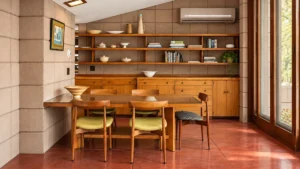
The main structure encompasses roughly 1,400 square feet of meticulously maintained interior space. Upon entry, visitors are greeted by high, wood-beamed ceilings that amplify the sense of volume within the open-concept footprint. A sunken dining room sits adjacent to an elevated living area, establishing dynamic sightlines and intimate zones for gathering. The updated kitchen features contemporary appliances and an eat-in island, bridging midcentury charm with modern convenience.
Ascending a curving staircase past a secondary bedroom and bathroom leads to the home’s crowning achievement: a full-floor primary suite. Complete with an integrated office nook, a walk-in closet, a modernized bathroom, and a vaulted bedroom, the space opens onto a private balcony. From here, occupants are treated to sweeping north-facing vistas of the downtown San Francisco skyline and the iconic towers of the Golden Gate Bridge.
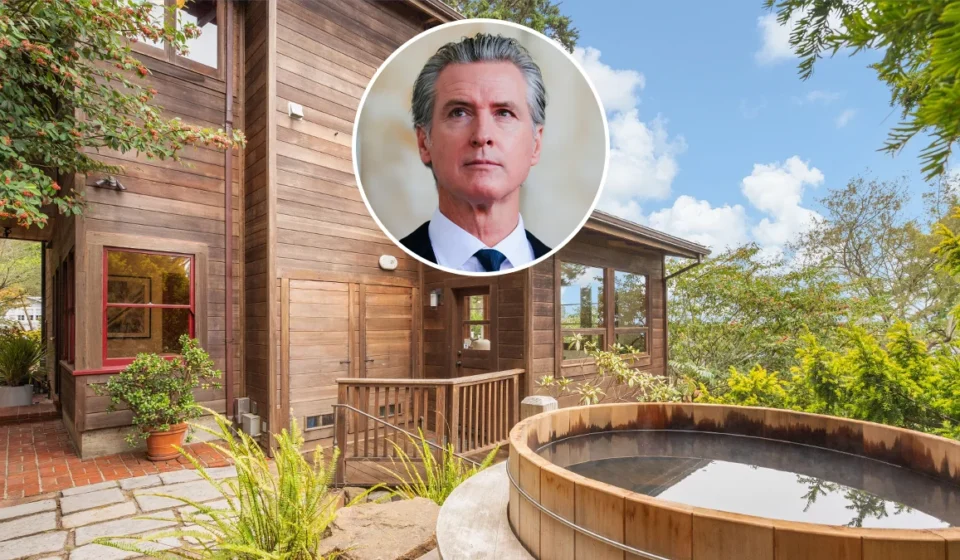
The exterior grounds are equally compelling. The property spans two separate parcels, the second of which houses a small, finished cabin capable of functioning as an artist’s studio, a private home office, or detached guest quarters. The park-like landscape is defined by stacked-stone retaining walls, mature greenery, and a tranquil patio equipped with a Japanese soaking tub, creating an oasis of calm mere minutes from the city’s bustling commercial corridors.
Chronology: A Timeline of the Stanyan Street Property and the Newsom Family
To fully understand the significance of the Stanyan Street home, one must trace its trajectory through decades of family milestones and real estate transactions.

- 1951: The midcentury retreat is constructed on the edge of Mount Sutro Forest, initially acquired by Gavin Newsom’s maternal grandfather.
- Late 1967: William A. Newsom, Gavin’s father, officially lists the Stanyan Street property as his residence while mounting a campaign for the San Francisco Board of Supervisors.
- 1967 (Later that year): Gavin Newsom is born into a family whose local footprint is firmly anchored to the Upper Cole Valley neighborhood.
- 1970s: Tessa Newsom, Gavin’s mother, who inherited the home from her father, ultimately decides to sell the property.
- 1979: The house undergoes a significant structural refresh, being resurfaced in clear heart redwood sourced from neighboring Marin County.
- 2025: The property changes hands in a private transaction, fetching $3.9 million.
- Late 2026 / Early 2027: The home returns to the open market, listed by Compass for $4.5 million, drawing renewed attention amid shifting political dynamics across California.
While Newsom’s published memoir, Young Man in a Hurry, reflects on an upbringing characterized by various moves and a complex family dynamic elsewhere in the region, the Stanyan Street address remains the geographical anchor of his birth year and his father’s early foray into municipal politics.
Supporting Data: Real Estate Portfolio Transitions
The sale of the Stanyan Street home coincides with a broader real estate reshuffling by Governor Gavin Newsom and First Partner Jennifer Siebel Newsom. As the administration prepares for its constitutional conclusion, the family’s property portfolio has experienced significant activity across Northern California.
The Newsom Real Estate Footprint
- San Francisco Childhood Home (Stanyan Street):
- Status: Listed for $4.5 million.
- Significance: Birthplace connection, midcentury architecture, historic family ties.
- Fair Oaks Suburban Estate (Sacramento Area):
- Status: Listed for $7.5 million.
- Details: Situated approximately 15 miles from the State Capitol on an expansive eight-acre lot, serving as the family’s primary gubernatorial residence during legislative sessions.
- Kentfield Estate (Marin County):
- Status: Occupied / Retained.
- Details: Purchased for $9.1 million from a Hyatt hotel heir, this affluent Marin County sanctuary serves as the family’s primary long-term Bay Area base.
This strategic liquidation and consolidation of high-value assets underscores a transitional phase for the Newsoms, moving away from the state-provided proximity of Sacramento back to the familiar, affluent enclaves of the greater San Francisco Bay Area.
Official Responses and Market Perspectives
Real estate professionals handling the Stanyan Street listing emphasize that the home’s market appeal extends far beyond its political pedigree. In a city where Victorian and Edwardian row houses dominate the architectural landscape, a secluded, midcentury redwood-clad sanctuary abutting a protected forest is an extreme rarity.

John DiDomenico of Compass noted in promotional materials that the property’s combination of architectural integrity, privacy, and expansive views makes it a prized trophy asset regardless of its famous historical footnote. "It’s a rare pocket of absolute tranquility located right in the geographic heart of San Francisco," notes a local architectural historian familiar with the Mount Sutro enclave. "Properties that offer this level of rustic isolation paired with skyline and bridge views simply do not come to market often."
Public reaction has similarly focused on the irony of the home’s valuation. Having broken the $3 million barrier in 2025, the jump to $4.5 million highlights the relentless upward trajectory of San Francisco’s prime real estate sector, even amidst broader market corrections in other urban centers across the United States.
Implications: Political Futures and Bay Area Real Estate Trends
The return of the Stanyan Street home to the market carries symbolic weight as California approaches a major political inflection point. Governor Gavin Newsom is constitutionally barred from seeking a third consecutive term, setting up a high-stakes exit from the Sacramento governor’s mansion in January 2027.
1. The 2028 National Speculation
As Newsom offloads his suburban Sacramento estate and consolidates his lifestyle back into the progressive stronghold of Marin County—while retaining deep historical roots in San Francisco—political analysts are watching closely. The physical relocation of the family back to the Bay Area is frequently interpreted by pundits as a clearing of the decks, paving the way for a potential national campaign or a broader role in federal politics ahead of the 2028 election cycle. The shedding of regional properties symbolizes a literal and figurative closing of the gubernatorial chapter.

2. Micro-Market Resilience in San Francisco
From a real estate perspective, the pricing and positioning of 1284 Stanyan Street reflect enduring buyer demand for architecturally distinct properties in San Francisco. While the city’s downtown commercial sectors and high-rise condo markets have faced documented headwinds, well-maintained single-family homes boasting private outdoor spaces, historical narratives, and unobstructed views continue to command premium figures. The property’s appreciation from $3.9 million to $4.5 million in a compressed timeframe demonstrates that unique architectural provenance remains insulated from broader market sluggishness.
3. Preserving Midcentury Heritage
Finally, the listing shines a light on San Francisco’s lesser-known midcentury architectural stock. While the city is world-famous for its Painted Ladies and Edwardian flats, the post-war building boom introduced visionary designs that utilized natural topography and indigenous materials—such as the Marin County clear heart redwood featured prominently in the Stanyan home. Preserving these structures against the pressures of modern urban development remains a priority for local preservationists.
Conclusion
Whether viewed through the prism of California political history, high-end real estate economics, or midcentury architectural design, the Stanyan Street house remains a compelling artifact of the Bay Area. As it seeks its next steward at $4.5 million, the wooded retreat on the slopes of Mount Sutro continues to bridge past eras of San Francisco history with the dynamic, unfolding futures of both the city and its most famous former residents.