
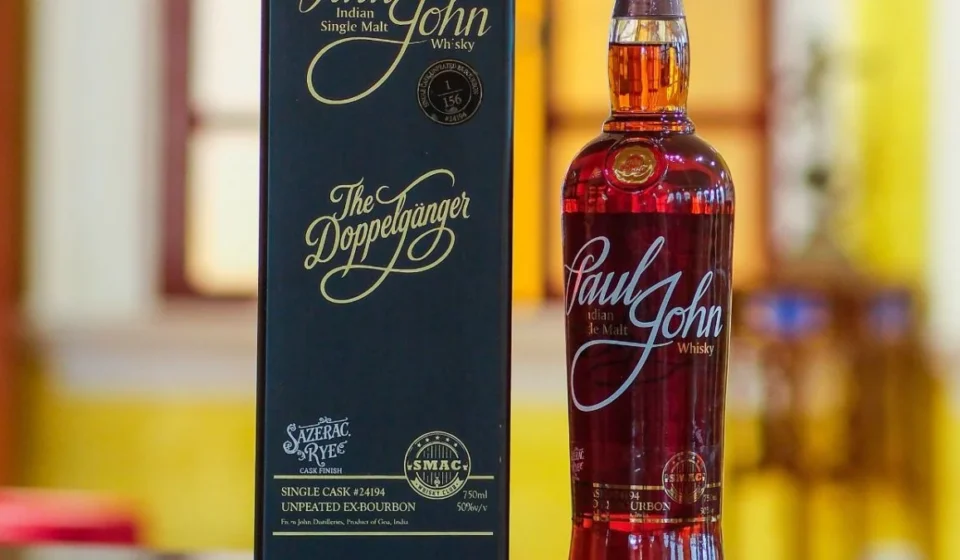
The Rise of Indian Single Malt: Paul John and SMAC Unveil the Ultra-Limited ‘Doppelgänger’ Finished in a Sazerac Rye Cask

For decades, the global appreciation of single malt whisky was dominated by a familiar geographic map: the misty highlands of Scotland, the rugged coasts of Islay, the rolling hills of Kentucky, and the craft distilleries emerging across Japan and Ireland. Today, however, that map is rapidly expanding, and no region is capturing the attention of connoisseurs quite like India.
If you are still unfamiliar with the burgeoning Indian whisky movement, now is the ideal moment to get acquainted. The American market, in particular, is experiencing an unprecedented influx of high-quality, complex expressions from the subcontinent. The latest entry into this thrilling landscape is an exceptionally rare, highly anticipated single-cask release from Goa’s renowned Paul John distillery: the Doppelgänger.
Created in partnership with the Single Malt Amateur Club (SMAC) India, this ultra-limited expression represents a fascinating cross-cultural bridge. It combines the explosive, tropical maturation profile of Indian single malt with the spicy, robust American oak heritage of a premier Sazerac Rye barrel—sourced directly from the legendary Buffalo Trace distillery in Kentucky.
Main Facts: The Anatomy of a Rare Collaboration
At its core, the Doppelgänger is a testament to modern global partnerships in the spirits industry. Distilled, matured, and bottled by John Distilleries in the sun-drenched coastal state of Goa, India, this release is defined by several extraordinary specifications:
- The Expression: The Doppelgänger (Single Cask #24194)
- The Producer: Paul John (John Distilleries)
- The Collaborator: Single Malt Amateur Club (SMAC) India
- The Cask Heritage: A single American white oak barrel previously used to mature Sazerac Rye whiskey at the Buffalo Trace distillery in Frankfort, Kentucky.
- Maturation Period: Nearly nine years—an exceptionally long aging process given Goa’s intense tropical climate.
- Total Yield: A microscopic allocation of just 156 bottles.
- Pricing & Availability: Priced at approximately Rs. 8,200 (roughly $85 USD), the expression is currently rolling out in select regions of India and is accessible to global members of the SMAC network.
Despite the relative novelty of finishing Indian single malt in Sazerac Rye casks, the underlying corporate connection provides a logical foundation. Sazerac Company, the parent organization of Buffalo Trace, holds a majority stake in Paul John, allowing for innovative, cross-continental barrel-sharing initiatives that few other distilleries can replicate.
Chronology: From Goa’s Shores to Kentucky’s Cooperage
To truly understand the magnitude of the Doppelgänger, it is necessary to trace the timeline of Paul John’s ascendance and its ongoing partnership with India’s most influential whisky collective.
2008–2012: Laying the Foundations in Goa
John Distilleries, founded by entrepreneur Paul John, officially entered the single malt arena in 2008. While the company had long established its footprint in the Indian mass-market blended whisky sector, the vision for Paul John was distinct: to craft a world-class single malt capable of competing with established Scottish powerhouses.
Because Goa sits in a tropical coastal environment characterized by high heat and humidity, the distillery faced a unique challenge. In Scotland, single malt matures at a slow, measured pace, often taking 12 to 18 years to reach maturity. In Goa, however, the intense climate causes the liquid to expand and contract aggressively within the oak barrels. The interaction between wood and spirit is amplified exponentially—by some estimates, up to three times as fast as in traditional European climates. Consequently, Paul John released its inaugural single malt expression in 2012 to widespread critical acclaim, proving that youth in a tropical climate does not equate to a lack of complexity.
2020: The Birth of the SMAC Collaboration
As the Indian single malt community expanded, digital and community-driven platforms began shaping consumer tastes. Founded by Hemanth A. Rao, the Single Malt Amateur Club (SMAC) India quickly grew into the nation’s premier authority on fine spirits. In 2020, SMAC and Paul John forged a strategic partnership designed to hand-select exclusive, single-cask expressions for discerning enthusiasts.
2024–2025: The Genesis of the Doppelgänger
Over the course of their ongoing collaboration, SMAC and Paul John have released several distinct single casks. However, the selection of Cask #24194 marked a significant milestone. It represents the first time a Paul John malt has been married to an American white oak Sazerac Rye cask from Buffalo Trace. Furthermore, the spirit’s nearly nine-year maturation period pushed the boundaries of what is typically expected from tropical aging, testing the limits of how much oak influence a single cask can impart without overwhelming the distillate.
Supporting Data: The Economics and Science of Tropical Maturation
The release of the Doppelgänger highlights several fascinating data points regarding modern whisky production, geographical maturation rates, and collector economics.
The Mathematics of Angel’s Share and Wood Interaction
In the spirits industry, the "angel’s share"—the percentage of alcohol and water that evaporates through the oak barrels during aging—is a critical metric. In Scotland, this loss hovers around 2% per year. In Goa, however, annual evaporation rates can surge past 10% to 12%.
This extreme loss means that letting a single cask mature for nearly nine years in India is a high-stakes gamble for the distillery. A massive portion of the original liquid evaporates, concentrating the remaining spirit and drawing intense flavors from the wood. For a barrel to survive nine years in this climate without becoming overly woody or bitter requires immaculate barrel selection and constant monitoring by the master distiller.
The Secondary Maturation Anomaly
While secondary maturations (finishing a whisky in port, sherry, or wine casks) are common in the Scotch whisky industry, finishing an Indian single malt in a high-proof American rye whiskey barrel is a comparative rarity. Sazerac Rye, produced by Buffalo Trace, is famous for its spicy, herbal profile, derived from a high-rye mash bill. Introducing this specific wood profile to a rich, tropical Indian malt creates a chemical dialogue between sweet, buttery malt notes and assertive, peppery rye spices.

Micro-Allocations and Market Value
With only 156 bottles produced, the Doppelgänger is fundamentally a collector’s item. At roughly $85 USD (Rs. 8,200), the pricing is remarkably accessible for a rare, near-decade-old single cask, reflecting Paul John’s commitment to keeping its domestic and club-allocated releases within reach of true enthusiasts rather than purely speculative investors.
Official Responses: Behind the Blind Selection
One of the most compelling aspects of the Doppelgänger’s creation was the entirely blind nature of its selection process. In an industry where flashy marketing, age statements, and prestigious cask pedigrees frequently influence buyers, the members of SMAC were forced to rely solely on their palates.
Hemanth A. Rao, founder of SMAC India, recounted the selection process in an official statement:
"For us, the most exciting part is that members chose the whisky before they knew anything about it. There was no age, cask, or identity to influence the room—only the liquid. What came afterwards made that choice even more fascinating."
Rao elaborated on the historical significance of the barrel type for their ongoing collaborative project:
"This is a nearly nine-year-old single cask, and for the first time in our collaboration with Paul John, we are seeing what an American white oak Sazerac Rye cask can do to a mature Indian malt."
Because the tasting panel evaluated the liquid without knowing its provenance, they were genuinely surprised by its flavor profile. Rao noted that the members initially assumed the whisky had been aged or finished in a traditional sherry cask due to its rich, dark fruit and sweet aromatic notes. When it was revealed that the cask was actually a former Sazerac Rye barrel, the club realized the liquid had completely challenged their assumptions about American oak finishes, prompting the tongue-in-cheek moniker: the Doppelgänger.
Although critics and the general public have had limited opportunities to sample this ultra-exclusive bottling, early tasting notes provided by Rao outline a remarkably complex sensory profile:
- Palate: Beyond the expected signature rye spice, tasters will find rich layers of dried fruit, pungent licorice, warming cinnamon, dark chocolate, creamy vanilla, and caramelized brown sugar.
- Nose & Finish: A harmonious balance between the robust, earthy grain characteristics of Paul John’s unpeated malt and the sweet, medicinal, and spicy residual sugars left behind by Buffalo Trace’s legendary rye whiskey.
Implications: What the Doppelgänger Means for the Future of Global Whisky
The arrival of the Doppelgänger is far more than a blip on the radar for eccentric collectors; it signals broader, structural shifts in the global spirits landscape.
1. The Blurring of Geographic and Cultural Boundaries
For generations, whisky categories were rigidly defined by geography: Scotch had to be made in Scotland, Bourbon in America, and single malt was culturally synonymous with the British Isles. Today, non-traditional whisky-producing nations—including India, Taiwan, Australia, and Sweden—are dismantling those boundaries. By taking an Indian single malt and marrying it with a Kentucky rye cask owned by a global parent company, the Doppelgänger embodies the modern, borderless reality of craft distillation.
2. The Elevation of Indian Single Malt as a Luxury Asset
As distilleries like Paul John, Amrut, and Rampur continue to rack up international awards, international perception is shifting. No longer viewed as an exotic novelty or a budget-friendly alternative to Scotch, Indian single malt is increasingly recognized as a premium, high-craft category capable of standing shoulder-to-shoulder with the finest offerings from Speyside or Islay. Releases like the Doppelgänger prove that Indian distilleries are willing to experiment with rare cask types that even legacy Scottish brands might hesitate to touch.
3. The Power of Consumer Clubs in Shaping Cask Programs
The deep collaboration between Paul John and SMAC India underscores a growing trend in the spirits industry: the democratization of cask selection. Rather than leaving product development entirely to corporate boards or traditional master blenders, forward-thinking distilleries are opening their warehouses to organized enthusiast communities. This direct-to-club model ensures that experimental releases align with the evolving palates of hyper-engaged consumers, fostering brand loyalty and creating immediate secondary market demand.
Final Thoughts
As the global whisky enthusiast looks toward the horizon, the conversation is no longer about where a great single malt is made, but how it is crafted. With only 156 bottles in existence, the Doppelgänger will likely remain an elusive unicorn for most American drinkers. However, its existence serves as a bold declaration of intent: Indian single malt has arrived, and it is ready to rewrite the rules of wood, climate, and taste.