The Ghost of the Principality: Inside the Astonishing History and Rare Auction of the 1990 Monte Carlo Automotive Centenaire

In the hyper-exclusive echelon of exotic supercars, extreme rarity is practically a baseline requirement. Yet, beyond the limited-run production numbers of Ferrari, Lamborghini, or Bugatti lies a shadow-world of ultra-obscure boutique manufacturers whose creations barely crossed the threshold from ambitious dreams into tangible reality.
Enter the Centenaire by Monte Carlo Automotive (MCA)—a machine that sits at the absolute pinnacle of both rarity and obscurity. Built between 1990 and 1992, this low-slung, Lamborghini V-12-powered coupe was manufactured by the Principality of Monaco’s first and only homegrown automobile manufacturer. Production was capped at a minuscule 16 examples.
Now, automotive history is about to unearth one of its best-kept secrets. The second of only five original MCA Centenaire prototypes ever constructed—resplendent in its original Ivory White over a striking, diamond-quilted red leather interior representing Monaco’s national colors—is heading to the auction block. Slated for Broad Arrow Auctions’ second annual Zoute Concours Auction in Knokke-Heist, Belgium, this rolling piece of motorsport folklore is expected to fetch between $1 million and $1.35 million.
For elite collectors hunting the automotive Holy Grail, this sale represents a once-in-a-lifetime opportunity to acquire a pioneering vehicle that even the most seasoned connoisseurs may have never seen in the metal.

Main Facts: The Anatomy of a Monégasque Unicorn
To understand the MCA Centenaire, one must first appreciate the audacious ambition required to build a supercar in a nation measuring less than one square mile. Founded in 1985 by Fulvio Maria Ballabio—a former Formula 2 and Le Mans racing driver—Monte Carlo Automotive was conceived to place Monaco firmly on the global manufacturing map.
The debut of the Centenaire was intentionally timed to coincide with the 100th anniversary of the Automobile Club de Monaco, the legendary organizing body behind the Monaco Grand Prix. From its inception, the project enjoyed the enthusiastic, high-level backing of a young Prince Albert II, who envisioned the coupe as the ultimate proud symbol of Monégasque engineering prowess.
Despite its diminutive birthplace, the Centenaire packed serious mechanical heavy metal. Ballabio assembled an absolute dream team of Italian motorsport royalty to bring the car to life:
- Carlo Chiti: Serving as technical director, Chiti brought an legendary resume that included designing the iconic Ferrari 156 "Sharknose" Formula 1 car.
- Pierluigi Corbari: The former sporting director of Alfa Romeo lent his vast organizational and operational expertise.
- Guglielmo Bellasi: A former Formula 1 driver, constructor, and carbon-composite pioneer who helped spearhead the vehicle’s lightweight construction.
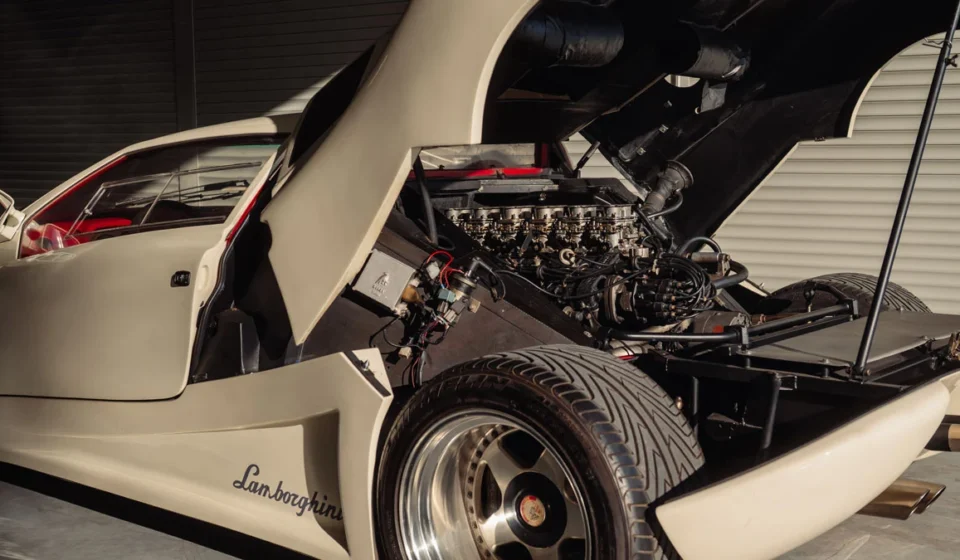
Together, this formidable alliance spent nearly half a decade developing a revolutionary lightweight carbon-fiber monocoque chassis. Wedged amid this cutting-edge framework sat a thunderous, Lamborghini-sourced 5.2-liter V-12 engine, identical to the powerplant utilized in the ferocious Countach 5000 QV. Pumping out 455 horsepower and mated to a ZF six-speed manual gearbox via a long, polished aluminum shifter, the Centenaire offered performance that matched its aggressive, avant-garde aesthetic.

Chronology: From Princely Ambitions to Museum Vaults
The life story of the specific prototype heading to Broad Arrow Auctions reads like a cinematic thriller, spanning development grounds, Italian museums, French restoration shops, and private collections.
1985–1990: Genesis and Debut
Fulvio Maria Ballabio and his team spent five grueling years engineering the Centenaire. When it finally debuted in May 1990, it achieved a monumental engineering milestone: it became the world’s first supercar to feature a carbon-composite chassis. It proudly beat out the Jaguar XJR-15 road-going racer (which debuted in November 1990) and the legendary McLaren F1, which did not break cover until May 1992.
1990–1992: Testing and Global Showcase
The Ivory White prototype crossing the auction block was retained by the factory as the primary development, testing, and auto-show car. It served as MCA’s ambassador to the world during its brief operational window. However, external economic forces spelled doom for the boutique firm. The early 1990s marked a catastrophic collapse in the global supercar market, forcing Monte Carlo Automotive to shutter its production doors by 1992 after completing only a fraction of its planned run.
1992–2000s: The Sant’Agata Exile
Following the cessation of production, this historic prototype was dispatched to the official Lamborghini Museum in Sant’Agata Bolognese, Italy, in 1992. It remained safely tucked away within the museum’s hallowed halls for a decade. In the early 2000s, Ballabio retrieved the car. Around 2007, he commissioned a repaint in a rich Alpine blue and proudly displayed it at the prestigious Rétromobile classic car show in Paris.

2014–Present: Restoration and Return to Form
In 2014, Ballabio parted with the prototype, selling it to its current custodians—the Cannes-based exotic-car specialists Autodrome, owned by renowned Lamborghini collectors Claude, Michel, and Neldo Levy. Recognizing the car’s historical significance, the vehicle was sent in 2016 to legendary Parisian coachbuilder Établissements Lecoq. There, it was painstakingly restored to its factory-correct specifications, receiving a fresh coat of its original Ivory White paint and a meticulous restoration of its striking red leather interior.
Supporting Data: Specifications and Provenance
For the analytical collector, the MCA Centenaire prototype offers a treasure trove of documented history and impressive technical metrics:
- Chassis & Body: Carbon-composite monocoque chassis paired with polarizing, wind-tunnel-informed styling penned by Ballabio. Features a bulbous rear end, high-mounted wing, stubby nose, and split-rim polished-aluminum OZ Racing wheels.
- Dimensions: Approximately 158 inches in length and 79 inches in width—making it roughly seven inches shorter and an inch wider than a Lamborghini Countach.
- Engine: 5.2-liter naturally aspirated V-12 (sourced from Lamborghini), generating 455 horsepower.
- Transmission: ZF six-speed manual gearbox operated via an exposed, polished-aluminum gate.
- Interior: A low-roof cockpit blanketed in bright red diamond-quilted leather, tight-fitting bucket seats, racing harnesses, a Momo steering wheel, drilled-aluminum pedals, and Lamborghini-supplied Jaeger dials (including a 200-mph speedometer).
- Mileage: Under 1,600 kilometers (less than 994 miles) recorded on the odometer.
- Documentation: Accompanied by an exhaustive history file containing original MCA correspondence, period photographs of the car inside the Lamborghini factory and at Rétromobile, and—most crucially—a signed copy of the original engine-supply contract between Ballabio and Lamborghini.
Official Responses and Expert Perspectives
The rarity and cultural footprint of the MCA Centenaire have generated significant buzz among top-tier auction specialists ahead of the upcoming sale in Belgium.
Jean-Louis Baldanza, consignment consultant for Broad Arrow Auctions, emphasized the sheer exclusivity of bringing such an under-the-radar masterpiece to the open market.

“In the global car-collecting hobby, it is becoming exceedingly rare to bring a car to market that is truly unknown to even the most discerning collector,” Baldanza told Robb Report. “The MCA Centenaire is such a car, exceptionally rare, yet so influential in the history of supercar development.”
Baldanza further elaborated on the vehicle’s unique dual identity as both a technical pioneer and a golden ticket to the world’s most elite automotive gatherings.
“This wild and pioneering car will appeal to any collector of the rarest of rare supercars,” Baldanza added. “And with it will come a sure ticket to any renowned concours event, from Pebble Beach to Villa d’Este.”
Implications: A Milestone for the Alternate Supercar Market
The upcoming sale of this 1990 MCA Centenaire prototype carries significant implications for the upper echelons of the vintage car market. For decades, traditional blue-chip collecting has centered heavily on mainstream Italian and German royalty—Ferrari 250s, Porsche 911 variants, and Lamborghini Miuras.

However, a noticeable shift is underway. Modern classic collectors are increasingly casting their nets wider, searching for "unicorn" boutique hypercars from the late 20th century. Vehicles that dared to challenge the established order—despite financial collapse or commercial obscurity—are undergoing a massive reassessment.
Because this specific chassis represents the dawn of carbon-composite supercar construction, paired with a documented provenance linking Monaco, Lamborghini, and Parisian coachbuilding, its performance under the hammer will serve as an essential litmus test. If it achieves or surpasses its $1.35 million high estimate, it will signal a permanent elevation in market status for independent, low-volume visionaries of the analog supercar era.
When the hammer drops in Knokke-Heist, the lucky winning bidder will not merely be purchasing a vintage automobile; they will be taking custodianship of an irreplaceable chapter of Monégasque heritage—a wild, carbon-tubbed monument to an era when anything seemed possible in the world of high-performance engineering.
Related posts: