
In the rapidly expanding urban landscape of Charlotte, North Carolina, where glass-and-steel high-rises often dictate the aesthetic rhythm, a new culinary destination is challenging the status quo. Napa Bistro and Wine Bar Stonecrest has emerged not merely as a place to dine, but as a masterclass in adaptive reuse and thematic storytelling. Designed by the multidisciplinary studio FictionWorks, with architecture by In Situ Studio, the restaurant serves as a love letter to the 1976 "Judgment of Paris"—the legendary wine tasting that shattered the myth of French viticultural superiority and elevated California’s Napa Valley to the world stage.
The Genesis of a New Chapter
The project represents a significant departure from the typical "turnkey" restaurant renovation. Taking over the shell of a former taco establishment, the design team faced a daunting structural challenge: how to convert a flat, utilitarian open-plan space into an intimate, layered, and sophisticated environment that honors the rustic charm of a farmhouse while maintaining the sharp, polished edge of a Parisian bistro.

The result is a 6,500-square-foot sensory journey. By strategically prioritizing "high-impact" design investments, FictionWorks—led by co-founders Andrea De Camps and Olivia King—has managed to synthesize a narrative of discovery, history, and craftsmanship that feels both established and refreshingly modern.
Chronology: From Taco Shell to Wine Sanctuary
The transformation of the space was a high-stakes race against time, completed in under nine months. This aggressive timeline required a rigid hierarchy of design interventions.

- Phase 1: Structural Reimagining (Months 1-3): Working with In Situ Studio, the team broke the monotonous floor plan into a series of interconnected "rooms." By creating varied volumes and sightlines, they moved away from the "big room" feel, instead fostering the intimacy necessary for a wine-centric venue.
- Phase 2: Technical Integration (Months 3-5): To address the acoustic pitfalls of high-ceilinged dining rooms, the team installed a custom curved, vaulted ceiling system by Baswa Acoustics. This was not merely an aesthetic choice; it was a functional necessity to dampen the clamor of a busy dining room, allowing the "spatial rhythm" to be felt rather than just heard.
- Phase 3: The Curatorial Finish (Months 5-8): The final months were dedicated to the "high-impact" details: custom stained glass, bespoke lighting fixtures, and carefully sourced millwork. The team utilized a "smart budget" approach, choosing to invest heavily in elements that command immediate visual attention while remaining pragmatic with secondary features like tabletops and off-the-shelf mosaic floorings.
Supporting Data and Design Philosophy
The aesthetic DNA of Napa Bistro and Wine Bar is rooted in a deliberate color palette and material selection. To evoke the spirit of the 1976 Paris Wine Tasting, the designers looked to the verdant hues of the valley and the warmth of mid-century aesthetics.
Materiality and Texture
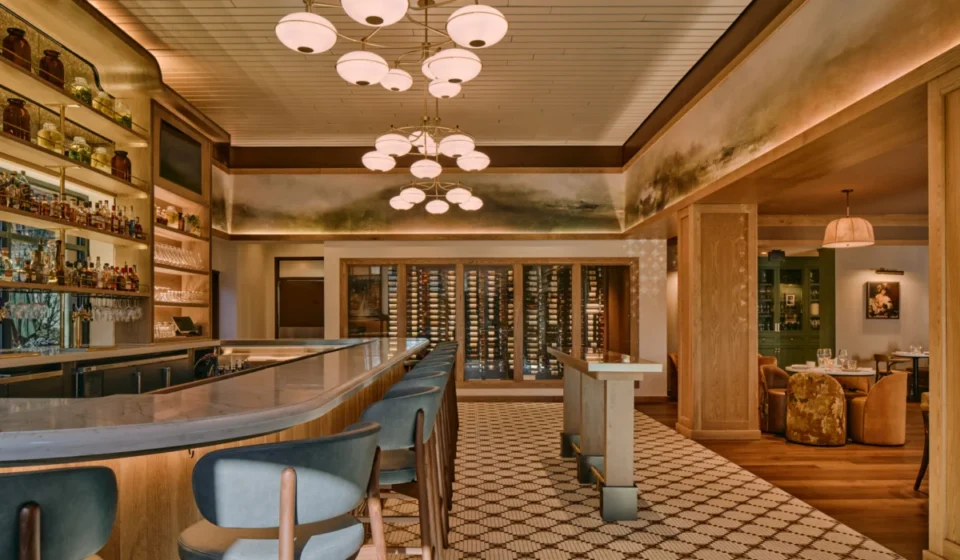
- The Floor: The restaurant utilizes classic black-and-white tiles from Daltile’s Keystone collection. This choice grounds the space, providing a sharp, geometric contrast to the more organic textures found elsewhere in the building.
- The Light: Lighting acts as the primary tool for emotional regulation. The mix of linen pendant fixtures and custom sculptural chandeliers allows the staff to transition the space from a bright, breezy lunch atmosphere to an intimate, moody environment suited for evening wine service.
- The Focal Point: The most striking feature is the custom stained-glass installation crafted from hand-blown rondels. Designed to mirror the shape of a wine bottle’s "punt" (the indentation at the bottom of a bottle), the installation serves as an homage to the glasswork common in 1970s design.
Official Perspectives: The Philosophy of FrictionWorks
The co-founders of FictionWorks, Andrea De Camps and Olivia King, emphasize that their design process is never just about the visual—it is about the "sense of occasion."

"The goal was to create a restaurant that feels approachable enough for a casual weeknight dinner while offering the sense of occasion people look for when celebrating a great meal and a bottle of wine," say De Camps and King. They further explain that their budgeting strategy was a deliberate exercise in storytelling: "We put the money into the details that would really make an impact—the stained-glass installation, custom lighting, and millwork—and we stayed more practical with the secondary elements, like the tabletops, mosaic flooring, thrifted artwork, and accessories."
This hierarchical approach ensured that the budget was never squandered, but rather channeled into the elements that visitors would touch, notice, and remember.

The Cultural Implications of the Design
The success of Napa Bistro and Wine Bar lies in its ability to bridge the gap between two worlds: the local Charlotte community and the global history of wine. By integrating photography and digital artwork by California artist Julia Crane with works by local Charlotte creatives, the designers have created a "trans-regional" identity.
Challenging Expectations
The restaurant functions as a physical metaphor for the very event that inspired it. Just as the 1976 tasting challenged the world’s perception of what wine could be, this design challenges the common perception of what a suburban restaurant space can achieve.

The "transformation" mentioned by the design team is not about nostalgia or recreating a specific historical set piece; rather, it is about honoring the spirit of transformation. By layering textures—worn leather upholstery, cool marble bar tops, and deep green accents—the designers have ensured that the restaurant does not feel like a museum piece, but a living, breathing social hub.
Conclusion: A New Standard for Hospitality Design
As Charlotte continues to grow, the demand for spaces that offer more than just a meal will increase. Napa Bistro and Wine Bar Stonecrest proves that with a clear vision, a rigorous design hierarchy, and a commitment to material storytelling, a previously unremarkable building can be transformed into a landmark.

Through the lens of FictionWorks and In Situ Studio, the space succeeds because it refuses to be one-dimensional. It is a confluence of a French bistro’s elegance, a Napa farmhouse’s warmth, and the grit of 1970s design innovation. For the patron, the result is a rare level of immersion where the architecture, the lighting, and the art collectively elevate the act of drinking a glass of wine into a historical experience.
In a city that is constantly redefining its skyline, this restaurant serves as a poignant reminder that true innovation often lies not in building something new from scratch, but in the intentional, thoughtful reimagining of what is already there.

Reporting by Malia Agostinelli. This article explores the intersection of design, architecture, and the hospitality industry. For more insights on the built environment and design narratives, follow the author’s work via her Substack, Collected Elsewhere.