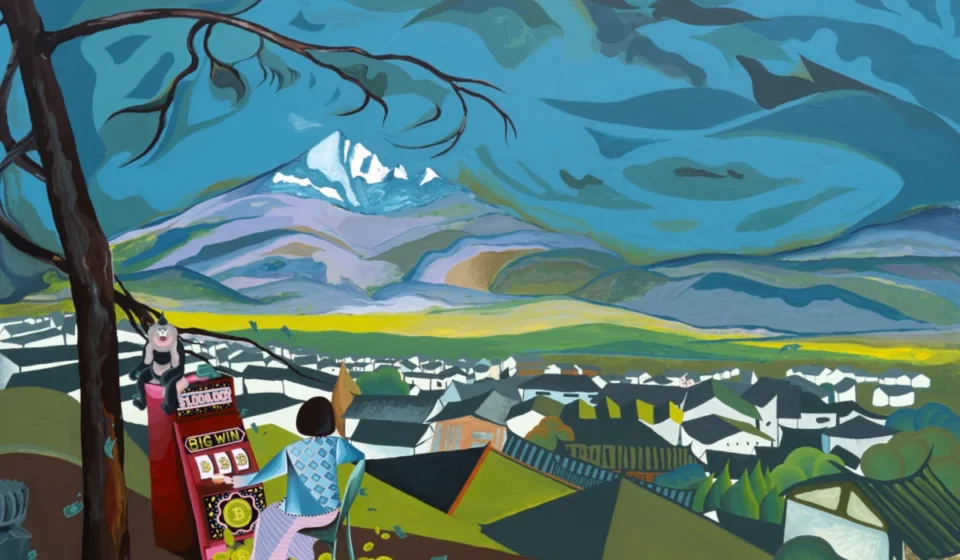

In the high-stakes, hyper-rational world of finance, where every microsecond is measured in capital and every trend is scrutinized for statistical significance, Grace Zhang occupies a unique space. A San Francisco-based professional, Zhang navigates a dual reality: by day, she engages with the complex, volatile machinery of global markets; by night, she translates that very complexity into the fluid, evocative visual language of fine art. Her latest exhibition, Spacetime Monologue, currently on view at the GCS Agency gallery in San Francisco, serves as a bridge between these two spheres, offering a profound meditation on the patterns that govern both our balance sheets and our existence.
The Intersection of Two Worlds
To the casual observer, finance and fine art are diametrically opposed. One is grounded in the hard metrics of profit, risk, and structural logic; the other is the realm of subjectivity, emotion, and aesthetic inquiry. For Zhang, a graduate of Columbia University’s prestigious international affairs program, these fields are not merely compatible—they are mirror images.
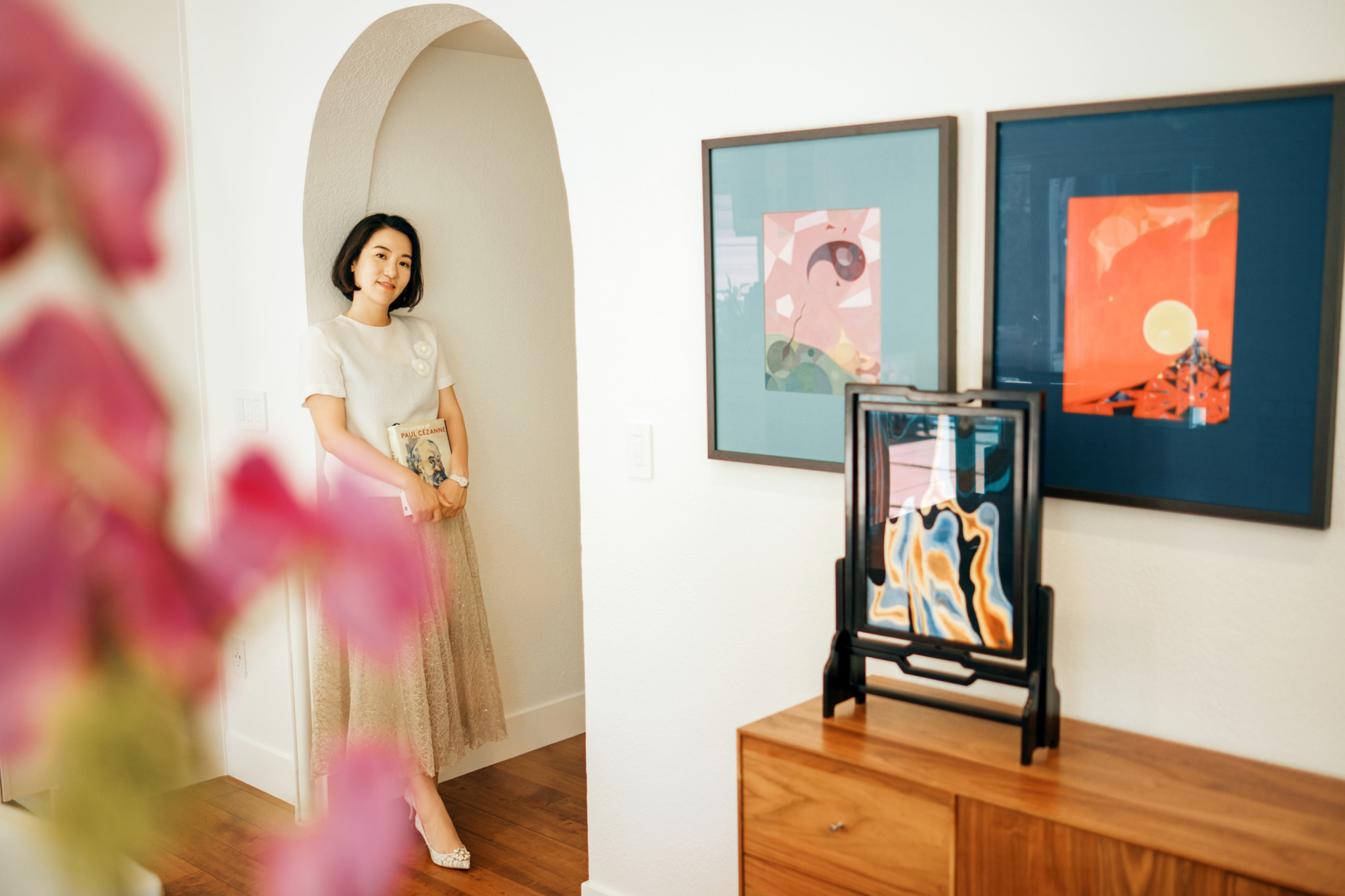
"I am constantly moving between these two worlds," Zhang explains. "They may seem completely different, but both are fundamentally about looking for patterns, understanding cycles, and making sense of what can initially feel like chaos."
This analytical approach to creativity is perhaps best exemplified by her admiration for the structural precision of Paul Cézanne. Much like the Post-Impressionist master who reduced nature to its fundamental geometric forms, Zhang employs a rigorous methodology to decompose the "noise" of modern life. Her art acts as a necessary counterpoint to the relentless intensity of the trading floor, a deliberate shift from the external pressures of the market to the internal landscape of the psyche.

Chronology of an Artistic Evolution
The genesis of Spacetime Monologue is not the result of a single epiphany, but rather the culmination of years spent observing the intersections of disparate fields.
- Formative Years: Zhang’s early intellectual development at Columbia provided a foundation in global systems, which she would later apply to her interest in Buddhist philosophy and art history.
- The Market Connection: Her professional career in finance introduced her to the Elliott Wave Theory—a technical analysis technique that maps market movements to the ebb and flow of collective human psychology. This became a foundational element of her artistic process.
- Travel and Observation: Extensive world travels, including a pivotal visit to Lijiang, China, shifted her focus toward the landscape, where the jagged silhouettes of mountain ranges began to appear as market charts rendered by nature.
- The Exhibition Milestone: Spacetime Monologue, her first major public exhibition, showcases 32 distinct works that synthesize these experiences, ranging from haute couture-inspired portraiture to abstract cosmic studies.
Supporting Data: The Language of Dots and Waves
Central to Zhang’s visual vocabulary are the "dot-and-wave" motifs. These are not merely decorative; they are symbolic representations of physical and metaphysical truths.

In her painting Quantum Whisper, Zhang confronts the duality of light—a phenomenon that behaves as both a wave and a particle depending on the act of observation. By applying this scientific principle to the canvas, she invites the viewer to consider the observer effect: the idea that the way we interact with the world fundamentally alters our perception of it.
Furthermore, in Jade Hash, Zhang maps the rugged ridgelines of the Jade Dragon Mountain against the volatile rhythms of cryptocurrency and debt markets. By superimposing the "peaks and troughs" of financial data onto the permanent, stoic forms of the earth, she creates a visual shorthand for the human desire to impose order upon a chaotic, shifting reality.

The Influence of Music
Beyond the visual arts, Zhang cites the profound influence of classical music—specifically Johann Sebastian Bach’s Fugue No. 24 in B minor. "What I love about that piece is the balance between structure and emotion," she notes. "It is weaving together into something extraordinarily intricate yet harmonious. I’m fascinated by how something so carefully constructed can also express such profound feelings." This pursuit of harmony within complexity is the heartbeat of her entire collection.
Official Perspectives: The Philosophy of the Canvas
In discussions regarding her creative process, Zhang emphasizes that her work is not merely about representation but about discovery. "At the heart of my painting is a search for the underlying structures and principles of the universe," she states. "I embrace the complexity of lived experience: the constant flow of impressions, stories, and encounters, alongside my interests in travel, fashion, and financial markets."

Her self-portraits, which often feature elements of haute couture—specifically pieces from Chanel and Dior—serve as a vessel for these explorations. In Self Portrait I, a Chanel haute couture jacket is reinterpreted through the lens of physics; the wave-like patterns of the fabric become the waves of light, while the reflective embellishments transform into celestial bodies.
Similarly, in Self-Portrait—One Night at Dar El Bacha, she draws on her travels in Morocco to link the geometric traditions of Islamic art with the vast, cosmic questions of existence. The dark, ornate ensembles she depicts are not just fashion; they are armor and expression, bridging the gap between the individual’s daily life and the eternal night sky.

The Implications of "Spacetime Monologue"
The success and resonance of Spacetime Monologue suggest a growing appetite for interdisciplinary art—work that acknowledges the intellectual rigor of non-artistic fields. Zhang’s ability to weave together the disparate threads of haute couture, quantum physics, Buddhist theology, and financial technical analysis is a rare feat.
A New Way of Seeing
The implications for the art world are significant. As we move deeper into an era defined by data and complexity, artists like Zhang offer a path toward synthesis. Her work suggests that:

- Complexity is not to be feared: By finding the "rhythm" in market fluctuations or the "duality" in light, we can transform anxiety into curiosity.
- The personal is universal: By examining her own life through the lens of high-fashion and global travel, Zhang identifies common human themes—the search for stability, the awe of the cosmos, and the desire for beauty.
- Cross-pollination is essential: The most compelling art is often produced at the intersection of two seemingly incompatible disciplines.
Conclusion: The Quiet Transcendence
As Spacetime Monologue remains on view at the GCS Agency gallery through October 25, it stands as a testament to the idea that our professional and personal lives need not be silos. Through her meticulous application of color, form, and philosophy, Grace Zhang has created a space where the Bloomberg Terminal and the painter’s brush can exist in harmony.
Her work does not merely document the world; it attempts to decode it. In doing so, she provides the viewer with more than just a visual experience—she provides a framework for understanding the invisible, intricate patterns that define our modern existence. Whether through the rising and falling waves of a stock market chart or the ethereal, geometric precision of a Chanel silhouette, Zhang reminds us that even in the most chaotic of times, there is a profound, quiet sense of transcendence to be found if one only knows how to look.