
Beyond the Public Page: Why Corporate Event Teams Need Specialized Registration Software

NEW YORK — For corporate event professionals, the annual calendar is a high-stakes balancing act. Tasked with executing everything from high-touch executive summits and expansive sales kickoffs (SKOs) to secure internal town halls, partner conferences, and paid customer events, these teams frequently operate with lean headcount—often managing double the event volume their team size would traditionally suggest.
Yet, despite the unique and complex demands of the enterprise space, many organizations still rely on generic, public-facing event registration tools designed for consumer concerts or open-door webinars. The mismatch is glaring: a platform built for open public ticketing cannot natively gate an internal town hall to employees only, nor can it seamlessly manage a tiered, paid customer conference requiring secure, role-based single sign-on (SSO) and compliance tracking.
As organizations scale their experiential marketing and internal communication strategies, industry experts are urging a shift in how tech stacks are evaluated. This comprehensive guide explores the core challenges corporate event teams face, the structural shortcomings of generic tools, and a definitive framework for evaluating specialized enterprise registration software.
The Unique Registration Challenges Faced by Corporate Event Teams
According to industry analysts, corporate event teams encounter six fundamental hurdles that consumer-grade software simply fails to address. Without specialized infrastructure, these roadblocks result in administrative bottlenecks, fragmented data silos, and compromised attendee experiences.
1. Managing Internal and External Events Under One Roof
Corporate event managers rarely stick to a single event type. Their portfolios regularly swing between internal alignments—such as employee town halls, mandatory training programs, and leadership offsites—and external growth engines like customer conferences and partner summits.

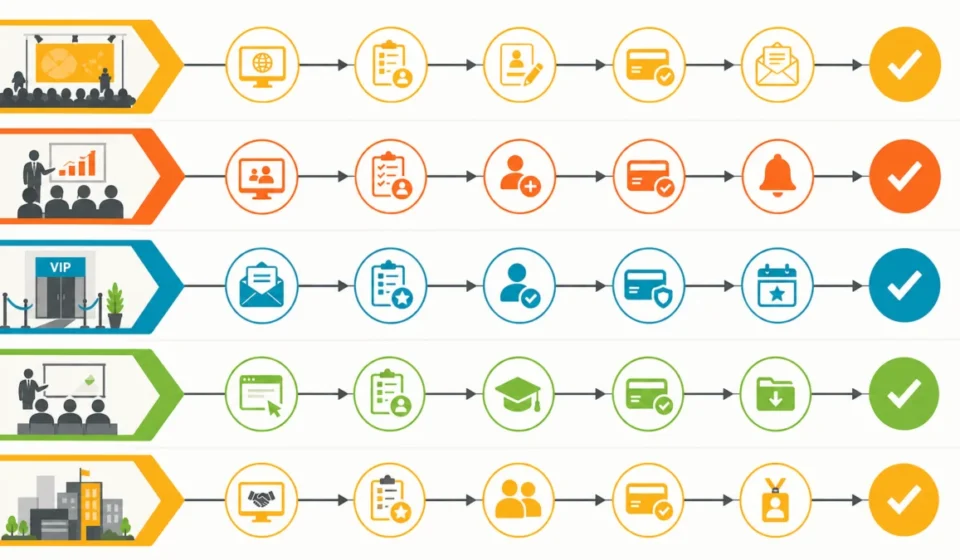
These divergent formats demand completely different toolsets. Internal gatherings require employee-only access gating, strict privacy controls, and integration with internal HR directories. Conversely, external programs require beautifully branded, public-facing registration portals, complex payment processing, and advanced marketing automation loops.
Relying on separate, siloed platforms for internal and external events creates fractured data footprints and erratic administrative workflows. Modern enterprise platforms resolve this by unifying both event archetypes into a single system, utilizing configurable access permissions. For example, domain-restricted registration—limiting sign-ups to verified company or partner email domains—allows a single form to dynamically serve internal personnel and invited external stakeholders without requiring entirely separate codebases or duplicate administrative overhead.
2. Safeguarding Brand Consistency Across Every Touchpoint
In the corporate sphere, every event is a direct reflection of the brand. According to Marq’s State of Brand Consistency report, 68% of businesses attribute 10% or more of their revenue growth directly to consistent branding.
For teams churning out multiple events annually, maintaining visual and messaging standards without reinventing the wheel for every single calendar item is a major operational requirement. Generic tools often force compromises, resulting in disparate registration landing pages that look disconnected from the corporate mother-ship. Specialized corporate platforms utilize modular event design templates and reusable asset libraries, allowing lean teams to scale production without sacrificing aesthetic integrity.
3. Navigating Multi-Tiered Stakeholder Ecosystems
Consider a mid-sized B2B customer conference: attendees, keynote speakers, global sponsors, exhibitors, media representatives, and internal staff all need to register. However, each constituency requires entirely different data points, access clearances, and pre-event communication streams.

Consumer event software typically forces organizers to spin up separate registration paths for each group. Enterprise-grade platforms solve this through flexible form architecture and conditional logic. By deploying smart "if/then" rules, a single registration form can dynamically adapt, exposing specific fields, ticket pricing, or session selections based entirely on the registrant’s recognized role or ticket tier.
4. Harmonizing With Existing Corporate Tech Stacks
Corporate event teams do not operate in a vacuum. They are deeply embedded within a broader enterprise technology ecosystem—including Customer Relationship Management (CRM) databases like Salesforce and HubSpot, marketing automation platforms, HR management systems, and internal communication suites like Slack or Microsoft Teams.
When event registration data remains trapped inside a standalone event tool, teams are forced into tedious manual data entry and reconciliation processes. Native integrations or robust API connectors (such as Zapier integrations) are no longer nice-to-have features; they are foundational requirements for enterprise programs aiming for real-time attribution and reporting.
5. Meeting Rigorous Compliance and Security Mandates
For corporations operating in heavily regulated sectors—such as financial services, healthcare, pharmaceuticals, and government contracting—data security, attendee privacy, and auditability are paramount. These organizations require strict private gating, invitation-only workflows, and customized form fields to verify professional credentials or compliance clearances.
Furthermore, corporate governance often dictates that a registration is not immediately final upon submission. An employee’s attendance may require sign-off from a department head or budget owner, or an external attendee may need vetting by a compliance officer. Enterprise registration tools handle these multi-stage approval workflows natively, eliminating the need to manage approvals via external email chains.

Security certifications are similarly non-negotiable. Leading platforms undergo rigorous SOC 2 Type II audits, provide robust data encryption at rest and in transit, support multi-factor authentication (MFA), and guarantee that clients retain absolute ownership of their proprietary data.
6. Managing High Attendee Expectations
Corporate audiences—particularly enterprise buyers and high-value partners—harbor zero tolerance for clunky, slow, or unintuitive registration interfaces. A basic, third-party form slapped onto a landing page signals a lack of polish. Attendees expect a seamless, responsive, multi-page event website featuring integrated registration, instant confirmations, and reliable, responsive support.
Essential Capabilities to Look For in Corporate Registration Software
When evaluating software vendors, buyers should look for seven core capabilities designed specifically for enterprise workflows:
- Branded Event Website Builders: Comprehensive customization over typography, color palettes, logos, and layouts, with multi-page support for agendas, speaker directories, and sponsor profiles.
- Flexible Access Controls: Granular settings that effortlessly toggle between public ticketing, private invitation-only queues, employee-only domain gating, and formal RSVP tracking.
- Smart Conditional Logic Forms: Dynamic form builders capable of surfacing or concealing fields based on user inputs, ensuring targeted data collection without workflow redundancy.
- Integrated Email Automation: Segmented communication tools that pull real-time data from registration statuses, enabling targeted messaging to incomplete registrants, VIPs, or confirmed attendees.
- Robust Payment Processing: Support for multiple global gateways (such as Stripe, PayPal Payflow Pro, Braintree, and Authorize.net) configured at the organizational level. Crucially, platforms should support group registration workflows—allowing an executive assistant to check off and invoice multiple colleagues in a single, unified transaction—without tacking on punitive per-ticket platform fees.
- Seamless Onsite and App Connectivity: Instant synchronization between web registration data, mobile event applications, digital badge printing, and onsite check-in kiosks.
- AI-Powered Attendee Support: Advanced, context-aware AI concierges that operate directly on registration portals, providing round-the-clock answers to attendee, speaker, and sponsor inquiries without requiring manual intervention or complex IT scripts.
Chronology of Evolution: From Consumer Ticketing to Enterprise Architecture
The event technology landscape has undergone a profound structural shift over the past decade:
- Phase 1: The Consumer Era (Early 2010s). Event registration was dominated by simple, public-facing ticketing utilities designed primarily for concerts, community meetups, and open-access workshops. These platforms prioritized rapid, transactional checkouts over deep data security or internal access gating.
- Phase 2: The Virtual Pivot (2020–2022). Global disruptions forced corporate teams to take all programming virtual. Event organizers rapidly adopted disparate point solutions for webinars, streaming, and registration, resulting in fragmented data ecosystems and severe administrative fatigue.
- Phase 3: The Unified Enterprise Era (Present Day). Recognizing the inefficiencies of cobbled-together tech stacks, modern corporate event teams are demanding unified platforms. The focus has shifted heavily toward enterprise-grade security (SOC 2), deep CRM integrations, AI-driven support automation, and the ability to seamlessly manage both internal town halls and external customer conferences from a single pane of glass.
Supporting Data: The ROI of Enterprise-Grade Alignment
- 68% of businesses report that maintaining strict brand consistency has directly contributed to 10% or more of their overall revenue growth (Marq State of Brand Consistency).
- Up to 30 minutes saved per attendee inquiry: Organizations utilizing AI-powered registration concierges report a dramatic reduction in pre-event helpdesk tickets, significantly lowering pre-event drop-off rates.
- Zero auxiliary transaction penalties: Enterprise buyers increasingly reject platforms that charge hidden per-ticket commissions on top of base software licensing costs, protecting profit margins on high-volume customer conferences.
Official Perspectives and Industry Implications
Industry leaders emphasize that the choice of registration software is no longer merely an operational decision—it is a strategic imperative that directly influences pipeline generation, brand perception, and employee alignment.

"Corporate event teams are asked to produce enterprise-grade results with mid-market resources," notes a leading enterprise event technologist. "Trying to force a consumer ticketing tool to manage a secure internal executive summit or a complex, multi-tiered customer conference introduces unnecessary friction, data fragmentation, and security vulnerabilities. The future belongs to unified platforms that speak the language of the enterprise."
Strategic Implications for Organizations
- Reduced Tech Stack Bloat: By consolidating internal and external events onto a single platform, organizations can decommission redundant point solutions, lowering software expenditures and streamlining vendor management.
- Enhanced Data Governance: Unified enterprise tools ensure that all attendee interactions—from internal training credits to external sales qualification data—flow cleanly into core CRMs and HRIS platforms while maintaining strict compliance with global privacy standards (GDPR, CCPA).
- Elevated Brand Equity: Providing a frictionless, highly polished, and secure registration journey reassures high-value customers, executive leadership, and strategic partners of the organization’s overall professionalism and attention to detail.
Evaluating Your Options: Critical Questions for Vendors
Before committing to a long-term software contract, corporate procurement and event teams should challenge prospective vendors with the following diagnostic questions:
- Can your platform natively handle employee-only domain-restricted gating alongside public, paid customer conference ticketing within the same account environment?
- How do you handle group registrations? Can a single administrative user check out and invoice multiple attendees in one transaction without forcing separate checkouts?
- What specific security certifications do you hold, and how do you ensure compliance with corporate data retention and SOC 2 requirements?
- Do you charge an additional per-ticket or per-transaction fee on top of standard payment gateway rates and software subscription costs?
- How do your native integrations function with enterprise CRMs and marketing automation platforms like Salesforce and HubSpot?
- Can your platform support multi-stage approval workflows—such as manager or compliance sign-offs—directly inside the registration flow?
The Bottom Line
For corporate event teams, the ideal registration software is not simply the platform with the flashiest marketing features. It is the infrastructure capable of weathering the entire corporate calendar—handling secure internal town halls, high-stakes executive retreats, and massive customer conferences with equal grace. By prioritizing unified workflows, robust security, deep integrations, and operational efficiency, enterprise teams can finally break free from the limitations of consumer-grade tools and scale their programs without burning out their workforce.