Meetup Lowers the Barrier to Entry with "Meetup Starter": A New Era for Community Management

By the Tech & Community Reporting Desk
Published October 11, 2024
Main Facts
In a strategic move designed to democratize community building and lower the barriers to entry for aspiring group leaders, the global event platform Meetup has officially introduced Meetup Starter. This newly unveiled, free-tier subscription model provides first-time and prospective organizers with a lightweight, risk-free environment to test the waters of digital community management.
For years, the financial commitment required to launch and maintain a group on Meetup has stood as a hurdle for hobbyists, niche enthusiasts, and civic-minded individuals who wanted to test a concept before investing capital. Meetup Starter directly addresses this friction point. By offering a curated sampling of the platform’s core benefits at zero cost, the company is aiming to remove financial hesitation and invite a broader demographic of leaders into its ecosystem.
At its core, Meetup Starter is positioned as a stepping stone. It strips away complex, enterprise-level features to focus strictly on the essentials of event management and member engagement. Conversely, the platform’s traditional workhorse offering, Meetup Standard, remains the flagship choice for established organizers, allowing them to oversee up to three distinct groups and host an unlimited monthly calendar of events. For enterprise-level needs, Meetup Pro continues to serve large-scale organizations, brands, and multi-chapter communities seeking advanced analytics, centralized billing, and custom branding.
The overarching goal of the rollout is straightforward yet ambitious: by making it easier than ever to start a group, Meetup hopes to diversify its global directory, injecting fresh, grassroots energy into local communities worldwide.
Chronology: The Evolution of Meetup’s Pricing and Hosting Tiers
To understand the significance of the Meetup Starter launch, it is vital to examine how the platform has evolved its monetization and organizer strategies over the years.
The Early Era: Flat Fees and Attendee Paywalls
In its initial decades, Meetup’s economic model relied almost entirely on charging the organizer a recurring monthly subscription fee to keep their group active. This created a high-pressure environment for new community leaders, who often had to pay out-of-pocket before they even secured their first registered member. While some organizers experimented with collection tools or dues, the burden of platform costs regularly choked out nascent, highly specialized hobby groups before they could gain traction.
The Shift Toward Tiered Flexibility
As competition in the community-building space intensified—with platforms like Eventbrite, Facebook Groups, Discord, and specialized local apps offering alternative ways to gather—Meetup recognized the need to modernize. The company gradually introduced tiered options, separating casual community builders from power users and commercial networks.

- The Introduction of Pro: Years prior, Meetup launched its Pro tier to cater to corporate users, large non-profits, and franchises that needed to manage dozens or hundreds of sub-communities under a single administrative umbrella.
- The Standardization of Plans: Meetup eventually streamlined its offerings into clear-cut subscriptions centered on group limits and event frequencies. However, a major gap remained: there was no permanent, zero-risk trial option for someone who simply wanted to host a casual book club, a neighborhood walking group, or a localized coding study session without entering their credit card information.
The October 2024 Launch of Meetup Starter
Culminating months of platform optimization and user feedback analysis, Meetup officially rolled out the Starter tier in October 2024. Designed specifically to bridge the gap between "curious bystander" and "committed organizer," the plan formalizes a lightweight pathway into community leadership. By cleaning up the onboarding funnel and publishing detailed comparative breakdowns against the Standard and Pro tiers, Meetup has set the stage for its next phase of organic growth.
Supporting Data: Comparing Meetup Starter, Standard, and Pro
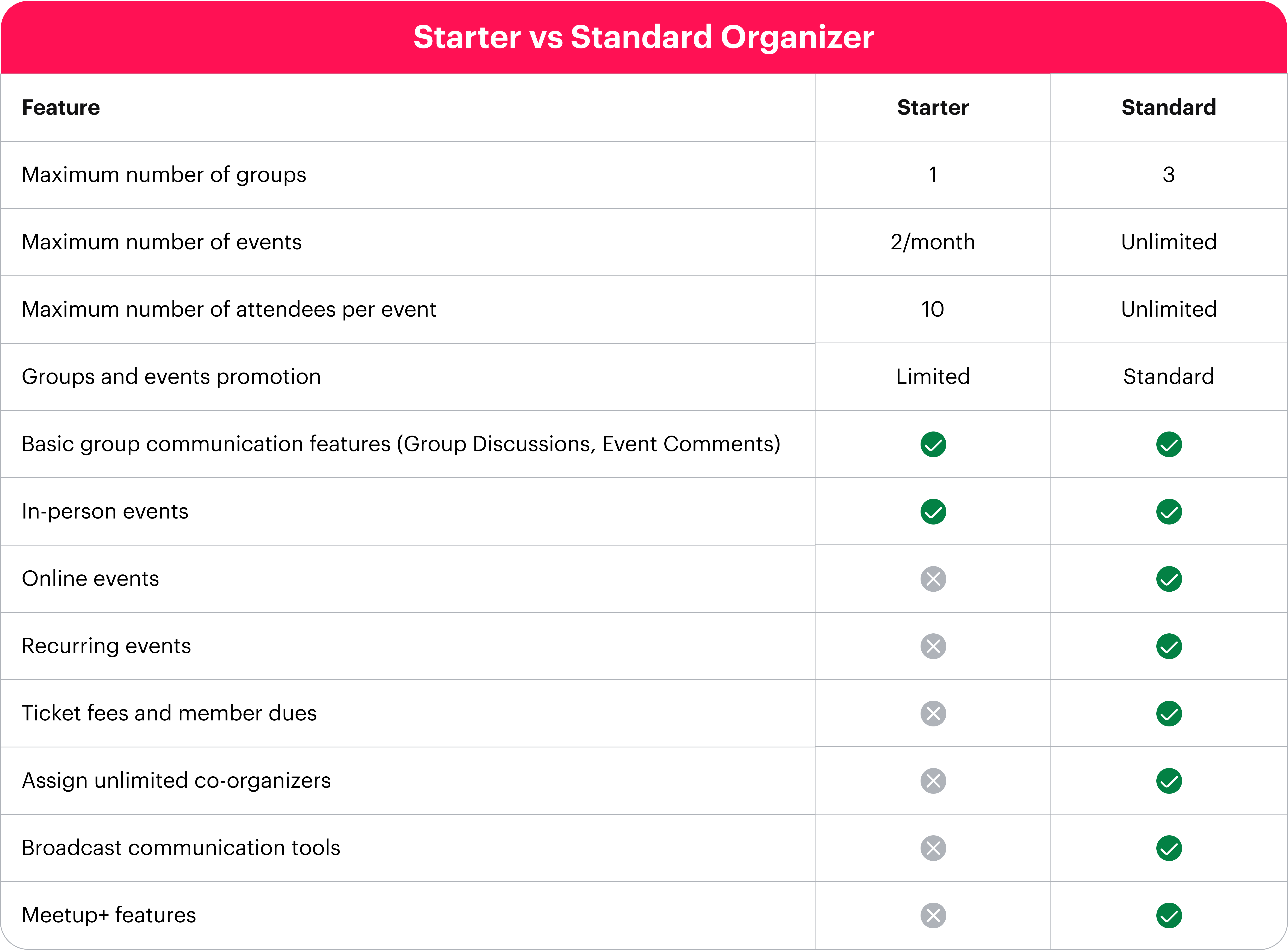
Choosing the right subscription tier is crucial for maximizing the value of the platform. Meetup’s updated ecosystem caters to three distinct user archetypes: the experimenter, the active community builder, and the enterprise network.
+------------------+-----------------------+-----------------------+-----------------------+
| Feature / Metric | Meetup Starter        | Meetup Standard       | Meetup Pro            |
+------------------+-----------------------+-----------------------+-----------------------+
| Cost             | Free                  | Standard Paid Tier    | Premium Enterprise    |
+------------------+-----------------------+-----------------------+-----------------------+
| Target Audience  | First-time organizers | Active, multi-group   | Large organizations   |
|                  | & hobbyists           | leaders               | & brands              |
+------------------+-----------------------+-----------------------+-----------------------+
| Group Limit      | Restricted / Trial    | Up to 3 distinct      | Unlimited multi-      |
|                  | Scope                 | groups                | group network         |
+------------------+-----------------------+-----------------------+-----------------------+
| Monthly Events   | Essential Sampling    | Unlimited             | Unlimited             |
+------------------+-----------------------+-----------------------+-----------------------+
| Core Benefit     | Low-friction testing  | Full management suite | Advanced analytics,   |
| Focus            | of community tools    | & flexibility         | branding & oversight  |
+------------------+-----------------------+-----------------------+-----------------------+
Deconstructing the Tiers
-
Meetup Starter (The Experimenter’s Tier):
- Financial Investment: Zero.
- Primary Function: Acts as an onboarding ramp. It introduces first-time organizers to the mechanics of group creation, member communication, and basic event publishing.
- Ideal Use Case: An individual testing out a brand-new community concept—such as a local language exchange or a weekend photography walk—who wants to gauge local interest before committing financially.
-
Meetup Standard (The Core Workhorse):
- Financial Investment: Standard monthly/annual organizer fee.
- Primary Function: Comprehensive community operations. It allows creators to scale their vision by managing up to three separate groups under one account.
- Event Capacity: Unlimited monthly events, granting total freedom to host weekly meetups, workshops, or social hours.
- Ideal Use Case: Passionate community leaders, professional networking organizers, and active hobbyist groups that hold regular, dependable gatherings.
-
Meetup Pro (The Enterprise Solution):
- Financial Investment: Custom enterprise pricing.
- Primary Function: Centralized administration for organizations running vast webs of chapters. Includes robust data analytics, custom branding, member data export capabilities, and advanced moderation tools.
- Ideal Use Case: Tech corporations, global non-profits, franchise networks, and large educational institutions.
Official Responses and Platform Philosophy
In official statements released alongside the launch, the Meetup Team emphasized that the introduction of the Starter plan is rooted in a desire to cultivate a more vibrant, inclusive digital neighborhood.
"By providing new organizers with a simplified option, we hope to make Meetup’s ecosystem richer with an ever more diverse range of organizers, groups, and events," the Meetup Team shared in their official release. "We look forward to welcoming our new Starter organizers to the Meetup community!"
Industry analysts have interpreted this move as a classic "freemium" acquisition strategy tailored specifically for the post-pandemic digital landscape. As remote and hybrid work models continue to alter how people seek out local socialization, the appetite for hyper-local, niche communities has skyrocketed. By removing the financial gatekeeper at the top of the funnel, Meetup is positioning itself to capture a massive wave of grassroots organizers who might otherwise have defaulted to free, less structured alternatives like social media groups.
Furthermore, platform leadership has noted that the Starter plan is not merely a promotional gimmick, but a functional learning environment. First-time leaders often suffer from "organizer burnout" or anxiety regarding event logistics. By wrapping essential tools into a streamlined, low-pressure package, Meetup is actively investing in the long-term success of its user base. Organizers who cut their teeth on the Starter tier are expected to graduate naturally to the Standard plan as their communities grow, thrive, and demand advanced features.
Broader Implications for the Community Management Industry
The launch of Meetup Starter carries significant implications for the broader landscape of digital platforms, event tech, and human connectivity.
1. The Democratization of Grassroots Organizing
In an era dominated by algorithmic feeds and isolating digital interactions, physical and localized digital communities are experiencing a renaissance. However, economic pressures have historically made community leadership an elite or heavily commercialized endeavor. By opening up a free tier, Meetup is signaling that starting a community should be as easy as starting a blog or a social media page. This could pave the way for a surge in hyper-niche, marginalized, and grassroots interest groups that previously lacked the budget to experiment.
2. Heightened Competition in Event Tech
Meetup’s strategic pivot puts pressure on competitors. While platforms like Eventbrite excel at ticketed one-off events, and Facebook Groups excel at passive digital discussion, Meetup has historically held a distinct advantage in recurring, relationship-driven local meetups. By lowering the entry barrier with Meetup Starter, the company is directly challenging free social platforms, enticing community organizers away from chaotic chat servers and unorganized social feeds by offering a purpose-built infrastructure for human gatherings.
3. The Future of Community Retention
The true test of Meetup Starter will lie in its conversion and retention rates. Will casual users who start free groups successfully transition into paying Standard subscribers as their communities scale? Or will the free tier satisfy casual organizers indefinitely? How Meetup balances the feature sets between Starter and Standard will dictate whether the strategy successfully drives revenue growth or simply shifts users into a perpetual free tier.
Regardless of these future economic dynamics, one thing is certain: the launch of Meetup Starter marks a welcoming milestone for the world of community management. For the aspiring organizer sitting on a brilliant idea for a local club, support group, or creative collective, the excuse of financial barrier has officially been removed. Meetup has laid out the welcome mat—now, it is up to a new generation of leaders to bring people together.