Revolutionizing Restroom Hygiene: Chicago Faucets Unveils the E-Tronic 80 SoapBank

In the evolving landscape of commercial architecture and facility management, the "touchless" revolution has transitioned from a luxury trend to a non-negotiable standard. As foot traffic in airports, corporate headquarters, hospitals, and educational institutions continues to return to pre-pandemic levels, the burden on maintenance crews to keep these spaces operational has reached a critical threshold. Addressing this logistical challenge, Chicago Faucets has officially launched the E-Tronic 80 SoapBank—a multi-feed soap dispensing system engineered to reconcile high-volume demands with the aesthetic and operational expectations of modern facility design.
Main Facts: The Engineering Behind the SoapBank
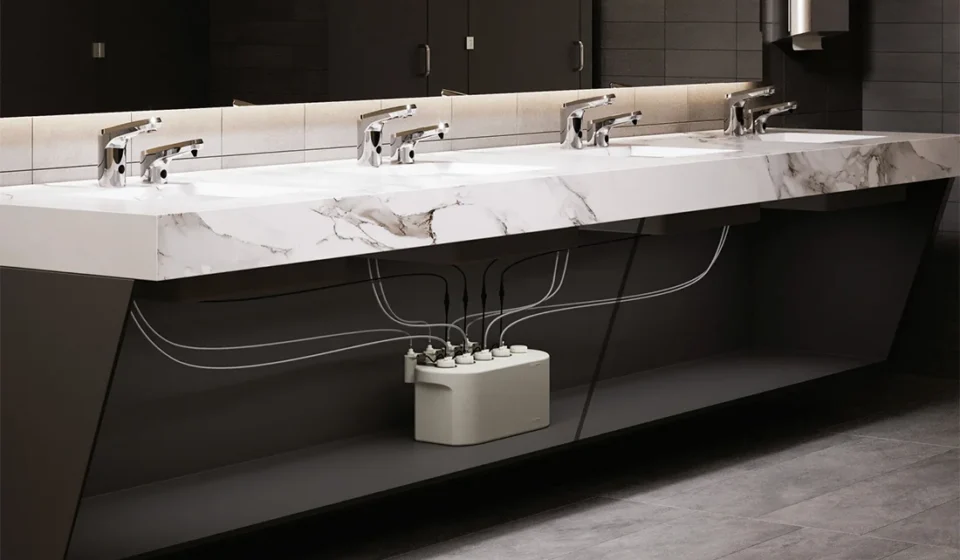
The E-Tronic 80 SoapBank is not merely a dispenser; it is a comprehensive infrastructure solution designed to mitigate the "maintenance fatigue" often associated with commercial restroom management. At its core, the system shifts the paradigm from individual, cartridge-dependent dispensers to a centralized, bulk-supply architecture.
Key Technical Specifications:
- Centralized Reservoir: A single, high-capacity soap source capable of feeding multiple dispenser heads simultaneously.
- Touchless Interface: Utilizing advanced sensor technology, the system ensures zero-contact operation, effectively reducing the transmission of pathogens—a critical requirement in healthcare and public-facing facilities.
- Scalability: The system is engineered to be modular, allowing for seamless integration into existing plumbing configurations or new construction projects.
- Sustainability Focus: By eliminating the reliance on single-use plastic cartridges, the SoapBank represents a significant reduction in the carbon footprint and waste stream of a facility.
The system is specifically tailored for architects and plumbing engineers who are tasked with balancing the competing needs of design elegance and operational efficiency. By streamlining the "behind-the-scenes" mechanics of soap delivery, the E-Tronic 80 allows for a cleaner, more minimalist visual profile above the vanity, while providing a robust, reliable supply chain below the deck.
Chronology: The Evolution of Commercial Sanitation
The trajectory leading to the development of the E-Tronic 80 mirrors the broader shifts in public health awareness and building management technology.
Pre-2020: The Era of Convenience
Before the global health crises of the early 2020s, commercial restroom design was primarily focused on cost-per-unit and ease of installation. Individual cartridge-based dispensers were the industry standard because they were cheap to procure and easy to swap out. However, this model created a "hidden cost"—the cumulative labor required to check and replace individual units across a multi-floor building.
2020–2023: The Shift Toward Touchless
The sudden mandate for hygiene-first environments forced a rapid acceleration in sensor technology. During this period, the industry saw an explosion of retrofitted touchless dispensers. While these addressed the hygiene concern, they often introduced new maintenance challenges, such as frequent battery changes and the inconsistent reliability of low-cost sensors.
2024: The Systemic Solution
Chicago Faucets identified that the industry had reached a plateau. The problem was no longer just about "touchless" technology; it was about system reliability. The E-Tronic 80 SoapBank emerged as the logical next step in this evolution: a transition from individual "point-of-use" devices to a "system-wide" infrastructure that prioritizes uptime, sustainability, and aesthetic coherence.
Supporting Data: The Economics of Maintenance
To understand why the SoapBank is being received as a breakthrough, one must look at the data surrounding labor costs in facility management. According to industry benchmarks, the largest operational expense in restroom maintenance is not the soap itself, but the labor hours required to manage inventory.
The Labor Deficit
In a standard high-traffic office building, a maintenance worker may spend hours each week traversing the facility to check levels in individual soap dispensers. If a building has 50 restroom stations, 50 manual checks are required. If 10 of those dispensers are empty, the worker must manage 10 separate cartridge replacements.
- Efficiency Gains: The E-Tronic 80’s bulk-feed system reduces these checkpoints by up to 80% in large-scale configurations. By having a centralized fill point, facility managers can implement a "just-in-time" inventory model, refilling the reservoir only when necessary, rather than reacting to the failure of individual units.
- Waste Reduction: A standard commercial cartridge is often made of non-recyclable or hard-to-recycle plastic. By moving to a bulk reservoir, facilities can purchase soap in larger containers, potentially reducing plastic waste by hundreds of pounds per year per building.
- Uptime Metrics: Reliability is the primary metric for facility managers. The E-Tronic 80 is designed to prevent the "empty dispenser" scenario, which is a primary driver of user dissatisfaction in public restrooms.
Official Responses and Industry Perspectives
The introduction of the SoapBank has been met with optimism from the design and engineering community.
"Our goal was to bridge the gap between the aesthetic vision of the architect and the reality of the maintenance crew," said a spokesperson for Chicago Faucets. "Often, these two groups are at odds. The architect wants a sleek, uncluttered vanity, while the maintenance team wants ease of access. The SoapBank provides both. It hides the mechanical clutter while providing a robust, high-volume solution that actually makes the janitorial staff’s job easier."
Plumbing engineers have noted that the system’s design simplicity—specifically its modularity—makes it an ideal candidate for LEED-certified projects. By reducing the frequency of maintenance visits, buildings can lower their operational carbon footprint, contributing to overall sustainability ratings.
Implications: The Future of Restroom Architecture
The E-Tronic 80 SoapBank represents a broader shift toward "integrated building systems." Just as modern buildings have integrated HVAC and lighting controls, the restroom is becoming a sophisticated, connected environment.
Design Cohesion
For architects, the SoapBank allows for a "clean deck" philosophy. By removing the need for individual dispensers at every sink, the vanity area becomes more hygienic and visually appealing. This is particularly important in high-end hospitality and corporate office environments, where the design of the restroom is viewed as an extension of the brand identity.
Long-Term Operational Resilience
Looking ahead, the integration of such systems will likely influence how new facilities are planned. We are moving toward a future where "hidden infrastructure"—the plumbing, electrical, and supply lines that support the fixtures—is just as important as the visible finishings. The SoapBank is a testament to the fact that high-traffic public spaces are no longer just about the user experience at the point of contact; they are about the invisible, reliable support systems that make that experience seamless.
Sustainability as a Standard
As environmental regulations tighten, businesses will be under increasing pressure to demonstrate waste reduction. The transition from individual cartridges to bulk-feed systems will likely become a requirement rather than an option. Chicago Faucets has positioned itself at the forefront of this shift, providing a roadmap for how manufacturers can balance commercial viability with the urgent need for more sustainable building practices.
Conclusion
The Chicago Faucets E-Tronic 80 SoapBank is more than just a new piece of hardware; it is a response to the systemic challenges of the 21st-century built environment. By addressing the labor, waste, and aesthetic concerns that have plagued commercial restrooms for decades, it offers a blueprint for more efficient, sustainable, and hygienic facilities.
As architects and facility managers look to the future, the emphasis will continue to move toward systems that perform better, last longer, and require less intervention. In that landscape, the SoapBank stands as a hallmark of modern engineering—a solution that recognizes that the most effective innovation is the one that allows a building to function quietly, cleanly, and reliably, day after day. For those interested in learning more about integrating this technology into their upcoming projects, full technical documentation is available via the Chicago Faucets website.