
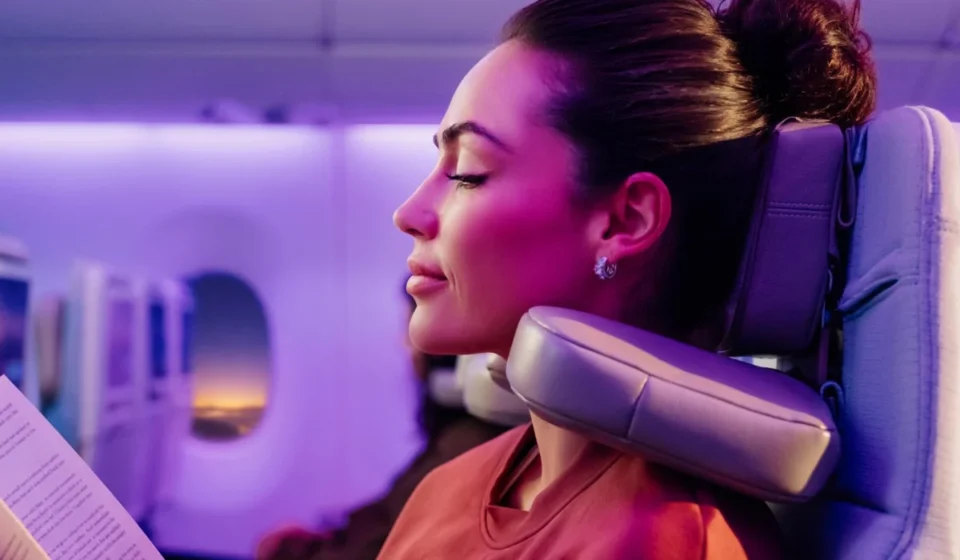

For decades, the standard economy-class experience has been defined by a universal struggle: how to achieve restorative sleep while sitting upright in a confined space. Travelers have long relied on a cottage industry of travel gear—inflatable neck pillows, memory foam wraps, and bulky travel cushions—to bridge the gap between discomfort and rest. However, Emirates is poised to render these accessories obsolete with the launch of its innovative “U-Dream” headrest, a design breakthrough that promises to transform the ergonomics of long-haul economy travel.
The Innovation: Redefining Economy Ergonomics
The Dubai-based carrier announced this week that it is rolling out the "U-Dream" headrest across its economy class cabins. Developed in collaboration with renowned aviation interior specialists Safran Seats, the U-Dream is not merely a cosmetic upgrade. While most legacy adjustable headrests rely on simple, forward-tilting "wings" to offer rudimentary lateral support, the U-Dream features a sophisticated mechanical hinge that allows the headrest to flip downward.
This motion provides a cradling effect, effectively mimicking the support structure of a dedicated, high-end travel pillow. By integrating this functionality directly into the Z400 seat frame, Emirates is moving toward a “gear-free” flying experience. Crafted from premium leather, the headrests are engineered not only for comfort but for operational longevity and hygiene, ensuring they can be sanitized efficiently between long-haul rotations.
Chronology of the Rollout
Emirates has adopted an aggressive, multi-year strategy to integrate the U-Dream technology into its global fleet. The implementation phase is already underway, with the following timeline providing a roadmap for when passengers can expect to experience the new seating configuration:
- Initial Launch: The headrests have already debuted on three of the airline’s newly delivered Airbus A350 aircraft.
- A350 Integration: Emirates anticipates that its entire A350 fleet will be fully equipped with the U-Dream headrests by the conclusion of 2026.
- New Deliveries: Future incoming aircraft, most notably the highly anticipated Boeing 777X, will arrive at the airline’s Dubai hub with the technology pre-installed as a factory standard.
- Fleet-wide Refurbishment: Beginning in 2026, the airline will commence a comprehensive cabin refresh program. During scheduled maintenance intervals, the existing Airbus A380 and Boeing 777 fleets will be retrofitted with the new headrests, ensuring a consistent level of comfort across the airline’s primary long-haul workhorses.
Official Perspectives: The Philosophy of Comfort
Emirates President Tim Clark, a long-time advocate for elevating the passenger experience, framed the introduction of the U-Dream as a vital component of the airline’s broader strategy to dominate the long-haul market.

"Emirates never rests on its laurels when it comes to customer experience," Clark stated during the launch announcement. "We have found a way to significantly improve the comfort for economy class passengers, especially those traveling long-haul. The U-Dream changes the game if the person wants to sleep—by supporting the neck in full. No more neck pillows needed. It’s another innovation that shows our commitment to customers and cements our economy class as the best."
Beyond the hardware itself, the airline has invested in specialized training for its cabin crew. Flight attendants are being instructed on how to assist passengers in optimizing the headrest’s various adjustment settings, ensuring that individuals of different heights and body types can find a configuration that works specifically for them.
The Competitive Landscape: An Industry in Transition
The aviation industry is currently experiencing a "comfort renaissance," driven by intense competition for the long-haul traveler. Airlines are moving away from the "cramped cattle-car" perception of economy class, opting instead to invest in seat modularity and connectivity.
Emirates currently sits at the top of many global rankings for its economy class product, but it is not alone in its pursuit of passenger satisfaction. The current trend toward "premiumization" of the economy cabin is visible across several major carriers:
- United Airlines: The U.S.-based carrier has experimented with "middle-seat-vacant" seating configurations and is actively rolling out options that allow passengers to purchase entire rows that convert into lie-flat beds.
- Air New Zealand: Perhaps the most radical innovator in the space, Air New Zealand has introduced "Skynest" bunk beds on their ultra-long-haul routes, such as the 17-hour flight from New York to Auckland. Passengers can book four-hour sessions in private, horizontal bunks, complete with fresh bedding and privacy curtains.
- Technological Integration: While Emirates is focusing on physical ergonomics with the U-Dream, it is simultaneously upgrading its digital offerings. The airline is in the process of rolling out free, high-speed Starlink internet to its economy cabins, acknowledging that modern comfort is as much about connectivity as it is about sleep.
Implications for the American Traveler
For U.S.-based passengers, the current availability of the U-Dream headrest is limited. As of now, Emirates does not operate the A350 on any of its routes connecting to the United States. Consequently, American travelers wishing to experience this new level of support will need to adjust their travel planning.

Travelers looking for a "U-Dream" experience may consider routing through Montreal, which currently receives A350 service. Alternatively, as the Boeing 777X and retrofitted A380s enter service, the technology will eventually become a standard feature on routes connecting to the airline’s 12 major U.S. gateways, including New York (JFK), Newark, Los Angeles, Chicago O’Hare, Boston, Dallas/Fort Worth, Houston, San Francisco, Washington Dulles, Miami, Seattle/Tacoma, and Orlando.
Given that the average flight from a U.S. gateway to Dubai spans between 14 and 17 hours, the physical toll of the journey is significant. For the millions of passengers who transit through Dubai to reach destinations in India, Africa, and Southeast Asia, the U-Dream headrest represents a meaningful reduction in the "travel fatigue" associated with ultra-long-haul flights.
The Future of the Economy Cabin
The introduction of the U-Dream headrest signals a shift in how airlines view the economy passenger. For years, the seat was treated as a static utility—a simple platform for transportation. Today, that platform is becoming a dynamic environment.
By addressing the specific physical pain points of the economy passenger—neck strain, lack of lateral support, and the necessity of packing extra gear—Emirates is setting a new benchmark for "value-added" comfort. As the airline moves forward with its multi-billion dollar cabin refurbishment project, the U-Dream will likely serve as the centerpiece of its branding, reminding passengers that even at the back of the plane, a restful night’s sleep is no longer a luxury reserved for the front of the cabin.
As the rollout progresses through 2026, the global travel community will be watching closely to see if other carriers follow suit. If the U-Dream proves as effective as its marketing suggests, the era of the bulky, inflatable neck pillow may well be reaching its sunset, replaced by the elegant, integrated design of the modern economy seat.