

Streamlining Hope: Why Nonprofits Desperately Need Specialized Event Registration Software

WASHINGTON — In the landscape of the modern nonprofit sector, organizations are increasingly expected to operate with the agility of tech startups while maintaining the fiscal discipline of traditional charities. Nowhere is this tension more palpable than in the realm of event management.
From annual charity galas featuring silent auctions and multi-tiered corporate sponsorships to community-driven awareness walks and intricate advocacy days, nonprofits shoulder some of the most logistically dense calendars in the corporate or charitable worlds. Astonishingly, these multifaceted operations are frequently orchestrated by lean administrative teams numbering just two or three individuals—staff members who must simultaneously juggle day-to-day organizational operations, donor relations, and programmatic execution.
As the demand for community engagement grows, the administrative burden of managing registrations across a diverse portfolio of events has reached a tipping point. Industry experts argue that the solution does not lie in working harder, but in adopting specialized nonprofit event registration software capable of slashing overhead, eliminating manual data entry, and preserving critical fundraising revenue for its intended mission.
The Anatomy of Nonprofit Complexity: Unique Registration Challenges
Standard commercial ticketing platforms—designed primarily for concerts, conferences, or sporting events—frequently fall short when deployed in the charitable sector. Nonprofits do not merely sell tickets; they cultivate relationships, manage volunteer workforces, honor major contributors, and navigate complex pricing tiers under intense budgetary scrutiny.

1. Multi-Tiered Access and Hidden Pricing
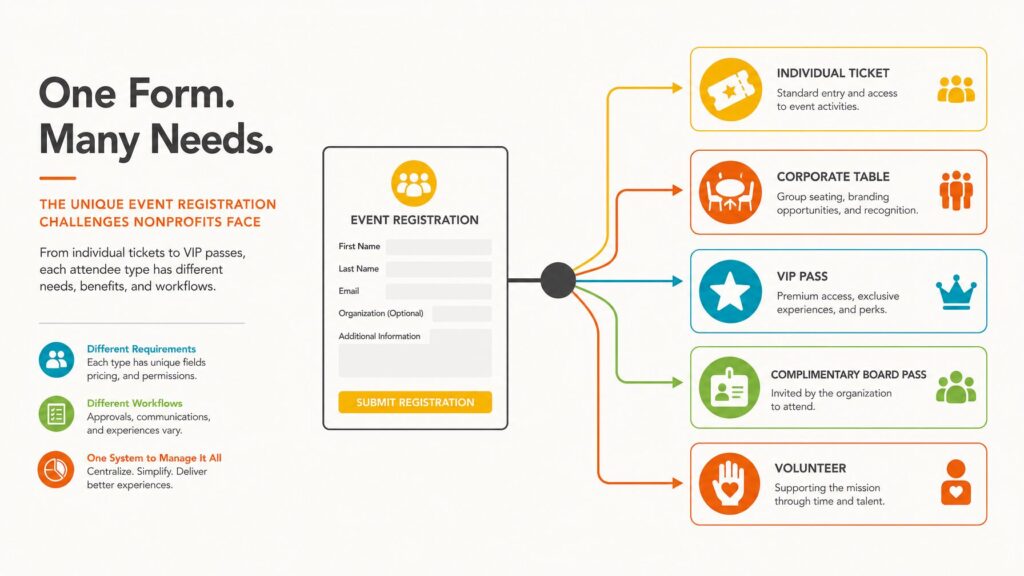
A typical nonprofit fundraising dinner rarely relies on a flat admission fee. Instead, organizers must coordinate individual tickets, corporate table packages, VIP passes, complimentary board member admissions, and volunteer registrations. Each category carries distinct pricing structures, access privileges, and data requirements.
Furthermore, many of these categories must remain invisible to the general public. Corporate packages and complimentary board seats require private workflows—often managed via secure promo codes—to prevent confusion on public-facing registration portals.
2. The Volunteer Integration Dilemma
Unlike corporate seminars, nonprofit events heavily rely on volunteer labor. Coordinators must often register attendees and volunteers through synchronized systems, tracking specific shifts, roles, and responsibilities. When platforms force organizers to use disparate tools for attendees and volunteers, data becomes fragmented, compounding the risk of miscommunication and administrative burnout.
3. Donor Stewardship and Data Capture
For fundraising events, the registration form is the first step in donor cultivation. Platforms must seamlessly capture contribution data, seating preferences, and donor recognition names. This structured data is vital for post-event acknowledgment letters, seating charts, and printed programs.
4. The Human Resource Deficit
With small teams managing high event volumes, every hour spent reconciling spreadsheets, chasing down bounced emails, or manually inputting RSVPs is an hour stolen from mission-critical work. Operational efficiency is not merely a convenience for nonprofits; it is an existential necessity.
5. Margin Sensitivity and Fee Transparency
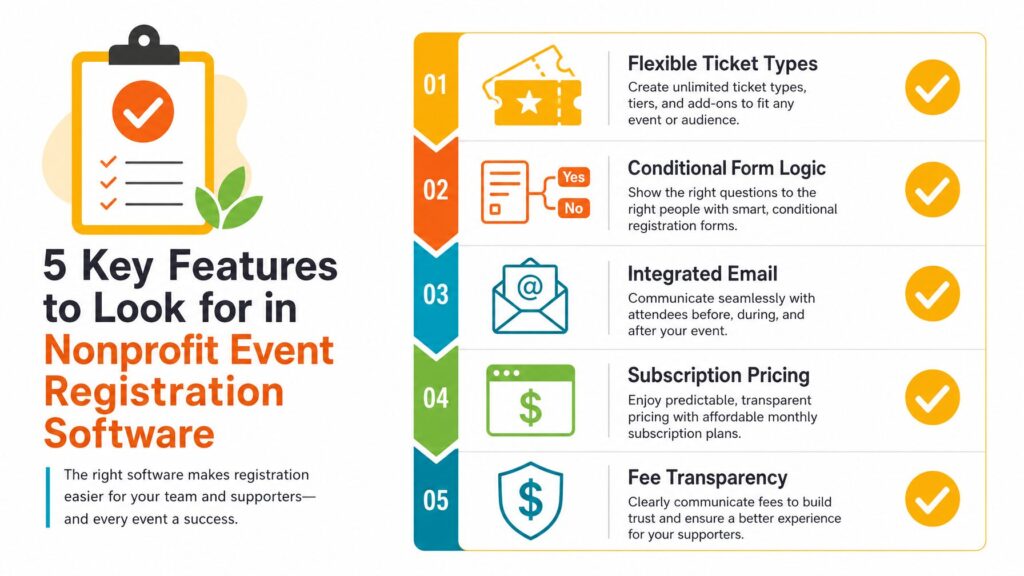
Operating on razor-thin margins, charitable organizations are acutely sensitive to transaction costs. Standard per-ticket processing fees charged by mainstream ticketing platforms can strip thousands of dollars from a successful fundraising campaign. Understanding the total cost of ownership—including subscription fees, payment gateway integration costs, and hidden transaction percentages—is paramount.
Core Capabilities: What to Look for in Nonprofit Registration Software
To combat these structural hurdles, software evaluators emphasize specific technological features that directly address the realities of resource-constrained organizations.
- Flexible Ticket Architectures: The ability to house diverse ticket tiers under a single event umbrella while utilizing hidden, promo-code-protected pricing levels.
- Conditional Form Logic: Advanced form builders that dynamically alter questions based on user input. For instance, a donor selecting a VIP table package can be prompted for seating preferences, while a volunteer is asked for shift availability, keeping general attendees free from irrelevant data entry.
- Invite-Only Gating and RSVP Flows: Essential for donor cultivation dinners and board meetings, ensuring uninvited guests cannot access restricted registration portals.
- Unified Email Communications: Integrated marketing tools that parse registration data directly, enabling automated, targeted follow-ups for incomplete registrations, confirmed guests, and no-shows without exporting spreadsheets to third-party mail clients.
- Multi-Event Subscription Models: Rather than paying per-event or per-ticket fees, subscription models allow nonprofits to host an unlimited number of smaller community workshops or advocacy sessions at no additional software cost.
- AI-Powered Concierge Support: Modern platforms increasingly feature AI chatbots to answer visitor inquiries 24/7, dramatically cutting down the volume of pre-event emails hitting small nonprofit inboxes.
Chronology of an Evolution: From Spreadsheets to Smart Platforms
The digital transformation of nonprofit event management has evolved across three distinct eras over the past two decades.
- The Paper and Spreadsheet Era (Pre-2010s): Nonprofits relied heavily on physical mail-in forms, checks, and cumbersome desktop databases or spreadsheets. Reconciliation was notoriously error-prone, requiring massive investments of staff time.
- The Commercial Ticketing Boom (2010–2020): The advent of cloud-based ticketing tools democratized event tech. However, these platforms were optimized for profit-driven entertainment events, leaving nonprofits to grapple with high per-ticket fees and rigid form structures that failed to accommodate donor and volunteer data.
- The Specialized Ecosystem Era (Present): Today, platforms like EventMobi have emerged with purpose-built features tailored to the charitable sector. By combining transparent, subscription-based pricing with advanced check-in apps, badge printing, and AI-driven support, the industry is shifting toward holistic event management ecosystems designed specifically to protect philanthropic bottom lines.
Supporting Data and Financial Implications
The financial stakes of choosing the right software are substantial. According to recent sector analyses, administrative inefficiencies cost U.S. nonprofits billions of dollars annually in lost productivity and diverted labor.
When evaluating software economics, financial officers look closely at the "revenue retention ratio"—the percentage of gross fundraising dollars that ultimately reach the cause. Consider a mid-sized nonprofit hosting an annual gala that generates $100,000 in ticket sales:
- On a platform charging a standard 3% per-ticket transaction fee alongside payment processing, the organization loses $3,000 straight off the top.
- On a platform utilizing flat-fee subscription pricing with zero per-ticket registration charges, that same $3,000 remains in the nonprofit’s operating budget, directly funding community outreach, medical research, or educational programs.
Furthermore, automated check-in and badge-printing integrations reduce on-site queuing times by an estimated 40%, elevating the guest experience for major donors and corporate partners who expect seamless professionalism.
Official Perspectives and Industry Insights
Technology advocates and nonprofit leaders alike stress that software selection must be treated as a strategic investment rather than an administrative line item.
"Nonprofit event teams do more with less than almost any other sector," notes one senior event technology strategist. "When you give a lean team of three people the tools to automate ticket gating, streamline volunteer check-in, and integrate data directly into their donor CRM, you aren’t just saving them hours—you are directly protecting their mission from administrative burnout."
Industry consultants recommend that executive directors and development boards pose five critical questions when vetting any event software vendor:
- What are the true, all-in costs, including hidden transaction fees and payment processing overhead?
- Does the platform support a multi-event calendar under a single subscription fee?
- Can we cleanly capture donor, volunteer, and attendee data within a unified form?
- How seamlessly does registration data flow into on-site badge printing, mobile apps, and check-in hardware?
- What level of onboarding, training, and ongoing customer support is included for non-technical staff?
Strategic Implications for the Future of Fundraising
As the nonprofit sector adapts to an increasingly digital world, the expectations of donors, volunteers, and corporate sponsors continue to rise. Attendees expect frictionless mobile registration, immediate confirmation receipts, and personalized communication, regardless of whether they are supporting a multi-million-dollar international NGO or a grassroots community food bank.
Ultimately, the deployment of specialized event registration software represents a fundamental shift in how charitable organizations value their own human capital. By eliminating manual data reconciliation and recovering thousands of dollars in transaction fees, nonprofits can refocus their energy where it belongs: driving meaningful, lasting change within the communities they serve.
Related posts: