The Death of the Registration Desk: Why Mobile Badge Printing is Reshaping Event Operations

Picture two versions of the same conference opening.
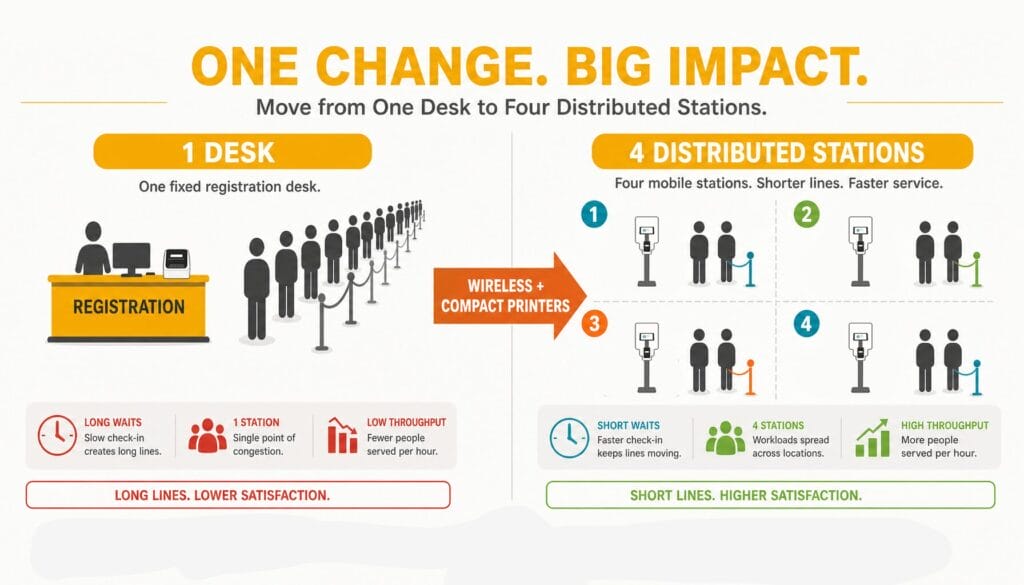
Version One: A long, monolithic table anchors the hotel lobby. Staff stand behind alphabetized badge bins, frantically searching through pre-printed stock while attendees wait in a stifling, disorganized queue that snakes toward the elevator bank. The line is not moving. Every attendee, regardless of their status or session, is bottlenecked at a single point of failure.
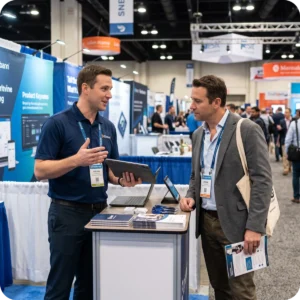
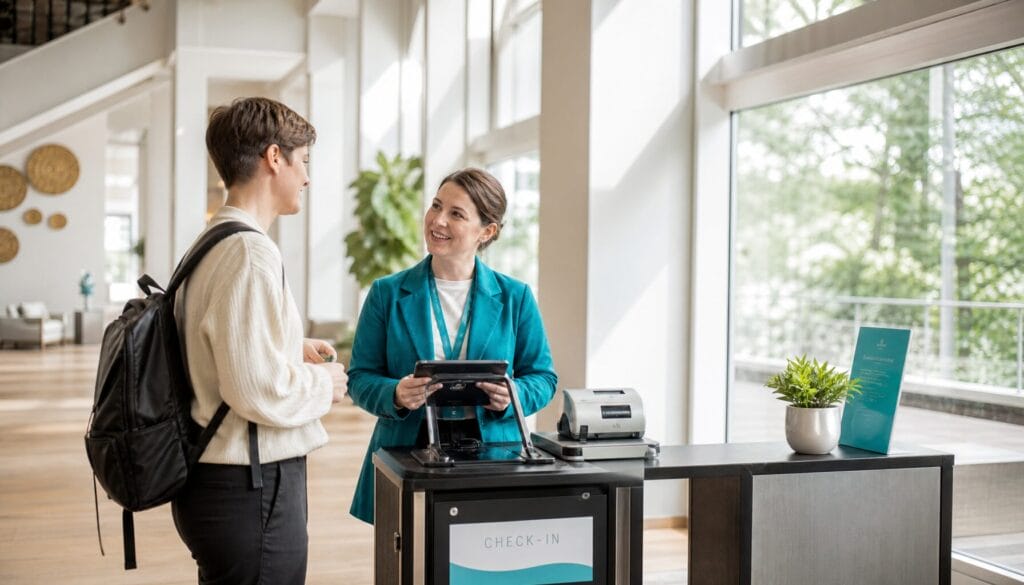
Version Two: Attendees walk into the atrium and are greeted by a seamless, fluid experience. Welcome stations are positioned near every entrance. A quick QR scan on an iPad triggers a compact printer, and a personalized badge is produced on demand in seconds. People keep moving toward coffee, conversations, and their first sessions.
The question for modern event planners is no longer whether check-in matters—you already know it dictates the tone of the entire event. The critical question is: How do you build a fast, resilient, and distributed check-in system that eliminates lines during peak arrivals, even when your venue’s physical layout or Wi-Fi infrastructure works against you?

The Strategic Shift: Why the Registration Desk Became a Compromise
A traditional, centralized registration desk isn’t inherently "wrong," but it is a rigid, legacy constraint. It forces the entirety of the arrival, verification, and badge-printing process to revolve around a single, congested physical anchor.
The Downstream Effects of Fixed Infrastructure
When we look at the logistics of event management, the traditional setup demands a heavy investment in table space, signage, and high-density staffing. The consequences are predictable:
- Queuing Theory Realities: A single-point entry creates a "choke point." Even with twenty staff members, the physical limitation of space means that if 500 people arrive in a 30-minute window, the wait time is mathematically guaranteed to be high.
- Operational Friction: Misspellings, missing records, last-minute walk-ins, and badge reprints act as "exceptions" that stop the entire line.
- The "Process" Over "People" Mentality: When the registration desk is the focal point, the arrival experience is designed around equipment (printers, PCs, power strips) rather than the attendee experience.
The root cause of these issues is historical. For decades, printing and check-in workflows were tethered to Ethernet cables and bulky hardware. Today, that has changed. Printers have shrunk, label technology has become lightning-fast, and wireless connectivity is now reliable enough to handle mission-critical traffic.
Defining "Mobile Badge Printing"
"Mobile" in the context of event check-in does not necessarily mean the staff is walking around with a printer strapped to their hip. Instead, it refers to the decentralization of badge production.
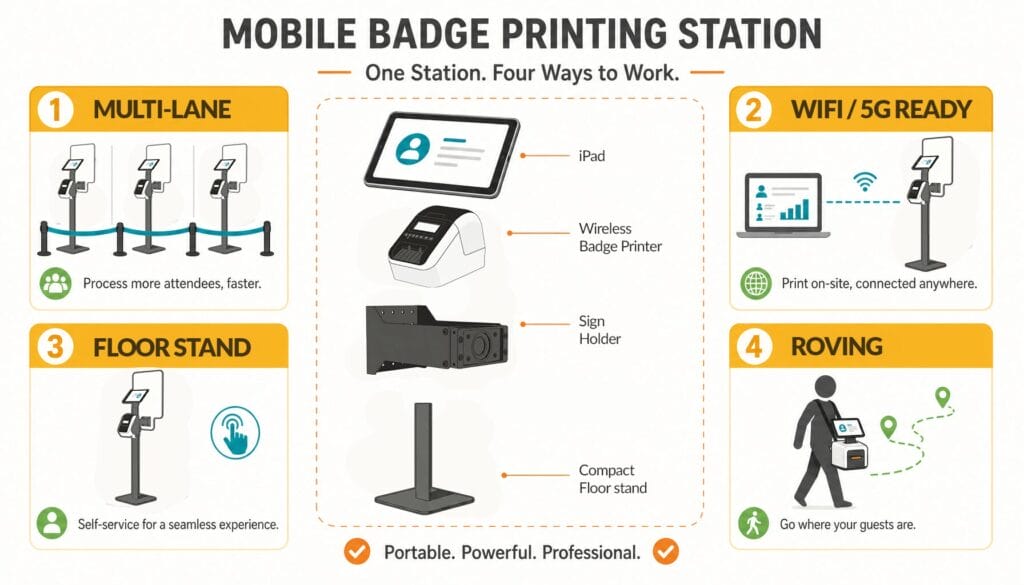
Mobile badge printing means moving the check-in and printing function away from a central desk and into portable stations placed precisely where the attendees arrive. By using an iPad or iPhone running robust check-in software paired with a compact thermal label printer, planners can transform any entryway, sponsor lounge, or session door into an active registration point.
Operational Advantages
- Load Balancing: By distributing the load across four or five entry points rather than one, you naturally reduce the density of the crowd.
- Scalability: If a specific entrance is seeing higher volume, you can shift portable stations to meet the demand in real-time.
- Waste Reduction: Printing on demand eliminates the "dead stock" of hundreds of pre-printed badges that end up in the trash after no-shows.
Reg-Ception: Blurring the Line Between Registration and Welcome
One of the most exciting trends in modern event design is the concept of "Reg-Ception." This is the operational philosophy of combining check-in and the welcome reception into a single, intentional moment.
The Traditional vs. The Reg-Ception Flow
- Traditional: Arrival → Wait in line → "Process" at the desk → Receive badge → Move to reception.
- Reg-Ception: Arrival → Immediate greeting by staff with mobile stations → Badge provided during the welcome → Seamless transition into the event space.
By removing the "dead zone"—that period where an attendee feels trapped in a bureaucratic bottleneck—you increase the ROI of your opening hour. Attendees are happier, staff are less stressed, and the energy of the event begins the moment they walk through the door.
The Connectivity Layer: Reliability Under Pressure
Mobility is only an asset if it is dependable. For event planners, the biggest fear is the "network drop." Before your doors open, you must have a clear strategy for connectivity and redundancy.
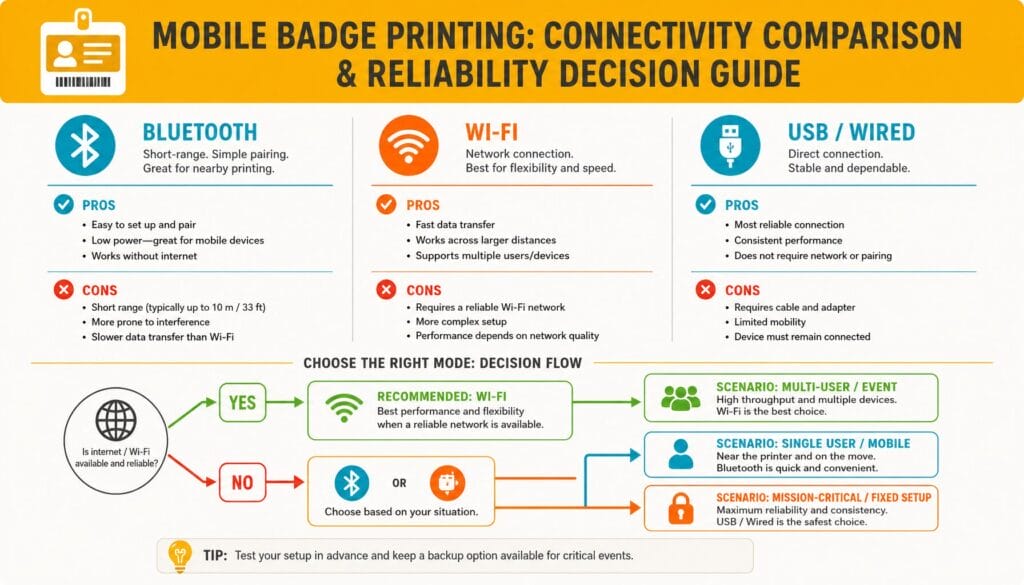
The Three Connectivity Modes
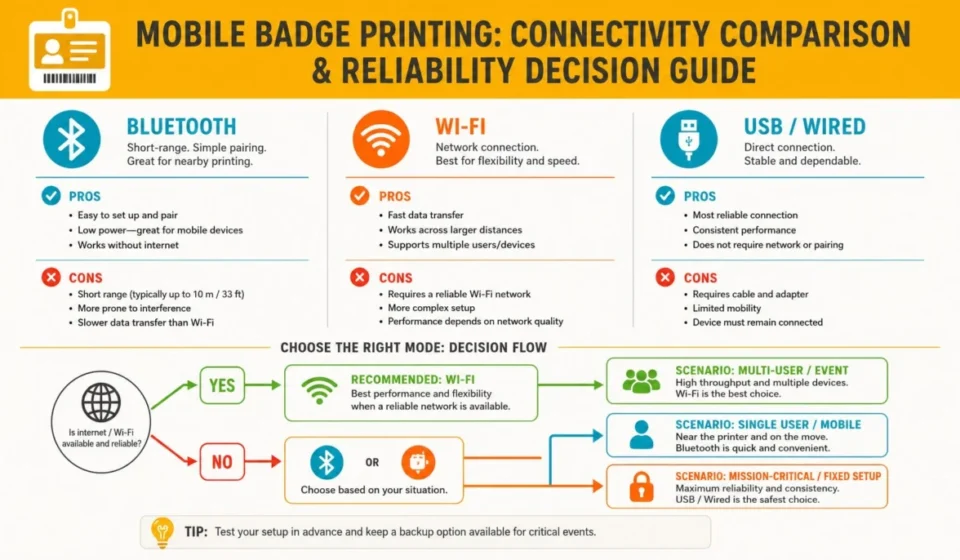
- Bluetooth: Ideal for roving satellites or temporary kiosks. It is highly portable but requires short-range proximity to the printing device.
- Wi-Fi: The standard for most modern setups. It offers flexibility, provided you have a dedicated, stable network that isn’t shared with the general attendee public.
- Wired (Ethernet/USB): The "Gold Standard" for primary, high-volume lanes. If you have a main registration bank, always use a wired connection to ensure 100% uptime regardless of wireless interference.
The "Local-First" Strategy
A common mistake is assuming that every check-in requires a live cloud connection to print. A resilient system uses local-first data caching. By ensuring that your check-in devices have the attendee list stored locally, the system can continue printing even if the internet goes down. The device can then sync with the central database once the connection is restored.
Implementation: How to Build Your Station Plan
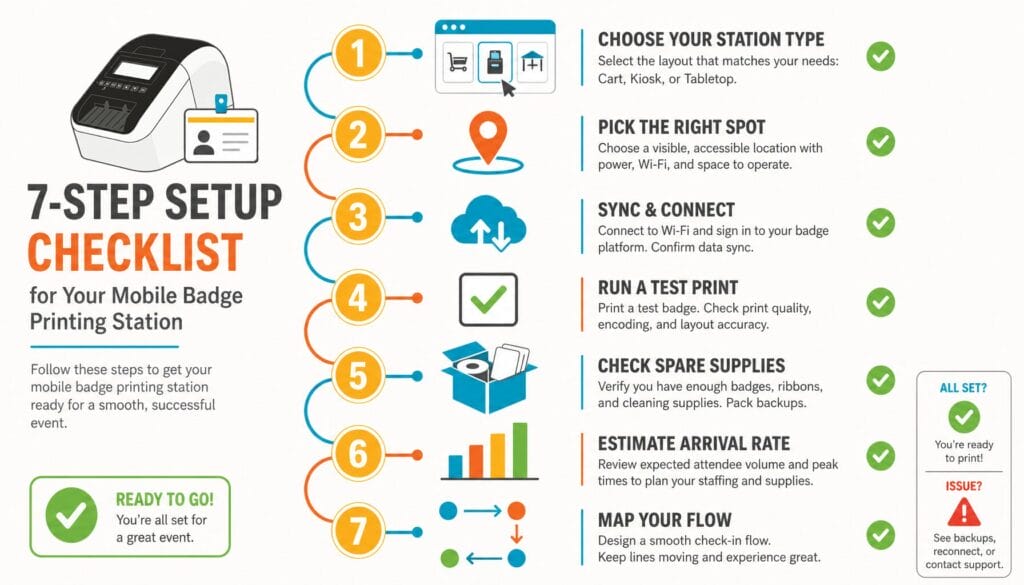
To successfully implement a mobile printing strategy, planners should follow a structured, seven-step deployment framework.
1. Size for Peak, Not Total Headcount
Do not ask, "How many people are attending?" Ask, "How many people will arrive in my busiest 30-minute window?" Use that number to determine your station count. A common rule of thumb is to calculate one station per 50–75 attendees per 30-minute period.
2. Confirm Placement and Range
Test your physical layout. If using Bluetooth, ensure the printer isn’t behind a concrete pillar or a large metal structure, as these can interfere with signal integrity.
3. Sync Data Early
Treat your data sync like a pre-flight checklist. Ensure all devices are updated with the latest registration database at least two hours before doors open.
4. The "Exception" Lane
Even the best mobile systems will have outliers—the VIP with a name change, the walk-in who didn’t register, or the technical glitch. Always dedicate one station as the "Exception Desk." This keeps your "Fast Lanes" moving.
5. Signage is Communication
If you are spreading stations out, your signage must be impeccable. Attendees need to know immediately where to go. Use high-contrast, directional signage that leads them to the station that best matches their registration type.
6. Test, Test, and Test Again
Run a "stress test" with your volunteers. Have them simulate a rush. If a printer jams, how long does it take to clear? If a battery dies, do you have a power bank or a spare unit?
7. Think in Flows
When you place your stations, prioritize the flow of foot traffic. Never place a station where it creates a natural barrier to the elevators or the main ballroom entrance.
The Technology Component: EventMobi BadgeON™
Solutions like EventMobi’s BadgeON™ have been engineered specifically to solve the problems of mobile, distributed check-in. By integrating the check-in software with the printing hardware, these systems provide a "closed-loop" experience.
When an attendee checks in, the system verifies their credentials, assigns them a seat or session, and triggers the print command in one fluid motion. This removes the "manual lookup" time that traditionally slows down queues.
Furthermore, by utilizing compact thermal printers—such as the Brother QL-820WNB—planners can leverage small, battery-operated units that fit on a cocktail table or a podium. This allows for a clean, professional aesthetic that is a far cry from the messy "spaghetti wires" of the past.
Implications for the Future of Events
The transition to mobile, distributed check-in is not merely a technical upgrade; it is a fundamental shift in the event industry’s approach to customer service.
By treating check-in as an "operational system" rather than a piece of furniture, planners can reclaim their time and resources. Instead of spending two days building a massive, imposing registration desk, they can spend that time refining the event program, training staff to act as brand ambassadors, and focusing on the attendee experience.
Summary Checklist for Planners:
- Audit Your Entryways: How many points of entry exist? Can you place a station at each?
- Define Your Peak: Calculate your 30-minute peak arrival rate and divide by your station capacity.
- Prioritize Redundancy: Always have a spare printer and a backup manual check-in list at every station.
When you successfully execute a mobile badge printing strategy, the registration process becomes "invisible." It ceases to be an event in itself and becomes what it was always intended to be: a quick, professional, and welcoming handshake that signals the official start of your event.
By moving away from the "registration desk" and into a "registration ecosystem," you are not just checking people in—you are setting the stage for success.
Related posts: