The Geography of Flavor: How Russell’s Reserve Single Rickhouse Proves the Power of Bourbon Terroir

For generations, the spirits industry has debated the concept of terroir—a French term traditionally used in winemaking to describe how a specific region’s soil, climate, and topography imprint themselves on the final product. While wine enthusiasts have long linked a bottle’s flavor profile to the sun-drenched hillsides of Bordeaux or the limestone-rich earth of Burgundy, whiskey drinkers have historically focused on other variables. When discussing the nuances of a fine bourbon or single malt, the conversation almost invariably turns to grain selection, water sources, and the mechanics of distillation.
Yet, as the American whiskey renaissance matures, distillers and blenders are increasingly turning their attention to the profound influence of maturation. Nowhere is this more evident than in Kentucky, where the relentless summer heat and freezing winter conditions force bourbon deep into the porous oak of the barrel, extracting sugars, tannins, and environmental characteristics year after year.
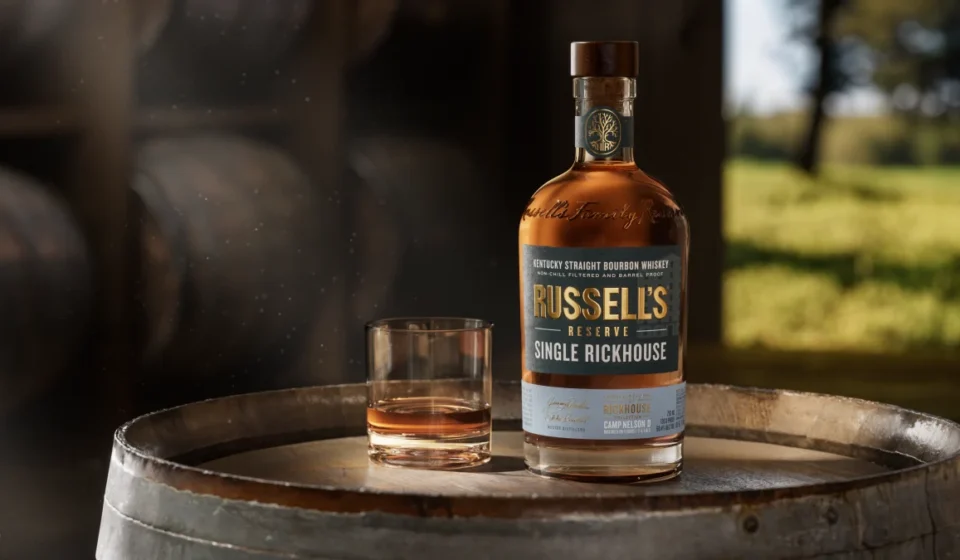
Kentucky bourbon brand Russell’s Reserve is taking this exploration a step further. With the latest entry in its acclaimed Single Rickhouse series, the brand isn’t just showcasing the general effects of barrel aging—it is offering a masterclass in architectural terroir, proving that the exact floor, orientation, and microclimate of a single aging warehouse can fundamentally transform a whiskey’s soul.
Main Facts: The Anatomy of a Landmark Release
The newest addition to the Russell’s Reserve Single Rickhouse lineage is a monumental achievement for the distillery, marrying historic provenance with unorthodox blending techniques.
Distilled at the legendary Wild Turkey distillery in Lawrenceburg, Kentucky, the expression was crafted under the watchful eye of master distiller Eddie Russell. This release steps away from the brand’s traditional single-floor selection methodology, drawing barrels from multiple elevations within Warehouse D—the very building where Eddie began his career nearly fifty years ago.
- Age: 12 years old
- Proof: 120.8 (60.4% ABV)
- Filtration: Non-chill filtered
- Source: Warehouse D (multi-floor selection: floors 1, 3, 4, 5, and 6)
- Retail Price: $300 per bottle
- Flavor Profile: High-proof warmth balanced by unexpected, rye-like spice, alongside decadent notes of vanilla, maple, tobacco, baked apple, plum, cherry, and toasted almond.
What sets this bottling apart from its predecessors is its striking flavor profile. By dipping into the damp, cool microclimate of the rickhouse’s first floor—a level typically avoided for premium batched releases—the blending team unlocked a distinctly earthy, high-spice character. The result is a bold, high-proof bourbon that routinely defies expectations, tasting so heavily of spice and grain that even seasoned connoisseurs tasting it blind might mistake it for a high-end Kentucky rye.
Chronology: A Legacy Etched in Oak and Family
To understand the weight of this new release, one must trace the timeline of Russell’s Reserve and the multi-generational mastery that built it.
The Foundation of Wild Turkey
The story of Wild Turkey is inextricably linked to the Russell family. Jimmy Russell, affectionately known as the "Buddha of Bourbon," began his career at the Lawrenceburg distillery in 1954. Over the decades, Jimmy became a living monument to traditional bourbon-making, holding fast to old-school techniques while the rest of the industry modernized.
The Birth of Russell’s Reserve (1998)
In 1998, Wild Turkey introduced a new label: Russell’s Reserve. Created to celebrate Jimmy Russell’s remarkable 45th anniversary at the distillery, the brand was initially overseen by his son, Eddie Russell, who joined his father in the family business in 1981. What started as a celebratory small-batch release eventually blossomed into a standalone portfolio synonymous with well-aged, uncompromisingly traditional Kentucky bourbon.
Eddie Russell’s Milestone (2025–2026)
Mirroring his father’s historic trajectory, Eddie Russell celebrates his own 45th anniversary at the distillery. Over his tenure, Eddie has stepped into the role of master distiller, steering Wild Turkey and Russell’s Reserve into the modern era with critical acclaim. This tenure gives him an encyclopedic, boots-on-the-ground knowledge of every rickhouse on Wild Turkey’s properties—most notably Camp Nelson and the historic grounds surrounding the Lawrenceburg plant.
The Single Rickhouse Evolution (2022–Present)
- 2022 (Camp Nelson C): The Single Rickhouse series debuted, showcasing whiskey aged for at least 10 years in Camp Nelson Warehouse C—a site revered by blenders for its unique thermal cycling and maturation conditions.
- Subsequent Releases: The brand rolled out subsequent iterations varying in age and proof, all designed to isolate and celebrate how specific warehouses imprint flavor onto the spirit.
- The 2026 Warehouse D Release: Marking a poignant return to Eddie Russell’s roots, this 12-year-old, 120.8-proof expression breaks the mold by incorporating first-floor barrels to achieve a revolutionary, rye-forward profile.
Supporting Data: The Science of Rickhouse Terroir
Why does a rickhouse matter so much? To appreciate the $300 price tag of the latest Russell’s Reserve Single Rickhouse release, one must examine the physics and meteorology of bourbon maturation.

+-------------------------------------------------------+
|                WAREHOUSE D MICRO-CLIMATES             |
+-------------------------------------------------------+
|  Top Floors (5 & 6)  --> Heat traps; high evaporation,|
|                          concentrated sugars/oak.     |
+-------------------------------------------------------+
|  Middle Floors (3 & 4)--> Balanced expansion; steady    |
|                          interaction with wood.       |
+-------------------------------------------------------+
|  Bottom Floor (1)    --> Cool, damp; slow interaction,|
|                          earthy, savory compounds.    |
+-------------------------------------------------------+
Traditional Kentucky rickhouses are towering, multi-story wooden structures designed to maximize airflow. However, temperature stratification inside these buildings creates entirely different aging environments depending on elevation:
- The Upper Floors (Floors 5 and 6): Heat rises. During Kentucky’s sweltering summers, the upper tiers of a rickhouse act like convection ovens. The whiskey expands deep into the wood staves, accelerating maturation, increasing proof through water evaporation (angel’s share), and concentrating rich, sweet vanilla, caramel, and oak tannins.
- The Middle Floors (Floors 3 and 4): These tiers offer a more moderate, balanced environment where the spirit interacts steadily with the barrel without over-oaking or skyrocketing in proof.
- The Bottom Floor (Floor 1): Closest to the damp earth, the first floor remains significantly cooler year-round. Evaporation slows down, and the cooler temperatures encourage different chemical reactions. As Eddie Russell noted, barrels from this level often develop a distinct, savory, and earthy character that is frequently overlooked by commercial blenders.
By combining barrels from the extreme top (floor 6) and the cool depths (floor 1) with the balanced middle tiers (floors 3, 4, and 5), the distillery engineered a complex balancing act. The result is a liquid that bridges the gap between the sweet, fruity richness of high-elevation aging and the dry, spicy, earthy punch of the shaded ground floor.
Official Responses: In the Master Distiller’s Words
The creative process behind breaking long-held blending rules required a bold vision. Eddie Russell shed light on the accidental discovery that shaped the final profile of this Warehouse D release:
"We don’t typically draw from the first floor," Russell explained in an official statement. "But some of the barrels we tasted down there contributed an earthy character that helped build the spicy, rye-like profile we found ourselves chasing. Once we realized what was developing, we leaned into it. This is the first Single Rickhouse release where, tasted blind, you’d bet it was a rye."
This willingness to experiment while leaning on decades of institutional memory underscores the philosophy of the Russell family. Rather than chasing a homogenized house style, the brand uses the Single Rickhouse series as an experimental canvas—a way to let nature write the recipe, with the master distiller acting merely as the curator.
Implications: What This Means for Collectors and the Industry
The release of a ultra-premium, single-warehouse bourbon carrying a $300 price tag carries several notable implications for the broader American whiskey market:
1. The Elevation of Warehouse Architecture
For years, distilleries marketed single-barrel selections based on rickhouse location, but few brands systematically dissected an entire building’s microclimates for a batched release. Russell’s Reserve is proving that consumers are hungry for granular data. Whiskey enthusiasts are no longer satisfied knowing a bourbon came from "Kentucky"—they want to know which direction the warehouse faced, how high off the ground the barrel rested, and how the ambient humidity shaped the glass in front of them.
2. Blurring the Lines Between Bourbon and Rye
By leveraging first-floor barrels to extract an unexpected, rye-like spice profile from a traditional corn-based bourbon mashbill, Wild Turkey has demonstrated the incredible versatility of aging environments. This could encourage other major distilleries to experiment more boldly with barrel placement, utilizing cool-floor aging to coax non-traditional flavor profiles out of established mashbills.
3. The Collector Market and Economic Realities
At $300 retail, the Single Rickhouse series sits firmly in the luxury tier of American whiskey. On the secondary market, bottles from this lineage routinely command even higher figures. While this price point places the expression out of reach for casual daily drinkers, it cements Russell’s Reserve’s status as a top-tier player in the rarefied air of ultra-aged, limited-allocation collecting—competing directly with heavyweights like Buffalo Trace’s Antique Collection and Four Roses’ Limited Edition Small Batch.
Tasting Notes: Inside the Glass
For those fortunate enough to secure a bottle—or lucky enough to pour a dram at a premier whiskey bar—the sensory experience matches the lofty narrative.
- The Nose: A robust wave of high-proof heat immediately gives way to layers of dark brown sugar, toasted almonds, and sweet pipe tobacco, underscored by crisp notes of autumn orchard fruit.
- The Palate: True to Eddie Russell’s word, the entry delivers an aggressive, delightful wave of rye-style baking spice and black pepper, instantly balanced by deep pools of vanilla extract, rich maple syrup, baked apples, stewed plums, and bright cherries.
- The Finish: Long, warming, and remarkably complex, leaving a lingering impression of spiced oak, damp earth, and lingering fruit sweetness.
Conclusion
The Russell’s Reserve Single Rickhouse Warehouse D release is more than just another expensive collector’s item in a crowded bourbon market. It is a testament to the partnership between human craftsmanship and the capricious forces of nature. By looking back at the first warehouse he ever worked in—and daring to pull barrels from the damp, forgotten floorboards of tier one—Eddie Russell has delivered a landmark expression. It proves conclusively that in the world of fine whiskey, geography is destiny.
Related posts: