The Squarespace Exodus: Pricing Hikes Ignite User Backlash and Spark a Search for Alternatives

For years, Squarespace has stood as a cornerstone of the creative economy, serving as the digital storefront and portfolio home for millions of photographers, filmmakers, and independent designers. With its sleek, drag-and-drop interface and aesthetically driven templates, it became the industry standard for those who prioritized visual impact over complex coding. However, that relationship is currently under significant strain.
In recent weeks, the platform’s user base has been flooded with notifications of substantial price increases—some reaching as high as 26%. This shift, arriving in an already volatile economic climate, has triggered a wave of frustration across social media platforms, with creative professionals openly discussing plans to migrate their digital assets elsewhere.
The Anatomy of the Price Hike
The communication from Squarespace to its users has been largely direct, delivered via email rather than through a public-facing press release or blog post. This approach has left many long-term subscribers caught off guard, scrambling to reconcile the new costs with their existing budgets.
A Breakdown of the Increases
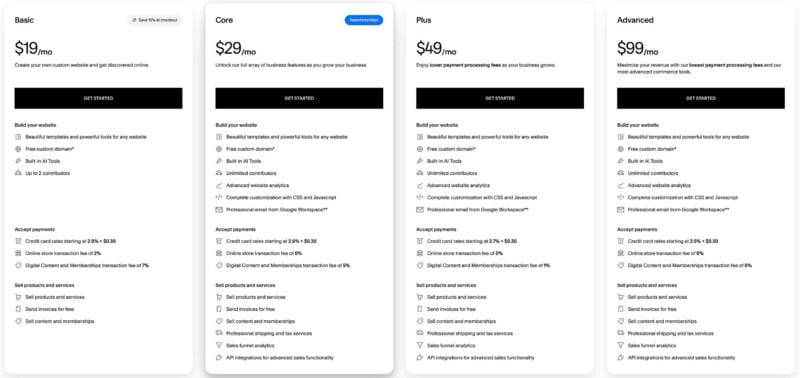
For those on annual billing cycles—typically the most common choice for small business owners and freelancers—the increases are sharp and pervasive:
- Basic Plan: Increasing from $16 to $19 per month (19% increase).
- Core Plan: Increasing from $23 to $29 per month (26% increase).
- Plus Plan: Increasing from $39 to $49 per month (26% increase).
While the Advanced tier has remained stable at $99 per month, the mid-tier plans—which host the vast majority of the company’s portfolio-focused user base—have seen the most aggressive jumps. Monthly payment options have also seen hikes, with the Plus tier jumping 16%, moving from $56 to $65 per month.
These adjustments are not occurring in a vacuum. Users are often navigating a "pricing onion" where different cohorts are affected differently based on legacy discounts, initial promotional pricing, and their specific renewal dates. For some, the cumulative effect of these hikes over the last few years has been staggering; one Reddit user reported a 61% increase in their total costs since signing up in 2021.
Chronology: From Creative Darling to Private Equity Target
To understand the current sentiment, one must look at the recent corporate evolution of the platform. Squarespace has long relied on a "creator-to-creator" marketing strategy. By sponsoring high-profile photography YouTube channels and design influencers, the company built a foundation of trust. Many photographers did not just use Squarespace; they advocated for it, often providing discount codes to their own audiences.
The Permira Acquisition
The landscape shifted significantly in October 2024, when the private equity firm Permira finalized its acquisition of Squarespace for $7.2 billion, taking the company private.
In the tech and media industries, the entry of private equity often signals a pivot in business strategy. Historically, firms like Permira focus on aggressive revenue optimization. While this is standard practice for shareholders, it often manifests as increased subscription fees and a push toward higher-margin features—a dynamic that frequently places the company at odds with its core user base, who are often operating on thin margins themselves.
Supporting Data: Why Creatives Are Feeling the Pinch
The outcry isn’t just about the dollar amount; it is about the perceived value proposition. Photographers and visual artists are currently grappling with a "cost-of-business" crisis. From the rising costs of camera gear and memory cards to the broader impact of global inflation, freelancers are finding that every line item in their professional ledger is inflating simultaneously.
The "AI Tax" Sentiment
A central point of contention is the direction of the platform’s development. In the wake of the acquisition, Squarespace has aggressively integrated AI-driven tools into its ecosystem. While some businesses may benefit from automated SEO or AI-generated copy, many photographers report that these features are irrelevant to their specific workflows.
"I feel like I’m paying for things I sincerely did not ask for," wrote Reddit user CheesecakeOdd3075. "I don’t use AI at all… I’m having a hard time coping with this because I now have less than a month to decommission using Squarespace and self-host."
This sentiment is echoed across Threads, where creators are actively swapping recommendations for alternatives. The frustration stems from a feeling that the platform is catering to "general" corporate interests rather than the specific, high-resolution, image-heavy needs of the photography community.
Official Responses and Corporate Strategy
As of the time of this publication, Squarespace has not issued a formal statement regarding the specific reasoning behind these pricing adjustments. However, the company’s recent activities suggest a move toward capturing more of the "limited drop" and e-commerce market.
Just this week, the company announced a suite of tools designed to support creators who sell limited-edition print releases. This indicates a strategic pivot toward transforming the platform from a simple "portfolio host" into a full-service "business-in-a-box" for creators. For the company, these features justify the price hike. For the photographer who simply wants a clean, fast, and affordable way to showcase their work, however, these new tools are viewed as "bloatware."
Implications for the Creative Industry
The immediate consequence of these price hikes is a visible migration. Photographers are currently vetting competitors such as:
- Format: A long-time rival specifically tailored to visual portfolios.
- SmugMug & Zenfolio: Platforms that have historically served the professional photography market with specialized proofing and print-fulfillment tools.
- Wix: Often cited as the primary alternative, though it faces its own set of criticisms regarding user experience.
- Self-Hosting (WordPress/Ghost): A growing number of tech-savvy creators are opting to leave "plug-and-play" services entirely to regain control over their costs and data, citing the long-term stability of owning their own site architecture.
The Future of "Influencer Marketing"
The relationship between Squarespace and the photography community may be irrevocably changed. When a company relies on its users to be its brand ambassadors, it builds its brand equity on a promise of mutual growth. By significantly increasing prices, Squarespace risks alienating the very influencers who helped scale the platform. If the photography community shifts its collective support toward other services, the cost of acquiring new users through traditional ads will likely rise, potentially creating a "churn cycle" that is difficult to break.
Conclusion: A Critical Juncture
The current situation with Squarespace serves as a case study for the friction between the creative arts and the corporate bottom line. As private equity influence becomes more pronounced in the software-as-a-service (SaaS) sector, users are forced to decide if the convenience of a managed platform is worth an escalating premium.
For many photographers, the answer is becoming a firm "no." As they migrate to leaner, more affordable, or more specialized platforms, the industry is seeing a reminder that in the digital age, a service is only as valuable as the community that supports it. Whether Squarespace will address the backlash with loyalty programs or further price adjustments remains to be seen, but for now, the creative world is clearly in a state of evaluation.