
From the humble, messy beginnings of a 13-year-old’s experimentation in her mother’s garage to the sophisticated, high-texture studio practice she maintains in Los Angeles today, Hannah Buechler has spent her life refining a unique visual language. A multidisciplinary artist with a background in fibers from the Savannah College of Art and Design (SCAD), Buechler’s work bridges the gap between chaotic, organic expression and the calculated precision of high-end fashion design.
Main Facts: The Intersection of Texture and Tenacity
Hannah Buechler is not merely an artist; she is a material scientist of the aesthetic. Her work, which spans from intricate tactile collages to custom-made textiles, is characterized by the transformation of small, repetitive gestures into complex, layered environments.
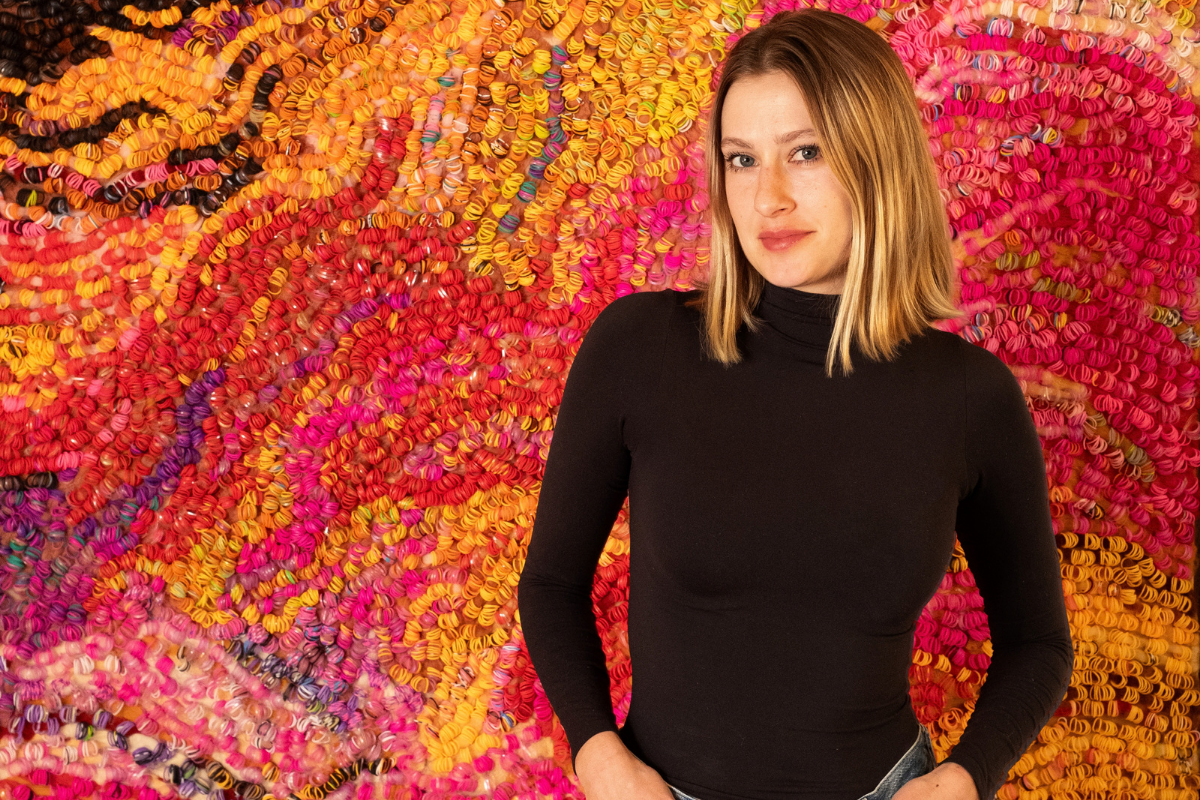
Currently based in Los Angeles, Buechler operates an eponymous studio while simultaneously holding a pivotal role as a senior designer at the apparel company Libertine. In this capacity, she specializes in patterns, screenprinting, and digital graphics. This dual life—the rigid, high-stakes environment of corporate fashion and the fluid, unscripted freedom of her personal studio practice—is the crucible in which her creative identity is forged.
Chronology: From Garage Experiments to Global Design
Buechler’s trajectory is a testament to the power of consistent, lifelong curiosity.

- The Early Years: At age 13, Buechler discovered her calling through hands-on, tactile painting in her mother’s garage. This early freedom fostered a lifelong comfort with "making a mess" as a gateway to discovery.
- Academic Foundation: During her time at SCAD, she honed her skills in fibers, learning the technical underpinnings that would later allow her to construct her signature "loom band" textiles.
- The SCAD Era (The Freshman 25): It was during her first year at SCAD that she began her long-term experiment with discarded chip bags, an installation-heavy project that remains a touchstone in her mental archive of potential future works.
- The Libertine Transition: In 2021, Buechler secured a senior design position at Libertine. This move validated her lifelong passion for fashion—a field she has admired since childhood, particularly inspired by the archival work of Karl Lagerfeld and Alexander McQueen.
- Present Day: Buechler is currently navigating a professional equilibrium. While she balances her 9-to-5 corporate duties with her independent art practice, she is actively planning a future pivot toward making her studio practice her sole career.
Supporting Data: The Five Pillars of Inspiration
In an exclusive "Friday Five" feature, Buechler revealed the bedrock of her creative process, highlighting how her diverse interests inform her finished works.
1. The Auditory Landscape
Music acts as the rhythmic scaffolding for Buechler’s work. She famously avoids "shuffling" her music, preferring to listen to full albums to understand the narrative arc and stylistic transitions intended by the artists. Her eclectic taste ranges from heavy metal and rock to pop icons like Ariana Grande, often naming her finished pieces after song titles that capture the emotional resonance of the work.

2. The Experimental Ethos
Buechler’s approach to material is deeply influenced by her upbringing as the daughter of a scientist. She approaches resin, embroidery, and textiles with an analytical mindset, constantly testing properties and possibilities. Her archive of over 100 microwaved chip bags—a project she refers to as Freshman 25—is a perfect example of her commitment to transforming industrial waste into art.
3. Fashion as a Language
Her aesthetic sensibilities were formed in the aisles of department stores and through the study of iconic fashion history. She cites Chanel’s Pre-Fall collections and the theatricality of Alexander McQueen’s 1999 "No. 13" paint dress as formative influences. These high-fashion inspirations are translated into her studio work through a meticulous focus on textile density and surface detail.

4. The Collector’s Mindset
Buechler views objects as vessels of memory. Her studio is populated by "tape towers" (VHS collections), cigar boxes filled with remnants of past projects, and a growing collection of rare Kieselstein-Cord handbags. Each object serves as a physical prompt for future creativity.
5. The Muse: Stevie
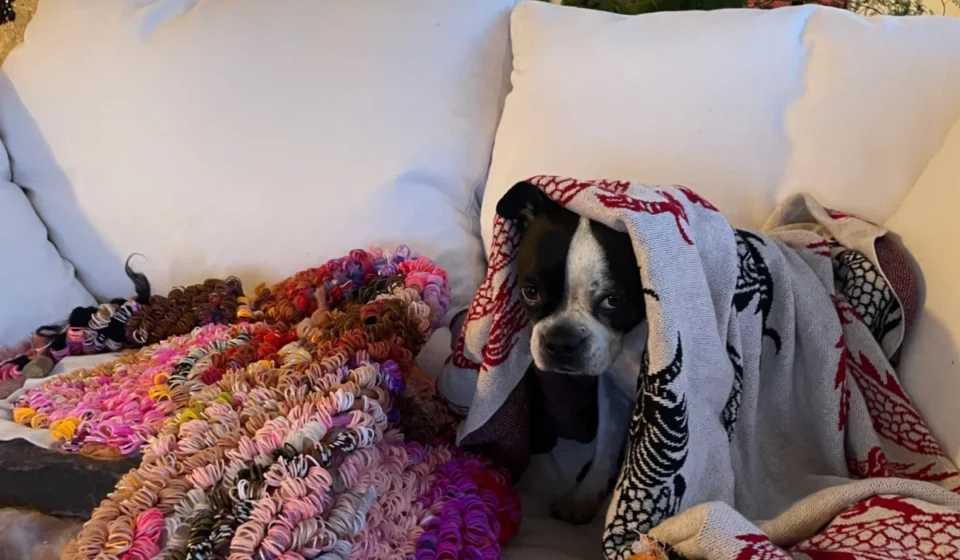
Stevie, a 9-year-old Boston Terrier, is a constant companion in the studio. Beyond her role as a pet, Stevie acts as a litmus test for the studio environment. Her ability to navigate around wet substrates and finished loom-band works is, in Buechler’s words, a quirky testament to the dog’s intuitive understanding of the artist’s process.

Notable Projects: A Portfolio of Deconstruction
Buechler’s work is marked by a deep desire to document moments in time.
The Satellite Series: Cosmos
Spanning 2022 to 2025, Cosmos is a 63-by-48-inch monument to the pandemic era. Created while quarantined, the piece incorporates broken jewelry, safety pins, glass, and recycled fabrics. It serves as a physical time capsule, demonstrating how confinement can lead to expansive, intricate output.

Palisade and the LA Fires
Created during the 2025 wildfires in Los Angeles, Palisade is a visceral reaction to environmental trauma. Using loom bands, wool, and felt, Buechler translated the terrifying sight of flames rising off the Santa Monica Mountains into a palette of blacks, grays, and piercing orange hues. The work stands as a defiance of the urge to flee, documenting a moment of staying grounded in the face of disaster.
The Alaska Commission
This piece explored the Japanese technique of Gyotaku—a method of creating a record of a fish catch—but elevated it into a textile sculpture. By using laser-cut plexiglass and fishing line, Buechler highlighted the technical intersection of the outdoors and the studio, noting that the patience required for fly-fishing is identical to the patience required for complex beading.

The Anatomy of Memory: Contemplation and The Weight of Memory
Drawing on childhood memories of "Walter," a human skeleton kept in her biochemist parent’s home, these two works represent a rare move toward figurative planning. By shifting away from her usual "freestyle" fluidity, Buechler forced herself to map out the anatomy of a skull, creating a poignant meditation on the physical remnants of the human experience.
Wild Like the West Texas Winds
Completed in 2019, this gouache-on-canvas painting remains one of her most cherished works. It represents a period of immense personal transition, created in the quiet moments between visiting her grandfather in a nursing home and working her daily job. It is a prime example of how Buechler uses painting as a meditative, expressive outlet that contrasts with the intense labor of her textile work.

Implications: The Future of the Studio Practice
Hannah Buechler sits at a crossroads common to many contemporary multidisciplinary artists. The "creative corporate job" has provided her with the financial stability to experiment, but the gravity of her studio practice is pulling her toward a full-time independent career.
Her work implies a shift in how we value "craft." By treating discarded materials—be it chip bags, broken jewelry, or fishing lures—with the same reverence as fine textiles, she elevates the ephemeral to the permanent. As she continues to refine her process, the implications for the art market are clear: there is a growing demand for work that is not only visually arresting but deeply rooted in the biography of the maker.

Whether through the lens of her fashion design work at Libertine or the intricate, bead-heavy surfaces of her studio practice, Buechler is building a legacy that celebrates the repetitive, patient, and often messy acts of creation. Her vision for the future—moving away from the corporate safety net to focus entirely on her art—is the next logical step in a career defined by the courage to experiment and the discipline to execute.
As Buechler continues to develop her "time capsule" approach to art, she offers a compelling model for the modern creator: one who does not choose between the commercial and the conceptual, but rather forces them to exist in a delicate, beautiful, and highly textured harmony.