The "Vibe-Coding" Disruption: Why DIY Lead Capture is Threatening the Event Industry’s Data Pipeline

By Event Technology Insights
Published: September 2026
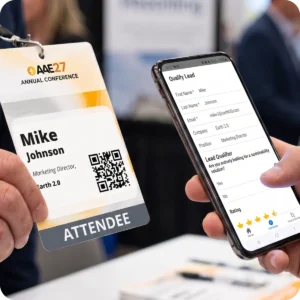
If you have spent any time walking a bustling convention center exhibit floor, you know that lead capture is the name of the game. For exhibitors, collecting contact information, scanning badges, and gathering prospective client data are the primary metrics that justify the hefty investment of a booth space.
However, standard app-driven barcode scanners and official event-tech platforms often come with steep, prohibitive add-on costs. Faced with tight marketing budgets, cash-strapped exhibitors are increasingly bypassing official channels entirely. Enter the era of "vibe coding"—the fast-evolving trend of using conversational AI tools, low-code APIs, and rapid prototyping platforms to spin up custom lead-capture solutions on the fly.
While building a bespoke, AI-powered badge scanner using tools like Replit, Lovable, or Clay might seem like a clever workaround for savvy marketers, industry leaders warn it is creating a ticking time bomb for event organizers. According to Adam Parry, co-founder of Event Tech Live, this decentralized approach to data collection threatens to blow a massive hole in event analytics, disrupt personalization efforts, and expose companies to severe cybersecurity risks.
Main Facts: The Rise of DIY Lead Capture
The traditional exhibition model relies on a centralized data pipeline. Historically, event organizers provided standardized badge-scanning hardware or official mobile apps, charging exhibitors extra fees for the privilege of collecting and exporting verified leads.
This closed-loop system served two primary functions:
- Quantifying ROI: It provided organizers with concrete engagement metrics to prove the event’s value to current and prospective sponsors.
- Standardizing Data: It funneled all interactions through a unified database, ensuring compliance and data hygiene.
Today, the proliferation of generative AI and rapid "vibe-coding" platforms has changed the landscape. Exhibitors no longer need a custom enterprise app built by developers. Instead, they can prompt AI models to generate functional web applications, integrate audio-transcription APIs, or deploy custom CRM connectors within minutes.
While these tools save exhibitors money upfront, they bypass official event platforms entirely. The result is a fragmented ecosystem where crucial engagement data remains siloed inside individual exhibitor spreadsheets, entirely invisible to the show organizers hosting the event.
Chronology: From Business Cards to AI Prototyping
To understand how the industry reached this precarious crossroads, it helps to examine the evolution of lead capture on the trade show floor:
- The Analog Era (Pre-2010s): Exhibitors relied on the humble business card fishbowl and manual badge-swiping machines. Data organization happened weeks after the event during tedious manual entry sessions.
- The App-Driven Boom (2010s–2023): Event tech companies introduced proprietary mobile apps and barcode-scanning hardware. While efficient, organizers frequently monetized these tools as high-margin add-ons, frustrating smaller exhibitors with limited budgets.
- The AI Acceleration (2023–2025): The rapid commercialization of advanced foundational models by companies like OpenAI and Anthropic lowered the barrier to technical entry. General-purpose automation and data tools like Clay gained widespread adoption.
- The "Vibe-Coding" Disruption (2025–Present): Non-technical marketers and startup founders began utilizing conversational AI prompts to build bespoke software applications instantly. "Vibe coding" transformed from a tech-culture meme into a viable workaround for trade show exhibitors looking to bypass expensive software licensing fees.
Supporting Data and Security Vulnerabilities
The financial savings of vibe-coded tools come with significant hidden costs—most notably concerning cybersecurity and data compliance.
Vibe-coded apps are notoriously prone to security vulnerabilities. Because these applications are often hastily constructed by non-developers using conversational prompts, they frequently lack standard enterprise security hardening. Recent investigative reports by outlets like Wired have highlighted how thousands of quickly assembled, AI-generated apps inadvertently expose corporate and personal data on the open web.
Furthermore, these practices sit uneasily alongside strict international regulatory frameworks like the European Union’s General Data Protection Regulation (GDPR). While large corporate enterprises maintain strict data privacy guardrails and invest in fully tested, compliant commercial software, smaller organizations frequently take calculated risks to gain a competitive edge.
Adam Parry compares this phenomenon to highway speeding: "It’s kind of like we all know that you shouldn’t speed on the highway or in town, but every now and again, you go over the speed limit."
Although high-profile regulatory penalties in the events sector—such as the massive GDPR fine levied against Mobile World Congress (MWC) for biometric data use in 2023—typically target large-scale entities, smaller players often assume regulatory enforcement will overlook them. This false sense of security encourages widespread rule-bending across the exhibit floor.

Official Responses and Industry Perspectives
Industry leaders are grappling with how to address the structural flaws in current expo-floor business models that incentivize exhibitors to break away from official systems.
Adam Parry argues that event organizers must fundamentally rethink how they monetize technology services. Rather than treating lead capture as an optional, high-cost upsell, organizers should bundle it directly into base exhibitor and sponsorship packages.
"I think lead capture should be given to exhibitors and sponsors ubiquitously, not necessarily sold as an additional add-on to them participating at the event," Parry states. He warns that viewing lead capture merely as a tactical revenue line on a budget sheet reflects short-term thinking that damages the long-term health of the event ecosystem.
By forcing exhibitors to pay extra for basic data collection, organizers inadvertently hand them a financial motive to seek out shadow-IT alternatives.
However, Parry is quick to note that AI and modern automation tools are not inherently enemies of the trade show industry. When integrated correctly into established platforms, AI can drastically reduce administrative friction. For instance, authorized tools equipped with audio-transcription capabilities can capture detailed conversational context during booth chats without forcing attendees to fill out tedious physical or digital forms.
Established event-tech providers—such as EventMobi—are already leveraging these advancements to enhance their native offerings. Parry notes that AI is empowering platforms to build advanced features that previously would not have made standard product roadmaps, ultimately bridging the gap between convenience and security.
Implications for Event Organizers and Exhibitors
The rise of decentralized, vibe-coded lead capture carries profound implications for all stakeholders in the business events industry:
1. For Event Organizers: The Data "Black Hole"
When exhibitors use unauthorized, AI-generated tools to scan badges or log notes, organizers lose visibility over critical engagement metrics. Without a centralized data pipeline, organizers cannot accurately measure booth performance, optimize floor layouts for future years, or provide concrete ROI validation to prospective sponsors. Furthermore, fragmented data makes comprehensive event personalization nearly impossible.
2. For Exhibitors: Compromised Lead Quality
While building a custom scraper may save money on software licensing, it often isolates the data. Without integration into a centralized CRM or event portal, sales teams lose access to broader contextual analytics provided by the event platform. This can result in poorly qualified leads and delayed follow-up times, ultimately defeating the primary purpose of attending the trade show.
3. For the Event Tech Sector: A Call to Evolve
The disruption caused by vibe coding serves as a wake-up call for commercial event-tech providers. To stem the tide of unauthorized tools, established platforms must drive down friction, improve user experience, and deliver undeniable value that justifies their cost. If traditional tech providers rise to the challenge, the pressure from shadow-IT alternatives could ultimately push the entire industry toward a more innovative, accessible, and secure future.
Frequently Asked Questions
Q: What is "vibe coding"?
A: "Vibe coding" refers to the practice of building functional software applications simply by conversing with generative AI models or using low-code/no-code platforms (such as Replit, Lovable, or Clay) without writing traditional lines of computer code.
Q: Why are exhibitors using AI tools for lead capture instead of official apps?
A: Many event organizers treat lead-capture software as an expensive add-on service. Cash-strapped exhibitors often turn to DIY, AI-generated alternatives to avoid these extra fees.
Q: What are the main risks of using vibe-coded apps at events?
A: Key risks include severe cybersecurity vulnerabilities (such as data leaks), non-compliance with data privacy regulations like GDPR, and the fragmentation of event data, which deprives organizers and exhibitors of holistic engagement insights.
Q: How can event organizers discourage exhibitors from using unauthorized tools?
A: Industry experts suggest that organizers should abandon the practice of upselling lead capture and instead include it as a standard, ubiquitous feature bundled into the baseline exhibitor and sponsorship fees.