Unveiling the "Hidden Mothers": The Ingenious, Eerie History and Modern Revival of 19th-Century Photography

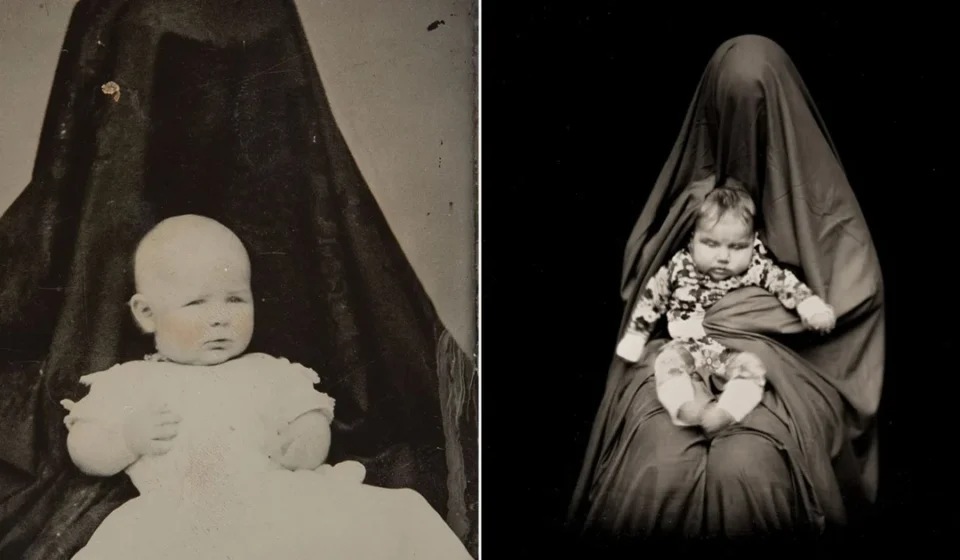
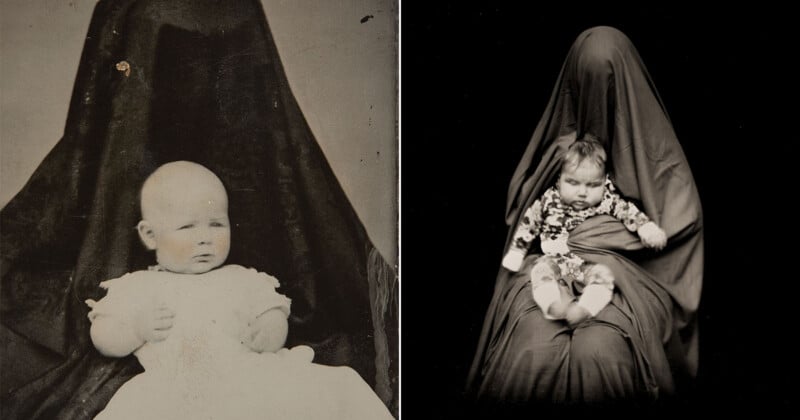
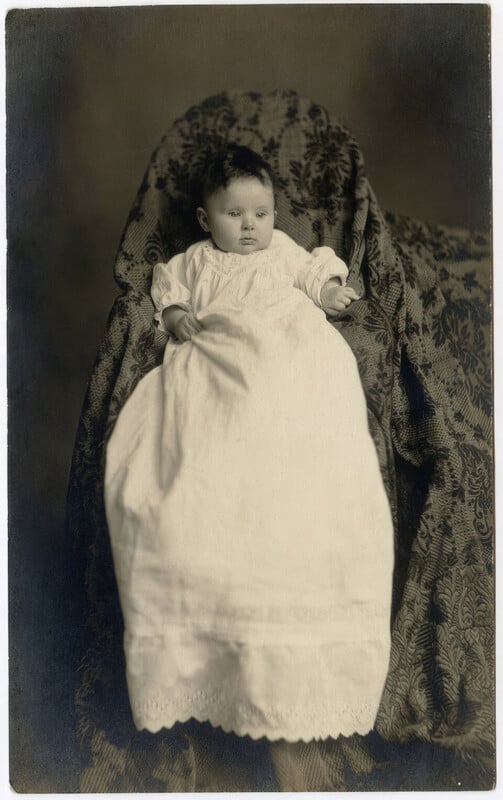
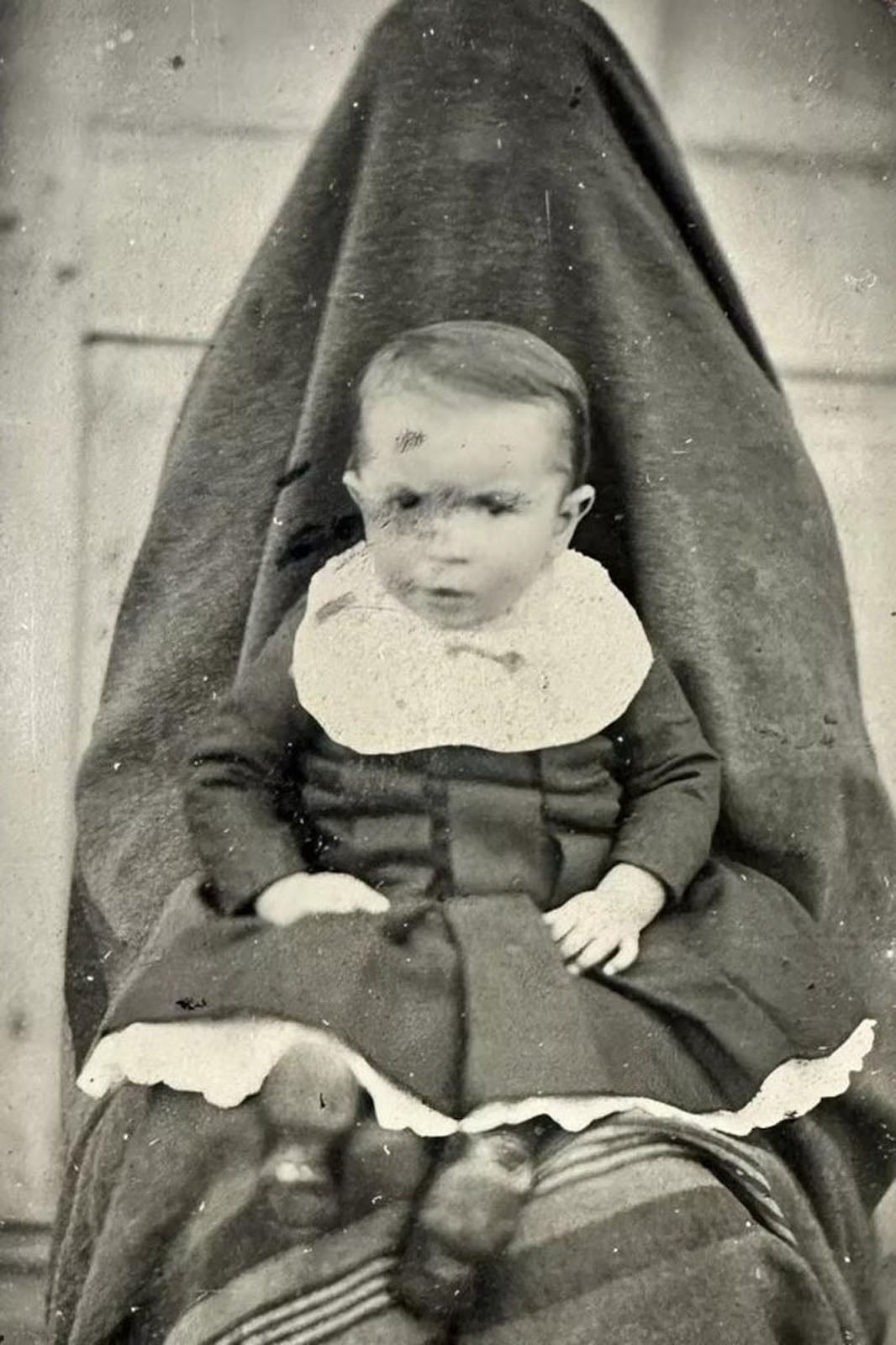
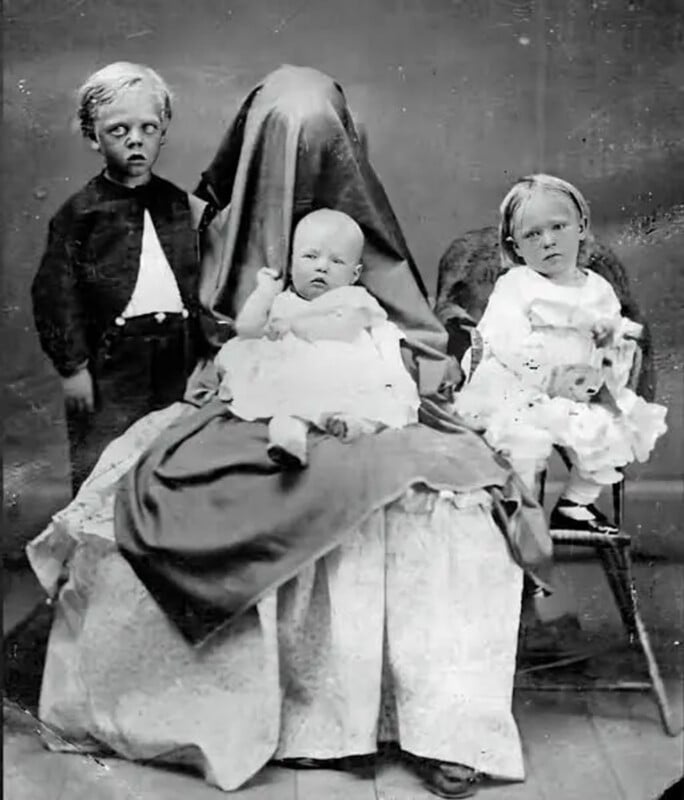
To the modern eye, few historical artifacts are as simultaneously fascinating and deeply unsettling as the 19th-century genre known as the "Hidden Mother." These vintage portraits, originating around the dawn of commercial photography in 1839 with the daguerreotype, typically feature a baby or young child posed upright—often seated in a chair or resting on a studio prop. Yet, standing or crouching directly behind the child is an adult, almost always a mother, completely obscured beneath a heavy, dark shroud, draped fabric, or patterned blanket.
To contemporary viewers steeped in horror tropes and ghost stories, these spectral figures look less like parents and more like figures out of a nightmare. They provoke intense internet fascination, frequently being misidentified or lumped together with spirit photography and post-mortem imagery.
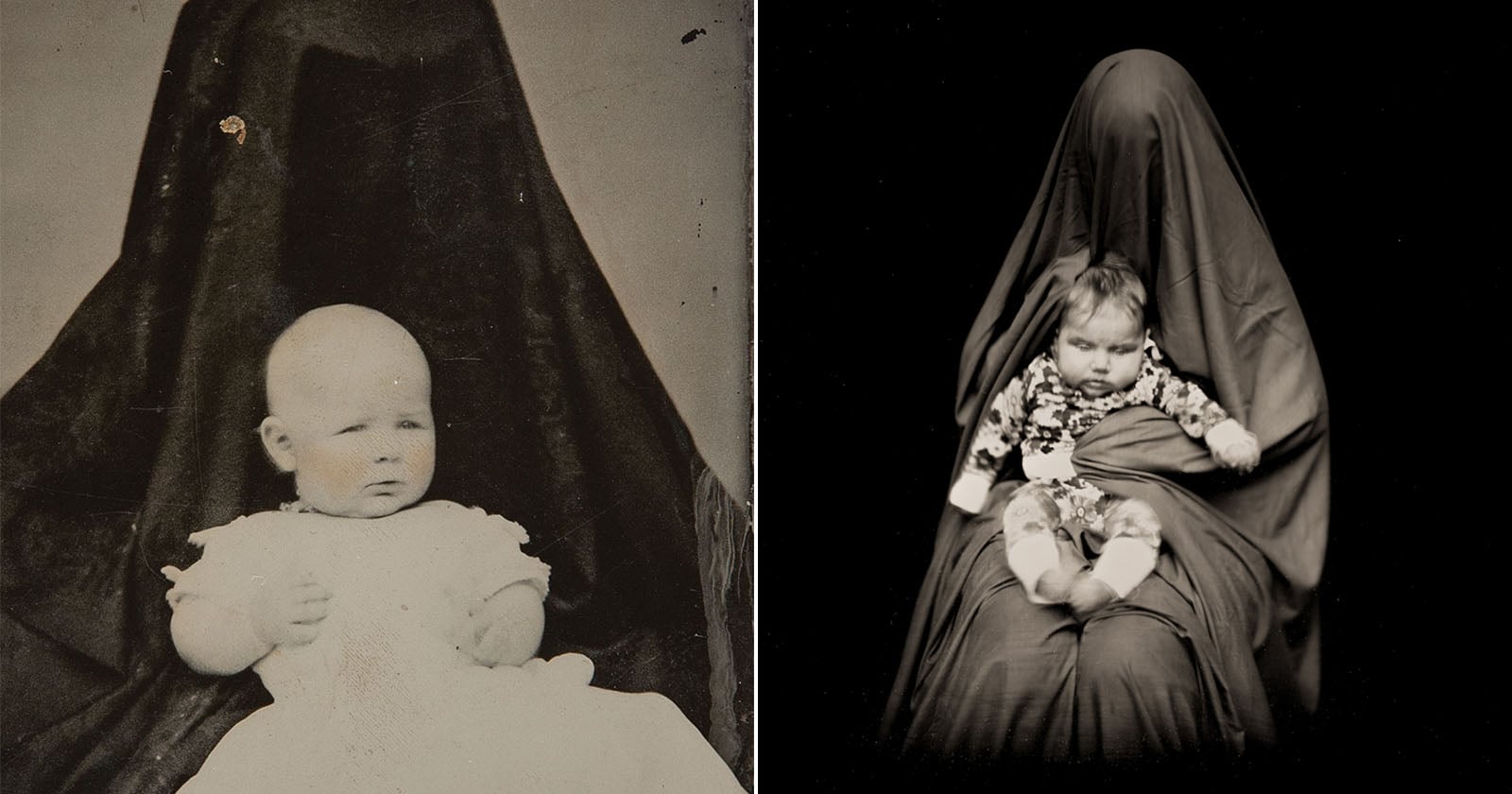
However, when the metaphorical veil is pulled back, these haunting images reveal a deeply pragmatic, touching story of parental love, technological limitation, and artistic ingenuity. Modern wet-plate collodion artist Shane Balkowitsch recently sought to demystify the genre by recreating the technique in his natural-light studio, shedding light on why these curious compositions came to be and what they tell us about the evolution of capturing human memory.
Main Facts: Decoding the "Hidden Mother" Phenomenon
The primary driver behind the "Hidden Mother" genre was purely technical: extreme exposure times.
During the mid-19th century—spanning the daguerreotype, ambrotype, and tintype eras—photographic emulsions were notoriously insensitive to light. Lenses were slow, and the chemical processes required the camera’s shutter to remain open for significant stretches of time. While modern digital cameras capture images in fractions of a millisecond, 19th-century exposures regularly demanded anywhere from a few seconds to several agonizing minutes of absolute stillness.
For adults, maintaining this stillness was difficult enough, frequently necessitating the use of heavy metal headbraces (posing stands) to keep subjects from blurring the frame. For infants and toddlers, absolute stillness was an absolute impossibility. Children naturally squirm, blink, crawl, and cry.
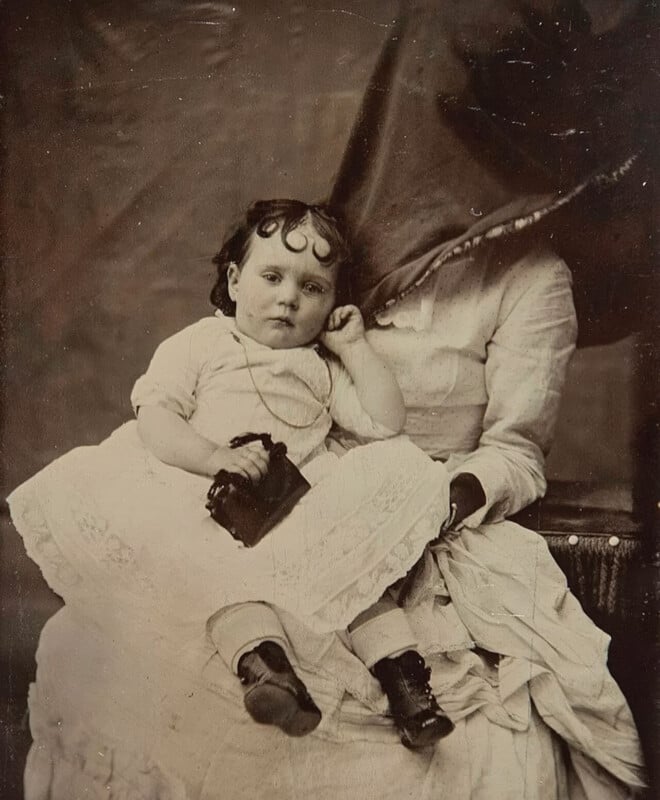
Because parents desperately wanted clear, treasured likenesses of their young children—at a time when child mortality rates were high and photography was an expensive, rare luxury—photographers devised ingenious workarounds. The mother would hold, steady, and comfort the child while cloaked in the same fabric used for the studio backdrop. Ideally, the adult would blend seamlessly into the background, leaving only the child sharply in focus. Depending on the photographer’s skill and composition, some parents hid behind draped chairs, while others were simply cropped out later if they stood just beyond the frame.
Chronology: From the Dawn of Photography to the 20th Century
1839 – The Inception
The birth of practical photography via Louis Daguerre’s daguerreotype process introduced the world to permanent, light-captured imagery. From the very infancy of the medium, portrait studios struggled with the inherent limitations of long exposure times.
The Mid-to-Late 19th Century – The Golden Age of Shrouds
As wet-plate collodion photography—introduced by Frederick Scott Archer in 1851—became the industry standard, the "Hidden Mother" technique flourished. Studios across Europe and North America routinely employed shrouds, drapes, and hidden seating arrangements to secure uncooperative young subjects.
1893 – The Documentation of Posing Stands
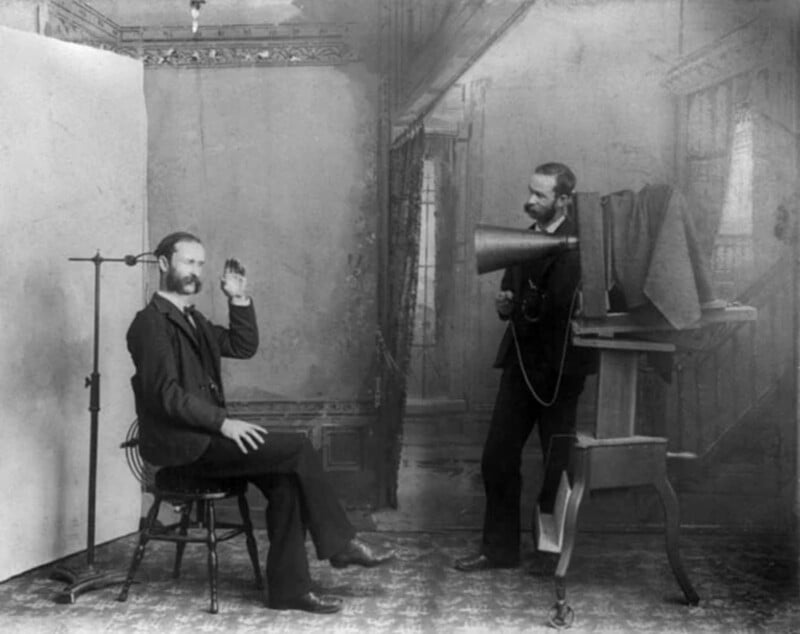
The necessity of stabilizing human subjects during long exposures was thoroughly documented by this era. Historic records, such as an 1893 photograph by A.H. Wheeler housed in the Library of Congress, illustrate the extensive mechanical aids—like headbraces—used to prevent motion blur in adult sitters.
1904–1937 – The Twilight of the Technique
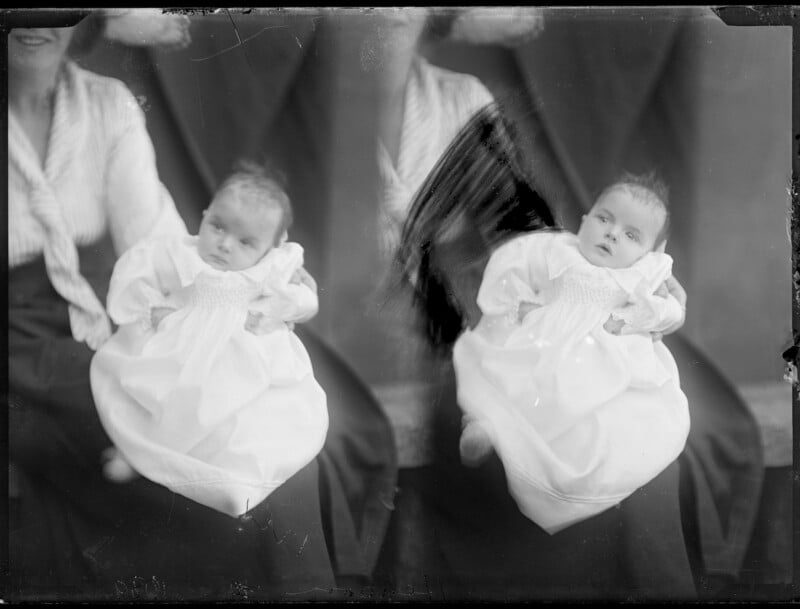
As photographic chemistry advanced, lenses grew faster, and plate photography gave way to more sensitive film emulsions, exposure times plummeted from minutes to fractions of a second. The need for hidden parental anchors evaporated, bringing a natural end to the "Hidden Mother" era by the 1920s and 1930s (such as the studio work of W. Vincent Kelly captured during this transition).
2013 – Cultural Re-evaluation
Swedish-Italian artist Linda Fregni Nagler published The Hidden Mother, a seminal book compiling over 1,000 of these vintage photographs. The publication cemented the genre’s status as a recognized sub-category of vernacular photography, causing physical copies and rare prints to fetch premium prices on the collector’s market.
Supporting Data: Technical Realities and Market Value
Understanding the "Hidden Mother" phenomenon requires looking closely at the hardware, chemistry, and economics of historic photography:
- Exposure Times: In a modern natural-light wet-plate studio, exposure times typically range from 6 to 12 seconds depending on the season. In the 1850s, without optimal natural lighting or fast lenses, exposures could easily stretch past a minute.
- The Gear: Contemporary practitioners like Shane Balkowitsch utilize large-format cameras—such as an Alessandro Gibellini 8×10 camera paired with a wide-open Carl Zeiss Tessar 250mm lens ($f$/4.5)—to recreate historical conditions.
- Archival Durability: A properly varnished wet-plate collodion ambrotype (silver on glass) is fully archival and can last up to 1,000 years if unbroken.
- Collector Demand: Vintage "Hidden Mother" photographs and specialized texts have exploded in economic value. Nagler’s 2013 compilation book routinely commands thousands of dollars on secondary markets like Amazon, while rare original 19th-century headbraces can fetch upwards of $10,000 at auction.
Modern Experimentation: Recreating History in the Studio
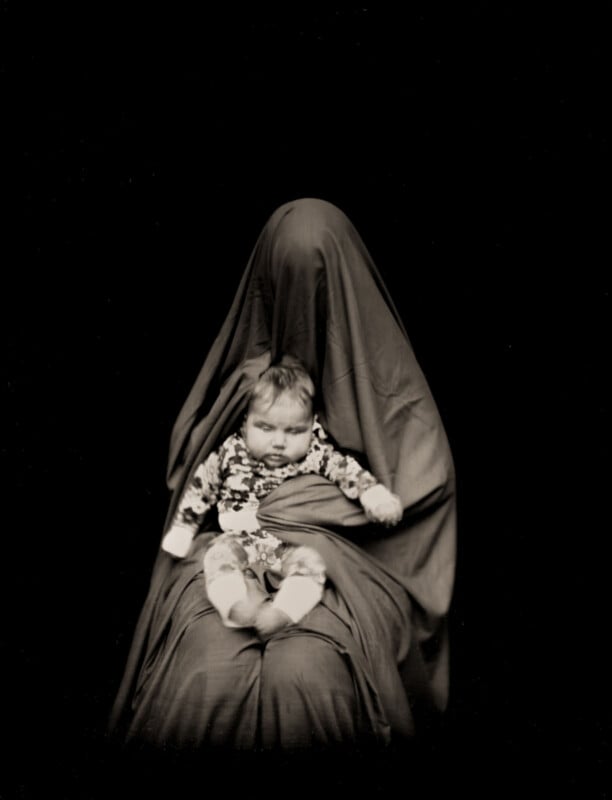
To truly understand the psychological and mechanical dynamics of the genre, wet-plate collodion photographer Shane Balkowitsch invited his friend Dana and her infant daughter, Mazie, into his studio to create a modern "Hidden Mother" plate.
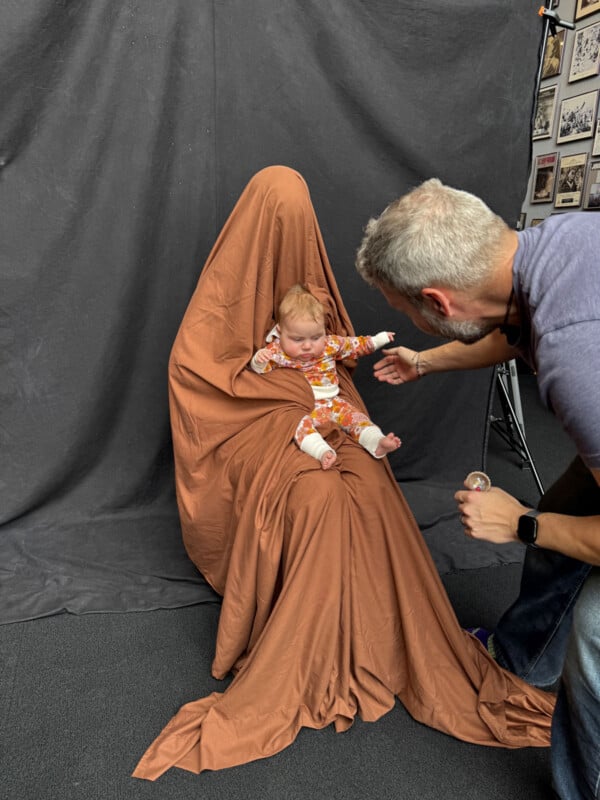
Using an Alessandro Gibellini 8×10 large format camera and an 8-second exposure time, Balkowitsch documented the process. The results validated the historical accounts:
- Sensory Comfort: Mazie had no idea her mother was shrouded beneath the dark fabric. She could still feel her mother’s warmth and hear her voice, which kept her calm.
- Physical Stability: Dana’s hidden embrace prevented the baby from sliding off the chair or tumbling out of frame.
- Distraction Techniques: Mazie’s father, Chris, stood just outside the camera’s framing, shaking a favorite rattle to give the infant a "safe face" to focus on.
Though Mazie kicked her legs with two seconds remaining—introducing a faint motion blur visible on the final glass plate—the resulting ambrotype, titled "Mazie’s Hidden Mother" (Plate #5804), successfully mirrored the artistic intent and aesthetic of 1850s studio photography.
Implications: The Myth of "Post-Mortem" Photography and the Digital Age
Debunking the "Dead Body" Myth
One of the most persistent misconceptions plaguing 19th-century photography is the conflation of headbraces and hidden supports with post-mortem photography. Laymen frequently encounter historical images featuring metal stands or shrouded figures and assume the subject is deceased.
Historians and photography experts repeatedly push back against this internet myth. The physical laws of "dead weight" mean that a slender, adjustable studio headbrace could never support the limp body of a deceased person. Furthermore, the psychological need for parents to capture lively, spirited portraits of their growing children far outweighs the morbid narratives often popularized online.
The Vulnerability of Digital Archives
As we reflect on the lengths to which 19th-century parents and photographers went to preserve a single image—agonizing over composition, mixing chemistry by hand, and waiting minutes for plates to expose—a stark contrast emerges regarding the digital age.
Today, humanity captures billions of photographs daily via smartphones, yet experts estimate that less than 1% of these digital files are ever printed into physical reality. Our modern photographic record is arguably more fragile than that of the Victorians. Digital files rely on proprietary software, hard drives, and cloud servers that are destined for technological obsolescence.
Conversely, a silver-on-glass ambrotype crafted in 1851—or replicated today—remains tangible, holding its integrity across centuries. The "Hidden Mother" genre stands not just as a quirky historical curiosity, but as a testament to the timeless human desire to cheat time and secure a permanent place in history for the next generation.