When Royalty Stargazed: London’s Historic King’s Observatory Hits the Market for $24 Million

There are exceedingly few addresses in London where a reigning monarch once climbed a winding staircase simply to gaze at the cosmos. Fewer still have transitioned from royal stargazing outposts and pivotal meteorological headquarters into ultra-luxury private residences. The King’s Observatory in Richmond is one of a kind.
Perched on nearly seven secluded acres within Richmond’s historic Old Deer Park—directly adjacent to the world-renowned Kew Gardens—this Grade I-listed architectural masterpiece has officially hit the open market for the first time in its illustrious history. Listed at £18 million (approximately $24 million) through Charlie Willis London, the property offers a rare blending of 18th-century regal heritage, centuries of scientific discovery, and modern luxury living.
Spanning roughly 7,300 square feet of meticulously restored interior space, the four-bedroom residence stands as a monument to Britain’s scientific and royal past. Yet, its story is far from finished. Alongside its historic splendor, the estate arrives with comprehensive planning permission for an additional 10,000 square feet of development—including subterranean parking for up to 17 vehicles—setting the stage for one of the most remarkable private compounds in the British capital.
Main Facts: The King’s Observatory at a Glance
- Location: Old Deer Park, Richmond, London (adjacent to Kew Gardens).
- Listing Price: £18 million (approx. $24 million USD).
- Real Estate Agency: Charlie Willis London.
- Current Size: Approximately 7,300 square feet of living space across four bedrooms.
- Property Grounds: Nearly 7 acres of private parkland, featuring landscaping influenced by Capability Brown and modern designs by Kim Wilkie.
- Architectural Heritage: Designed by renowned 18th-century architect Sir William Chambers and completed in 1769 for King George III.
- Development Potential: Approved planning permission for an additional 10,000 square feet, which would expand the estate to nearly 19,000 square feet, including staff quarters and a 17-car underground garage.
Chronology: Over 250 Years of Royal and Scientific History
The timeline of the King’s Observatory is a sweeping narrative that bridges Georgian pageantry, the Industrial Revolution, World War II strategy, and modern architectural preservation.

1769: Royal Commission and Construction
Commissioned by King George III, the Observatory was designed by the celebrated Scottish-Swedish architect Sir William Chambers—best known for his work at Somerset House and the Great Pagoda at Kew. Built specifically to allow the King, his family, and prominent astronomers to gather and observe the rare Transit of Venus across the sun, the building was positioned deliberately in the expansive meadows of Old Deer Park to secure unobstructed views of the horizon.
The 19th and 20th Centuries: A Hub of Global Science
Following its royal debut, the observatory evolved far beyond a royal viewing gallery. For generations, it operated as a premier institutional center for astronomy, precision timekeeping, geomagnetism, and meteorological research.
It played a critical role in standardizing scientific instruments and evaluating marine chronometers used by the British Royal Navy during the height of the British Empire. The building remained under the purview of the British Meteorological Office until 1980. Its storied scientific halls hosted some of the brilliant meteorological minds of the 20th century, including James Stagg. Stagg would later leverage the foundational meteorological data and methodologies honed during his career to advise Allied Supreme Commander Dwight D. Eisenhower on the treacherous, shifting weather windows ahead of the D-Day landings in June 1944. A plaque commemorating Stagg’s tenure remains mounted inside the building today.
2018: The Master Transformation
Following decades of institutional disuse, property developer Robbie Brothers undertook a monumental, multi-year restoration project. Working within the stringent guidelines required for a Grade I-listed building, Brothers and a team of historical conservationists, master craftsmen, and designers carefully revived the decaying structure. Completed in 2018, the painstaking renovation successfully rescued the 18th-century fabric of the building while seamlessly integrating state-of-the-art residential comforts, transforming a crumbling scientific relic into an extraordinary family home.

Present Day: A Historic Market Debut
Now, for the first time since George III laid its foundation stones over two and a half centuries ago, the King’s Observatory is available for private acquisition.
Supporting Data: Architecture, Interiors, and Grounds
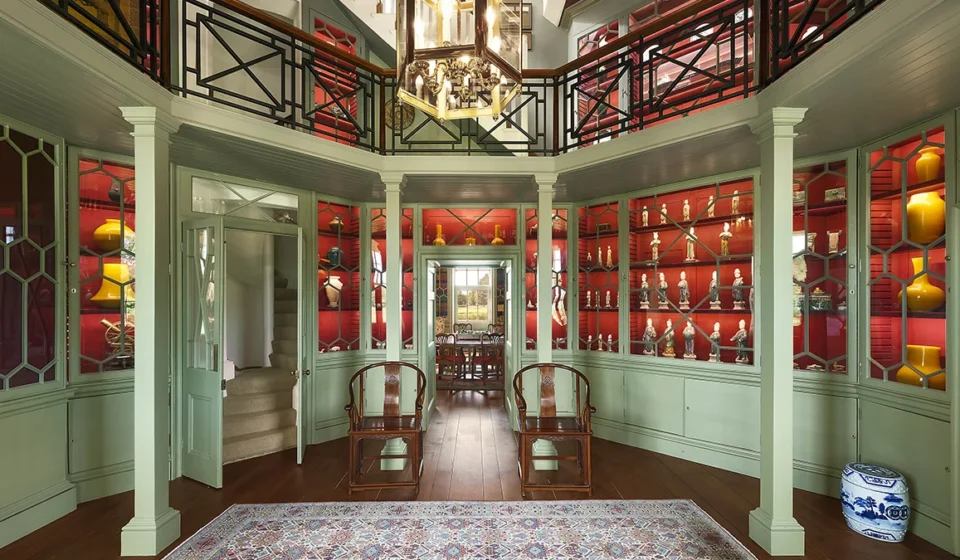
To step inside the King’s Observatory is to step back in time, yet the residence refuses to feel like a dusty museum. The careful marriage of historic artifacts and high-end interior styling defines every square foot of the main house.
The Interior Living Spaces
The approximately 7,300-square-foot floor plan balances grand entertaining spaces with intimate private quarters:
- The Library: Serving as the architectural anchor of the home, this magnificent room retains its original Georgian bookshelves, which currently house roughly 6,000 historic volumes. The soaring ceilings and rich millwork evoke the classic feel of an aristocratic English country house.
- The Dining Room: A masterclass in period-appropriate interior design, the dining space features bespoke, hand-painted wallpaper inspired by an authentic 18th-century view of Canton, paying homage to the global trade and exploration era of George III’s reign.
- The Main Sitting Room: Framed by tall, historic windows, the primary reception room offers sweeping, unobstructed views across the private lawns and ornamental water features, bathing the space in natural light.
- The Observatory Dome: Perched at the very top of the building, the original copper-capped dome remains fully accessible. Standing beneath its vaulted ceiling offers a profound sense of connection to history—the exact vantage point from which King George III watched the stars in 1769.
The Grounds and Landscape Architecture
The estate’s nearly seven-acre footprint feels entirely secluded, braying away the hustle and bustle of modern London.

- Landscape Heritage: Portions of the sprawling parkland trace their roots back to early landscape design principles laid down by Capability Brown, England’s most famous landscape architect.
- Modern Refinements: Contemporary landscape designer Kim Wilkie oversaw the recent integration of the modern gardens, which feature sweeping emerald lawns, mature specimen trees, an ornamental lake, and a charming stone boathouse.
- Future Expansion Potential: Beyond the existing 7,300 square feet, the sale includes approved planning permits to construct an additional 10,000 square feet of subterranean and above-ground structures. This approved master plan allows a future owner to add expansive staff quarters, underground wellness and leisure facilities, and a secure subterranean garage capable of housing up to 17 luxury automobiles—a rare commodity in prime London real estate.
Official Responses and Market Perspectives
The launch of the King’s Observatory onto the open market has generated immense buzz among architectural historians, high-net-worth buyers, and prime London real estate experts alike.
Real estate specialists at Charlie Willis London emphasize that properties of this caliber rarely surface. Unlike standard Georgian townhouses in Mayfair or Kensington, the King’s Observatory offers a unique triad: absolute privacy, royal provenance, and a sprawling pastoral estate footprint just a short distance from central London.
"To find a Grade I-listed property with this level of historical integrity—let alone one where a king literally walked the floors to study astronomy—is a once-in-a-generation occurrence," notes a representative close to the marketing campaign. "The fact that it has been brought up to modern luxury living standards without compromising its scientific soul is a testament to the vision of its recent developers."
Conservation bodies have also monitored the property closely. Because the building holds the highest tier of architectural protection in the United Kingdom (Grade I listing applies to buildings of exceptional national, architectural, or historical interest), any future developments—including the approved 10,000-square-foot expansion—must adhere to strict heritage guidelines. Historic England and local Richmond planning authorities have ensured that the delicate balance between modern livability and historical preservation is maintained.

Implications: What This Means for London’s Ultra-Prime Real Estate Market
The listing of the King’s Observatory at £18 million highlights several key trends currently shaping London’s top-tier property market:
1. The Premium on Provenance and History
In the upper echelons of global wealth, modern square footage is easily replicated, but historical pedigree cannot be manufactured. Ultra-high-net-worth buyers increasingly look for trophy assets that tell a story. Owning a home commissioned by a British monarch, utilized for groundbreaking global science, and featuring architectural details by Sir William Chambers offers a level of cultural capital that traditional new-build mansions simply cannot match.
2. Suburban Sanctuary vs. Urban Proximity
As urban centers become denser, estates that offer absolute privacy and vast green spaces while remaining tethered to a major metropolis command a significant premium. Situated in Richmond next to Kew Gardens and the winding Thames, the King’s Observatory provides a secluded countryside estate experience while remaining within easy reach of central London’s financial and cultural hubs.
3. The Value of Future-Proofing via Planning Permission
Securing planning permission for major subterranean expansions—such as the approved 17-car garage and additional 10,000 square feet of development—is notoriously difficult in historic London boroughs, particularly for Grade I-listed properties. By packaging the historic home with pre-approved, ready-to-execute expansion plans, the listing de-risks future development for prospective buyers, allowing them to customize the estate to their exact specifications without navigating years of bureaucratic hurdles.

Conclusion
The King’s Observatory is far more than a luxury home; it is a living archive of British history. From the royal stargazing sessions of the 18th century to the vital meteorological calculations of World War II, and now to its modern incarnation as a magnificent private sanctuary, the estate continues to evolve. For the discerning buyer ready to invest £18 million, it represents a rare invitation: to own a priceless piece of British heritage and write the next chapter in its extraordinary 255-year history.
Related posts: