Where the Drip Began: Jackson Pollock’s Historic West Village Apartment Hits the Market for $1.99 Million

Long before his chaotic, monumental canvases commanded nine-figure sums and redefined the boundaries of abstract expressionism, Jackson Pollock was simply a struggling 20-year-old art student sharing a modest, cramped Manhattan apartment with his brother.
Today, the historic top-floor residence at 46 Carmine Street in the heart of the West Village—where a young Pollock lived, slept, and practiced his craft during the height of the Great Depression—has officially hit the market. Listed at $1.99 million with Shane Boyle of Compass, the approximately 690-square-foot one-bedroom home offers a rare tangible link to the formative years of one of America’s most revolutionary artistic icons.
The listing arrives at an opportune moment for art historians and enthusiasts alike. It coincides with the Metropolitan Museum of Art’s major exhibition, Krasner and Pollock: Past Continuous, which runs through January 31, 2027, bringing together more than 120 defining works by Pollock and his equally legendary wife, Lee Krasner. While the next buyer of 46 Carmine Street will not have to share their living quarters with an aspiring master, they will undoubtedly inherit a storied piece of New York City’s rich cultural fabric.
Main Facts: The Property and the Pedigree
Nestled on a leafy, historic stretch of Carmine Street, the residence occupies the top floor of an 1827 Federal-style brick townhouse. Long before the block became one of the most coveted and affluent enclaves in Lower Manhattan, it served as a crucible for Depression-era creatives trying to carve out a living in an unforgiving economy.
- Location: 46 Carmine Street, Unit 4, West Village, Manhattan, New York.
- Asking Price: $1.99 million.
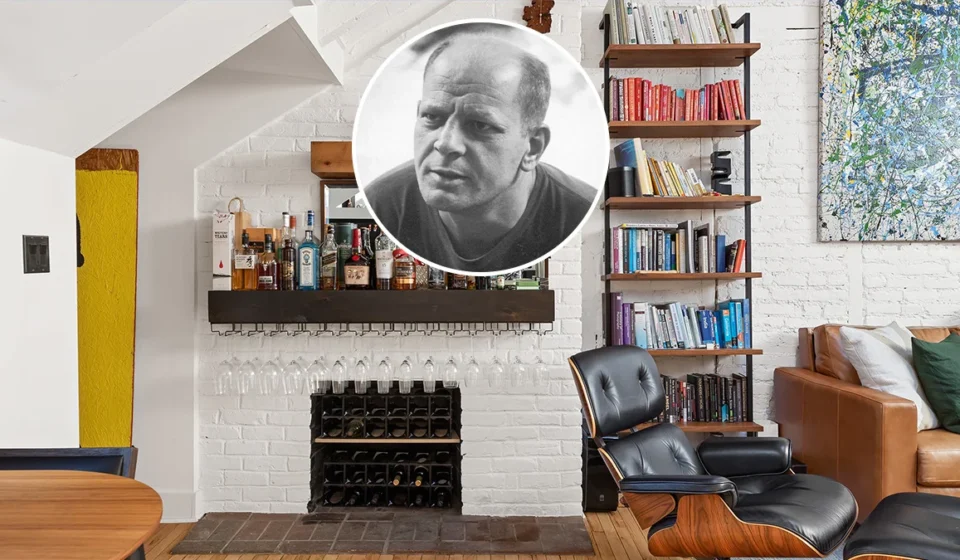
- Property Specs: Approximately 690 square feet, 1-bedroom, 1-bathroom, featuring 14-foot vaulted ceilings, four skylights, exposed brick, hardwood floors, an updated kitchen, and a functional upper loft space.
- Key Figures: Listed by Shane Boyle of Compass; currently owned by Irish entrepreneur and artist Fergus Hurley.
- Historical Significance: Home to Jackson Pollock from 1932 to 1933, shared with his older brother, Charles Pollock, and Charles’s wife, Elizabeth.
Though the apartment has undergone significant modern luxury renovations, it retains architectural markers of its past—most notably the soaring verticality and natural light streaming through expansive skylights that once illuminated the brothers’ makeshift studios.

Chronology: From Depression-Era Tenement to Modern Sanctuary
To understand the significance of 46 Carmine Street, one must look back nearly a century to the early 1930s, a period of profound economic hardship and intense artistic awakening in New York City.
1932–1933: The Pollock Brothers’ Enclave
In the early 1930s, a 20-year-old Jackson Pollock relocated to New York, landing in the top-floor, two-room apartment at 46 Carmine Street. He shared the space with his older brother, Charles—himself an accomplished artist and printmaker—and Charles’s wife, Elizabeth.
Far from the glamorous, expansive artist lofts that would later define SoHo and TriBeCa lore, this space was utilitarian and tight. The apartment functioned as a dual-purpose domicile and studio: Charles worked in the front room facing the street, while Jackson set up his workspace in the back. During this era, Jackson was scraping by financially, navigating the brutal realities of the Great Depression while studying under Regionalist painter Thomas Hart Benton at the Art Students League.
Crucially, the iconic "drip" painting technique that would cement Pollock’s legacy—his radical method of laying raw canvas on the floor and rhythmically pouring, splashing, and flinging paint—was still more than a decade away from invention. At 46 Carmine Street, he was a traditional student mastering draftsmanship, composition, and figure drawing under Benton’s watchful eye.
2010: Preservation of the District
The physical building housing the apartment has witnessed nearly two centuries of Manhattan history. Originally constructed in 1827 during the Federal architectural period, the townhouse was formally absorbed into the Greenwich Village Historic District in 2010, ensuring that its classic brick facade and historic streetscape would be legally protected from future out-of-character alterations.

2020–2021: A Modern Artistic Interlude
The apartment’s artistic lineage found a new torchbearer in current owner Fergus Hurley. An entrepreneur who relocated from Ireland to New York in 2020, Hurley initially rented the apartment before recognizing its unique aura and purchasing it off-market the following year.
During the COVID-19 pandemic lockdowns, Hurley utilized the apartment’s soaring loft space as a personal studio. Channeling the spirit of his famous predecessor, Hurley created a massive abstract expressionist painting inside the unit. In a poignant nod to modern history, his artwork was painted on reclaimed wooden boards that had been used to cover SoHo storefronts during the 2020 George Floyd protests.
Present Day: Hitting the Open Market
Now splitting his time between Miami and San Francisco, Hurley has decided to part ways with the historic residence. He has enlisted Shane Boyle of Compass to bring the property to market at just under $2 million. While Hurley’s pandemic-era protest painting is not automatically included in the sale, industry insiders note that negotiations for the artwork could potentially be arranged separately.
Supporting Data: Architectural Evolution and Market Context
The evolution of 46 Carmine Street mirrors the broader transformation of the West Village from a working-class immigrant neighborhood and bohemian haven into one of the most expensive real estate enclaves in the United States.
- Square Footage Value: At an asking price of $1.99 million for roughly 690 square feet, the property commands approximately $2,884 per square foot—reflecting both its prime Greenwich Village zip code and its irreplaceable cultural provenance.
- Architectural Upgrades: The modern incarnation of the apartment features high-end amenities that would have been unimaginable to the Pollock brothers in 1932. These include an updated chef’s kitchen, a sleek contemporary bathroom, whitewashed exposed brick walls, and custom hardwood flooring.
- Natural Light: The integration of four skylights into the 14-foot vaulted ceilings ensures that the top-floor unit is flooded with natural daylight—a critical amenity for painters then and now.
- Comparative Inventory: The West Village luxury market remains exceptionally robust. Recent high-end listings in the immediate vicinity include a Hudson River-view condo listed at $9 million and a penthouse in a converted 1860 church on the market for $19 million, cementing the neighborhood’s status as a magnet for high-net-worth buyers seeking architectural character.
Official Responses and Broker Insights
Real estate professionals handling high-profile historical properties often find themselves balancing the physical realities of a vintage home with the intangible emotional value of its history.

Shane Boyle of Compass, the listing agent charged with selling the property, emphasizes that homes like 46 Carmine Street offer a rare narrative depth that cannot be replicated in new-construction glass towers.
"When you step onto the top floor of 46 Carmine Street, you aren’t just looking at exposed brick and vaulted ceilings; you are standing in the exact room where a young artist was quietly figuring out how to change the course of art history," notes market observers familiar with the listing. While the apartment has been polished, modernized, and tailored for contemporary comfort, the underlying bones of the space remain remarkably connected to the early 1930s bohemian ethos of Greenwich Village.
Implications: Preserving Bohemian History in Modern Manhattan
The sale of Jackson Pollock’s former West Village apartment raises broader questions about how historic art spaces are valued, preserved, and consumed in the 21st-century real estate market.
1. The Commodification of Bohemian Spaces
As Manhattan real estate prices continue to climb, historic enclaves that once fostered starving artists have become exclusively accessible to wealthy executives, entrepreneurs, and investors. Properties like 46 Carmine Street bridge these two worlds. They represent a vanishing era when New York City was economically accessible enough to harbor unproven talents like a 20-year-old Jackson Pollock, even if today those same spaces require a multi-million-dollar entry fee.
2. The Intersection of Real Estate and Fine Art
The marketing of this apartment alongside major institutional events—such as the Metropolitan Museum of Art’s Krasner and Pollock retrospective—demonstrates a sophisticated synergy between the cultural art world and luxury real estate. Aligning a property listing with a major museum exhibition elevates the home from a mere commodity to a collectible artifact.

3. A Continuing Legacy
For the eventual buyer, 46 Carmine Street offers more than just prime West Village square footage, top-tier restaurants at their doorstep, and architectural charm. It offers a lineage. As Fergus Hurley proved during his tenure in the loft, the creative energy of the space is infectious—proving that long after the dust of the Great Depression settled and the paint dried on Pollock’s early sketches, the walls of 46 Carmine Street are still very much dripping with creative potential.
Related posts: