
For decades, the hierarchy of the camera lens market was rigid: first-party glass (Canon, Nikon, Sony, Fujifilm) occupied the premium tier, while third-party manufacturers were often viewed as "budget" compromises. However, the landscape has shifted dramatically. Today, photographers—especially those early in their careers—are finding that the barrier to entry for professional-grade, wide-aperture optics is crumbling. At the forefront of this disruption is Viltrox, a company that has successfully bridged the gap between affordability and uncompromising optical performance.
By delivering prime lenses that offer "bright" apertures (f/1.2 to f/1.8), Viltrox has forced a reckoning in the industry. For young professionals and enthusiasts, the choice is no longer between expensive native glass or lackluster third-party alternatives. Instead, they now have a viable, high-performance path that does not sacrifice artistic intent for budget constraints.
The Core Philosophy: Democratizing Professional Glass
The central appeal of Viltrox’s recent "Pro" and "Lab" series lenses lies in their technical specifications, which often mirror or exceed the performance of lenses priced three times higher. The company’s approach is systematic: prioritize weather sealing, metal construction, advanced electronic communication with camera bodies, and, most importantly, sophisticated optical formulas that handle modern, high-resolution sensors with ease.
This shift in strategy is not merely about undercutting competitors; it is about performance parity. As our testing at The Phoblographer has shown, these lenses are no longer "budget" options. They are professional tools that happen to be priced accessibly.
A Chronology of Innovation: The Viltrox Prime Evolution
Viltrox’s rise has been marked by a series of deliberate, high-impact product launches that targeted specific segments of the photography community.
The Ultra-Wide Breakthrough: Viltrox AF 16mm f/1.8
Released to target the full-frame landscape and astrophotography market, the 16mm f/1.8 was a watershed moment. Traditionally, ultra-wide primes with such wide apertures were bulky, prone to heavy distortion, and prohibitively expensive. Viltrox changed the narrative by introducing a lens that weighed only 550g and featured a 0.27m close-focusing distance. It arrived with a premium feature set: a customizable LCD screen on the barrel, a dedicated aperture ring, and robust weather sealing. It proved that Viltrox could handle complex optical challenges—like distortion control and edge-to-edge sharpness—without needing a massive price tag.
The Street Photography Powerhouse: Viltrox 27mm f/1.2 PRO
For the Fujifilm ecosystem, the 27mm f/1.2 PRO became an instant classic. By providing a 55mm full-frame equivalent field of view, it hit the "sweet spot" for street and portrait photography. Its significance lay in its speed. Achieving f/1.2 on a crop sensor system provided a depth-of-field separation previously reserved for full-frame sensors. Its focus speed rivaled the acclaimed 23mm f/1.4 R WR, and its optical rendering—characterized by "dreamy" bokeh and sharp contrast—cemented its place as a must-have for Fujifilm users.
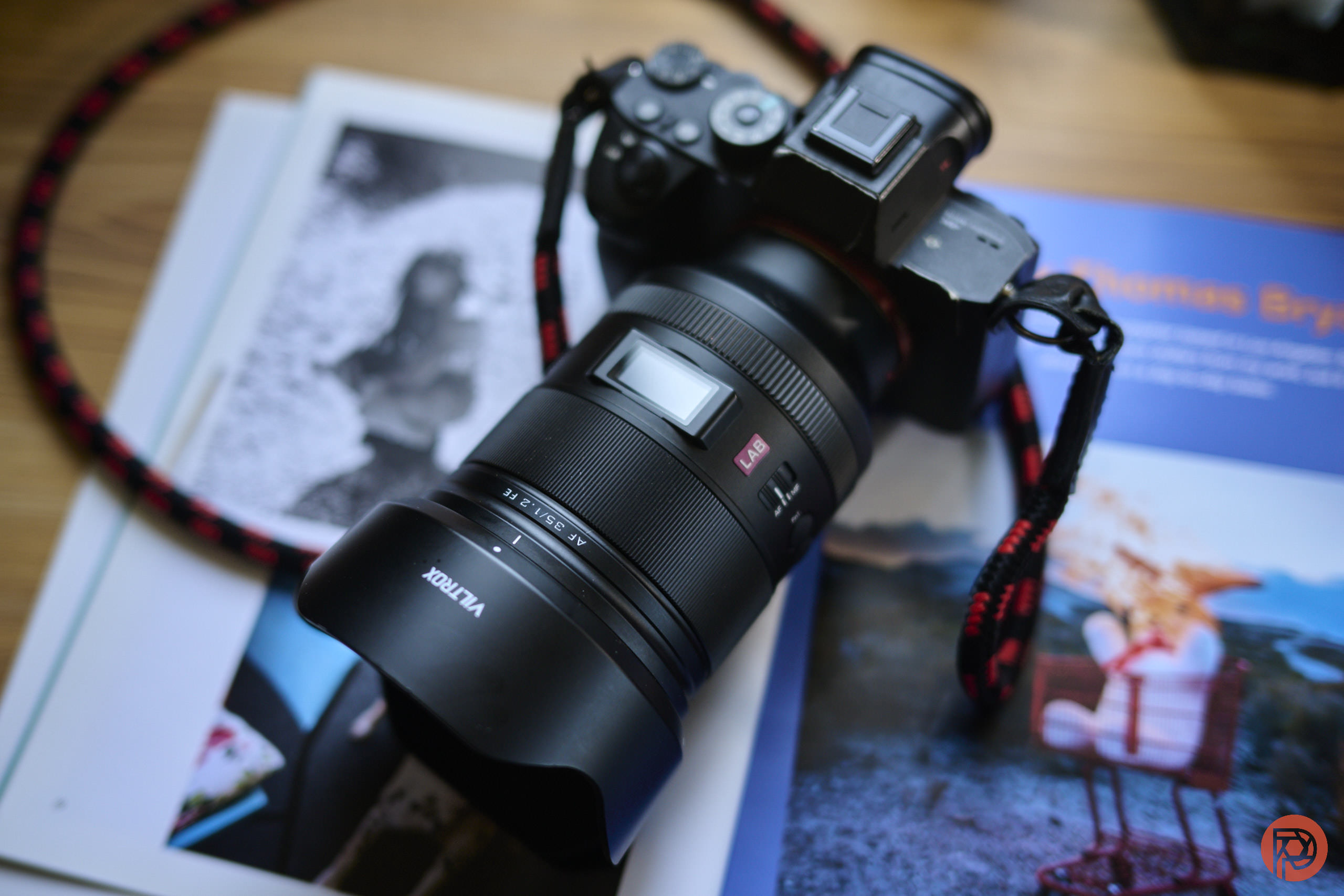
The "Lab" Milestone: Viltrox 35mm f/1.2 FE Lab
The introduction of the "Lab" series signaled Viltrox’s graduation into high-end, enthusiast-grade optics. The 35mm f/1.2 FE is a masterclass in modern lens design. By utilizing 5 ED (Extra-low Dispersion), 3 HR (High Refractive), and 2 UA (Ultra-Aspherical) elements, the lens produces images with clinical sharpness and rich color reproduction. During our tests with the Sony a7V, the autofocus performance was so consistent that it was difficult to distinguish it from Sony’s own G Master series.

The Portrait Master: Viltrox 50mm f/1.4 AF PRO LAB
Most recently, the 50mm f/1.4 AF PRO LAB has pushed the boundaries further. With 15 elements in 11 groups and a sophisticated 11-blade aperture mechanism, this lens serves as a testament to the brand’s commitment to "sublime" bokeh. It caters to the high-resolution requirements of modern Sony and Nikon full-frame cameras, offering reliable scene-detection autofocus even in challenging, low-light environments.
Supporting Data: The Technical Edge
To understand why these lenses are causing a stir, one must look at the specifications. Across the board, Viltrox has moved away from plastic housings, opting for durable metal builds that withstand the rigors of professional field use.
| Lens Model | Aperture | Build Type | Notable Feature |
|---|---|---|---|
| 16mm f/1.8 | f/1.8 | Metal/Weather Sealed | Integrated LCD screen |
| 27mm f/1.2 | f/1.2 | Metal/Weather Sealed | 11 Aperture Blades |
| 35mm f/1.2 | f/1.2 | Metal/Weather Sealed | Lab-grade ED/HR/UA elements |
| 50mm f/1.4 | f/1.4 | Metal/Weather Sealed | Clicked aperture mechanism |
Beyond the specs, the "feel" of these lenses is a major factor. The inclusion of physical aperture rings with "click" mechanisms caters to both photographers who prefer tactile control and videographers who require smooth transitions. The autofocus reliability, particularly when paired with the latest eye-tracking and subject-detection algorithms in modern mirrorless cameras, shows that Viltrox has effectively reverse-engineered or licensed the protocols necessary for seamless integration.
Official Responses and Industry Reception
The industry reception to Viltrox has been one of cautious observation turning into genuine respect. Initially, critics were skeptical of the brand’s ability to maintain long-term reliability. However, as independent reviews (including our own testing) have consistently noted, the "real-world" performance is undeniable.

When we tested the 35mm f/1.2, the consensus was clear: it is a lens that defies its price category. We observed that the sharpness is comparable to the best in the industry, and the color rendition—often a weakness in budget third-party lenses—is surprisingly rich and accurate. The company has essentially invited photographers to "test the limits," and in most cases, the lenses have held their own against the heavyweights from Japan and Germany.
Implications for the Future of Photography
The success of Viltrox carries significant implications for the photography industry at large.
1. The Death of the "Entry-Level" Compromise
For years, the industry operated under the assumption that if you wanted a "pro" lens, you had to pay a "pro" price. Viltrox has destroyed this correlation. By providing high-end optics at a fraction of the cost, they are allowing young photographers to invest their limited budgets into better camera bodies or travel, rather than sinking it all into one or two lenses.
2. Pressure on First-Party Manufacturers
First-party lens manufacturers are now facing a dilemma. They can no longer justify their high prices based solely on optical quality. They must now focus on proprietary features (such as specialized coatings, extreme weather resistance, or unique focal lengths) to differentiate their products from the Viltrox alternatives. This competition is ultimately a win for the consumer.

3. The Shift in Brand Loyalty
Brand loyalty, once defined by the logo on the front of the lens, is shifting toward "value loyalty." Photographers are increasingly asking, "What is the best lens for my money?" rather than "What is the best lens in the system lineup?" Viltrox has positioned itself as the answer to the former.
4. Innovation Beyond the Glass
The addition of LCD screens on lens barrels and advanced internal element configurations (like those in the Lab series) shows that Viltrox is not just copying designs; they are innovating. They are looking at the user experience and asking what features would make a photographer’s life easier in the field.
Conclusion
Viltrox has successfully transitioned from a budget-friendly manufacturer to a serious contender in the optical space. Through a combination of rigorous testing, high-quality material usage, and a deep understanding of what modern mirrorless systems require, they have earned their place in the bags of professionals and amateurs alike.
Whether it is the expansive 16mm f/1.8 for the landscape artist, the 27mm f/1.2 for the street shooter, or the 50mm f/1.4 for the portrait specialist, Viltrox offers a lens for every need. The era of the "expensive-only" prime is coming to a close. For the photographer looking to push their creative boundaries without breaking the bank, the Viltrox portfolio is not just an alternative—it is a destination.