
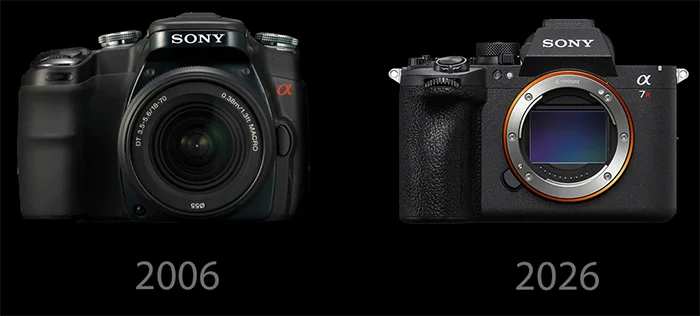

On June 5, 2006, the photography world witnessed an event that many industry traditionalists dismissed as a curiosity: Sony, a consumer electronics giant, announced its entry into the interchangeable lens market with the Alpha 100. Twenty years later, that "outsider" has cemented its status as the most dominant force in imaging history. The journey from the A-mount DSLR era to the cutting-edge, AI-driven mirrorless systems of 2026 is a masterclass in technological evolution and market disruption.
The Genesis of an Icon (2006–2009)
Sony’s entry into the camera market was not a leap into the dark, but a strategic acquisition of Konica Minolta’s imaging legacy. By inheriting the A-mount system, Sony gained instant credibility. The Alpha 100, featuring a 10.2-megapixel APS-C sensor and the revolutionary "SteadyShot INSIDE" in-body image stabilization, immediately set the tone: Sony would focus on democratization. By moving stabilization from the lens to the body, Sony made high-end imaging features accessible to enthusiast photographers.
The momentum gathered quickly. By 2008, the release of the Alpha 900 marked a turning point. As the company’s first full-frame DSLR, it offered 24.6 megapixels and proved that Sony could compete with the established giants of the era. The 2009 expansion, featuring a wide array of models from the entry-level A230 to the powerhouse A850, demonstrated that Sony was committed to serving every segment of the market simultaneously.
The SLT Revolution: Bridging the Gap (2010–2012)
Perhaps the most daring move in Sony’s history occurred in 2010 with the introduction of Translucent Mirror Technology (SLT). By using a fixed, semi-transparent mirror, the A33 and A55 cameras achieved continuous phase-detection autofocus during both stills and video—a feat previously thought impossible for DSLRs.
This period was defined by the A77, which arrived in 2011 as a high-speed flagship. With its 24.3-megapixel sensor and 12 frames-per-second burst rate, it pushed the boundaries of what enthusiasts could expect. The 2012 launch of the A99, the world’s first full-frame SLT camera, served as the peak of this design philosophy, proving that Sony’s commitment to innovation was fundamentally changing the industry’s trajectory.
The Mirrorless Paradigm Shift (2013–2016)
If 2010 was the year of the SLT, 2013 was the year of the mirrorless revolution. Sony’s announcement of the Alpha 7 and Alpha 7R changed the landscape forever. These were the world’s smallest and lightest full-frame mirrorless cameras, signaling the beginning of the end for the traditional DSLR.
The "R" series—representing resolution—became an instant favorite for landscape and studio photographers, while the subsequent introduction of the "S" (sensitivity) line in 2014 carved out a massive niche for low-light and video professionals. By 2015, the Alpha 7R II introduced the world’s first back-illuminated full-frame sensor, further solidifying Sony’s position as the leader in sensor technology. The 2016 expansion into the APS-C mirrorless space with the A6300 and A6500 brought professional-grade AF acquisition to a compact form factor, making Sony the brand of choice for hybrid creators.
The Era of Speed, AI, and Dominance (2017–2021)
From 2017 to 2021, Sony shifted from being a "disruptor" to the market leader. The Alpha 9 (2017) revolutionized sports photography with 20 frames-per-second blackout-free shooting. The A7 III (2018) became the industry benchmark for the "standard" full-frame camera, offering a balance of performance and price that forced competitors to scramble.
In 2020 and 2021, Sony leaned heavily into the needs of the modern content creator. The Alpha 7S III and the flagship Alpha 1—with its staggering 50.1-megapixel sensor and 8K video capability—proved that Sony was no longer just a hardware company, but an essential component of the professional creative workflow.
Pushing the Boundaries of Physics (2022–2026)
The most recent five years have focused on refining the "impossible." The Alpha 7R V (2022) introduced dedicated AI processing, fundamentally changing how autofocus tracks subjects in complex environments. 2023 saw the release of the Alpha 9 III, which utilized a global shutter to eliminate rolling shutter artifacts—a historic achievement in imaging engineering.
The trajectory continued through 2024 and 2025 with the second-generation Alpha 1 II and the fifth-generation Alpha 7 V, which featured the company’s first partially stacked sensor design. Finally, the 2026 release of the Alpha 7R VI stands as the current pinnacle of the Alpha system, showcasing an unprecedented level of resolution and processing speed that would have been unimaginable to the engineers who designed the Alpha 100 in 2006.
Supporting Data: The Growth of the Ecosystem
The success of the Alpha series is rooted in the E-mount ecosystem. While competitors often struggled to transition from legacy lens mounts, Sony’s early and aggressive development of the E-mount allowed for a seamless migration to mirrorless. As of 2026, the E-mount boasts one of the largest and most diverse lens selections in the world, ranging from compact prime lenses for travel to professional G-Master glass for cinematographers.
Market analysis shows that Sony’s R&D spend in imaging has consistently outpaced the industry average. This investment has led to:
- Sensor Dominance: Sony remains the primary supplier of image sensors for a significant portion of the global camera market.
- AF Accuracy: The transition from phase-detection to AI-driven real-time tracking has improved hit rates by an estimated 400% compared to 2010-era DSLRs.
- Video Integration: The Alpha line is now the standard for modern vlogging, independent filmmaking, and professional broadcast.
Official Responses and Industry Impact
In recent press materials regarding the 20th anniversary, Sony executives highlighted that the success of the Alpha system was never about the camera body alone, but about "the relentless pursuit of the creator’s vision."
"When we launched the Alpha 100, we were outsiders," stated a Sony spokesperson. "Today, we view our responsibility as providing the tools that define the next generation of visual storytelling. The Alpha system is not just a collection of cameras; it is a platform that has allowed us to listen to the feedback of millions of photographers and translate that into tangible, high-speed innovation."
Industry analysts agree, noting that Sony’s strategy of maintaining one mount for both APS-C and full-frame bodies provided a level of future-proofing that no other manufacturer has successfully replicated.
The Future Implications
As we look toward the next decade, the implications of the Alpha system’s 20-year history are clear: the era of the mechanical camera is effectively over. The future of photography is computational, software-defined, and increasingly reliant on integrated AI.
The Sony Alpha 7R VI and its contemporaries represent a convergence of high-resolution stills and cinema-grade video, suggesting that the divide between "photographer" and "videographer" will continue to blur. For Sony, the goal is no longer just to build a better camera—it is to build a smarter, faster, and more connected imaging system that anticipates the creator’s needs before they even press the shutter.
From an outsider in 2006 to the definitive leader in 2026, Sony’s Alpha journey proves that while the technology may change, the core desire to capture the world in stunning detail remains the driving force of the industry. The next twenty years will undoubtedly be defined by the foundation laid by these first two decades of innovation.