Trapped in the Inferno: Northern Ontario Wildfire Crisis Escalates as CN Rail Train Narrowly Escapes Destruction

By [Your Name/Journalism Desk]
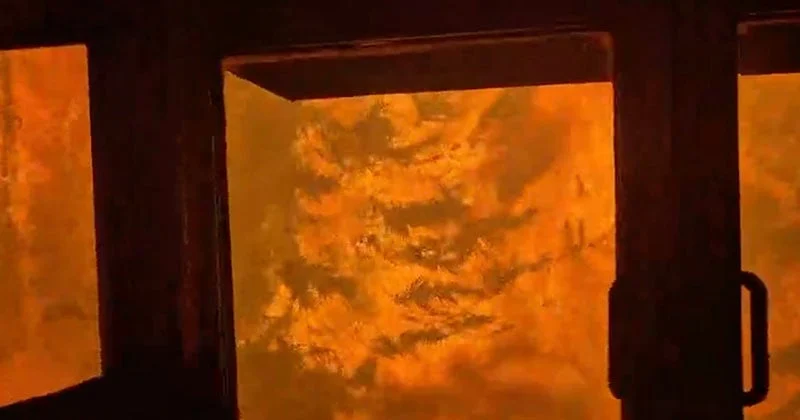
A harrowing video captured from inside the cabin of a Canadian National (CN) Railway train has provided a chilling, visceral look at the escalating wildfire crisis in Northern Ontario. The footage, which has circulated rapidly across social media platforms, depicts a scene of apocalyptic intensity: a commercial freight train stalled amidst a towering, encroaching wall of fire near the community of Armstrong. The incident has ignited a firestorm of its own, prompting urgent questions regarding corporate safety protocols, the vulnerability of critical infrastructure, and the mounting peril facing remote Canadian communities as climate-driven wildfires become increasingly unpredictable.
The Anatomy of a Near-Catastrophe
The video, originally shared by Ontario politician Sol Mamakwa, offers a claustrophobic view of the disaster. Through the reinforced glass of a train window, the forest is not merely burning; it has been transformed into a furnace. Intense orange flames lick the side of the tracks, and thick, billowing smoke obscures the horizon, casting an eerie, hellish glow across the interior of the locomotive.
"This could potentially overtake us here," a voice can be heard saying in the footage, amidst audible apprehension and raw, coarse language reflective of the extreme stress of the moment. "This is getting a little scary."
The footage captures a reality that many in the region are currently living: a landscape where the boundary between human transit and environmental collapse has been erased. The train, positioned precariously near Armstrong, Ontario, became a stationary target for a rapidly advancing wildfire front. While the visual evidence of the inferno is shocking, it serves as a stark reminder of the speed at which Northern Ontario’s boreal forests—currently suffering from severe drought conditions and high temperatures—can transform into high-intensity fire zones.
A Chronology of the Crisis
The incident, which took place on Monday, July 13, 2026, occurred against a backdrop of deteriorating conditions across the province. For weeks, the Canadian Ministry of Natural Resources and Forestry has been tracking a cluster of aggressive wildfires in the Thunder Bay and Armstrong districts.
- Early July 2026: Persistent heatwaves and a lack of precipitation lead to "extreme" fire danger ratings across Northern Ontario.
- July 12-13: Multiple fire starts are reported in the vicinity of Armstrong, fueled by high winds that push the blaze toward critical transport arteries, including the CN mainline.
- July 13 (The Incident): A CN freight train, staffed by a crew of employees, encounters the fire front. The train is forced to stall as the tracks become compromised by smoke, heat, or debris. The crew is forced to witness the forest being consumed just meters from their position.
- July 13-14 (The Aftermath): Following the harrowing ordeal, CN Rail confirms that the employees were safely evacuated from the area.
- July 14 (The Disclosure): Sol Mamakwa, Member of Provincial Parliament (MPP) for Kiiwetinoong, shares the footage on X (formerly Twitter), demanding accountability from the Canadian National Railway Company.
- July 15 and Beyond: CN Rail announces a temporary suspension of operations in the affected region, citing the need to prioritize the safety of personnel and local residents.
The Context: A Region Under Siege
The situation near Armstrong is not an isolated event but rather the latest chapter in a broader, systemic crisis. As of mid-July 2026, dozens of active wildfires continue to burn across Northern Ontario. These fires have necessitated the mass evacuation of several First Nations communities, many of which are already grappling with the logistical challenges of being in remote, fly-in or rail-accessible locations.
The smoke from these fires has traveled thousands of kilometers, blanketing large swaths of the northern United States and Southern Canada, serving as a visceral reminder that wildfires recognize no borders. For the residents of Northern Ontario, however, the threat is immediate and existential. The smoke has impacted air quality, hampered emergency response, and exacerbated the stress on an already fragile healthcare system.
Official Responses and Corporate Accountability
The release of the video has placed CN Rail under intense public scrutiny. In the immediate aftermath, the company issued a formal statement acknowledging the incident and the subsequent evacuation of its staff.
"CN has temporarily suspended rail operations near Armstrong, ON as a precaution due to wildfire activity in the area," the company stated in a release provided to Global News. "As a safety measure, CN employees in the area and residents of the Town of Armstrong were evacuated overnight. The safety of our employees, the community, and emergency responders remains our top priority."
However, the company’s statement has left several critical questions unanswered. Chief among them is the decision-making process that led to the train entering a high-risk fire zone. Observers and safety advocates are asking why the train was not stopped earlier, or why rail traffic was not suspended until a clear path could be guaranteed.
When contacted for further comment, representatives for the Canadian National Railway indicated that they remain in "close contact" with the Canadian Ministry of Natural Resources and local authorities. They maintained that the company is adapting to the "evolving" nature of the fire season, but did not provide a detailed breakdown of the specific operational protocols that failed to prevent the train from being caught in the fire.
Implications: The New Normal for Northern Infrastructure
The near-disaster has sparked a debate about the resilience of Canada’s national supply chain in the face of climate change. As forests become drier and fire seasons start earlier and last longer, the traditional methods of managing infrastructure through wildfire-prone regions are being challenged.
1. Re-evaluating Operational Protocols
Industry experts suggest that railway companies may need to implement more sophisticated real-time monitoring systems. This would include integrated satellite heat mapping, drone reconnaissance, and tighter coordination with provincial forestry agencies to trigger automatic stop-work orders long before fire fronts reach the tracks.
2. The Vulnerability of Remote Logistics
For many remote communities in Ontario, the railway is a lifeline, providing food, fuel, and essential supplies. When that lifeline is threatened by fire, the impact is immediate. The incident near Armstrong underscores the need for redundant supply lines and more robust emergency preparedness plans that account for the potential loss of rail access for extended periods.
3. The Climate-Wildfire Feedback Loop
The 2026 fire season is proving to be one of the most volatile in recent memory. Scientists emphasize that the frequency and intensity of these fires are directly linked to atmospheric warming, which creates the "flash drought" conditions seen this July. As the forest composition changes, the speed at which fires move—and the heat they generate—is exceeding the design tolerances of much of our existing infrastructure.
Conclusion: A Call for Transparency
The images shared by Sol Mamakwa are more than just a viral video; they are a document of a changing world. While the crew escaped the Armstrong fire without physical injury, the psychological toll and the sheer scale of the incident have left an indelible mark on the public consciousness.
As the fires continue to burn, the focus will remain on the safety of the residents of Armstrong and the surrounding First Nations. But once the smoke clears, a deeper investigation will be required. The Canadian public deserves to know why a train was allowed to navigate into the path of an active inferno, and what safeguards will be implemented to ensure that a similar, potentially fatal, scenario does not occur again.
For now, the story serves as a sober warning: in the face of an increasingly volatile climate, our traditional approach to risk management—both for the environment and the industries that operate within it—must undergo a radical transformation. The fires of 2026 are not just a challenge to be managed; they are a signal that the status quo is no longer sustainable.