

Navigating the Red Tape: A Definitive Guide to Selecting Event Registration Software for Public Sector Organizations

For event planners in the private sector, launching a new registration page is often a straightforward exercise in user experience and conversion rates. However, public sector event teams face a remarkably different reality. Federal agencies, state departments, municipal offices, and public sector associations operate under a microscope of stringent accessibility legislation, complex procurement frameworks, and high public accountability.
Whether a federal agency is organizing a high-stakes policy briefing, a major city is hosting a community-wide public consultation, or a municipal regulatory body is convening a stakeholder forum, the stakes are exceptionally high. Every single digital interaction must be handled with precision. Choosing the right event registration software for government organizations is no longer just about managing attendee lists; it is a critical administrative decision that requires clearing substantial regulatory hurdles before a single attendee even clicks "register."
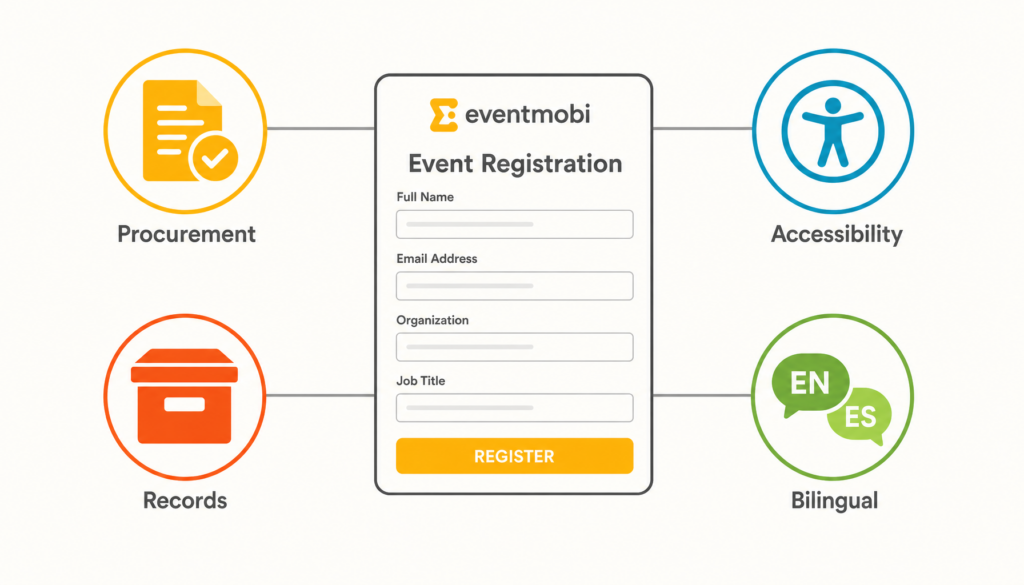
Main Facts: The Four Pillars of Public Sector Event Registration
Generic event management tools—often designed with corporate conferences and product launches in mind—frequently fail when introduced to government workflows. Public sector events are anchored by four foundational constraints that shape every aspect of software evaluation:
- Formal Procurement Approvals: Unlike corporate entities that can purchase SaaS tools via a corporate credit card, public sector organizations must navigate lengthy, heavily regulated purchasing processes, including Requests for Proposal (RFPs), vendor pre-qualification, and rigorous security assessments.
- Mandatory Accessibility Compliance: Public-facing digital infrastructure must comply with strict accessibility laws. Agencies cannot simply shift this legal liability onto third-party software providers; the ultimate responsibility rests squarely on the organizing body.
- Transparent Public Record-Keeping: Because government entities are subject to open-government laws, registration data must be easily exported, securely stored, and readily accessible for freedom-of-information requests, internal audits, or legislative reporting.
- Bilingual and Multilingual Obligations: Many public sector organizations are legally mandated to provide services in more than one language. Registration workflows must seamlessly support dual-language interfaces, confirmation emails, and multi-faceted audience engagement.
Chronology: The Evolving Landscape of Public Sector Compliance
The urgency surrounding public sector software compliance has accelerated dramatically over recent years, driven by evolving federal and state timelines.

- December 2024: The General Services Administration (GSA) published its comprehensive FY24 Governmentwide Section 508 Assessment, highlighting a persistent compliance gap across federal entities—revealing that only 23% of top-viewed federal internet pages were fully conformant with Section 508 standards.
- Early 2026: Euna Solutions released its 2026 State of Public Procurement report, underscoring that administrative bottlenecks remain a major pain point, with 46% of public sector procurement teams still managing their purchasing pipelines primarily through manual tools like spreadsheets, emails, and paper files.
- April 2026: The countdown continues toward critical compliance milestones for state and local entities under ADA Title II regulations, transforming how public bodies evaluate digital vendors.
- April 26, 2027: This represents the formal compliance deadline for state and local governments serving populations of 50,000 or more to ensure their web content and mobile apps meet strict WCAG 2.1 AA standards.
- April 26, 2028: Smaller entities, rural municipalities, and specialized public districts are granted until this date to achieve full ADA Title II digital compliance.
Supporting Data: By the Numbers
To understand why standard corporate tools fall short in government contexts, industry data highlights the structural friction public administrators face:
- 46%: The proportion of public sector procurement teams still relying on manual, fragmented methods—such as spreadsheets, email threads, and paper documents—to manage vendor approvals and purchasing, according to the 2026 State of Public Procurement report.
- 23%: The percentage of federal agencies’ top-viewed public internet pages that achieved full conformance with Section 508 standards, as detailed in the GSA’s FY24 Governmentwide Section 508 Assessment (which surveyed 245 federal reporting entities).
- 50,000: The population threshold that divides compliance deadlines for state and local governments under ADA Title II regulations, dictating whether an agency must comply by April 2027 or April 2028.
Official Responses and Industry Perspectives
Government technology specialists and procurement officers emphasize that selecting software cannot be rushed or treated as an afterthought. According to compliance experts, public sector organizations must proactively demand transparency from software vendors well in advance of contract signing.
Instead of accepting high-level sales pitches, public sector evaluators are advised to request explicit, written documentation verifying security postures, such as SOC 2 or ISO 27001 reports, alongside comprehensive data processing agreements. Regulatory bodies maintain that utilizing a third-party application does not insulate an agency from compliance failures. If a registration page lacks keyboard navigation or screen reader compatibility, the legal liability remains entirely with the public institution. Consequently, procurement teams are increasingly standardizing their evaluation matrices around platforms that offer integrated, out-of-the-box solutions for bilingual communication, conditional form logic, and secure, auditable data exports.
Implications: How to Evaluate and Choose the Right Platform
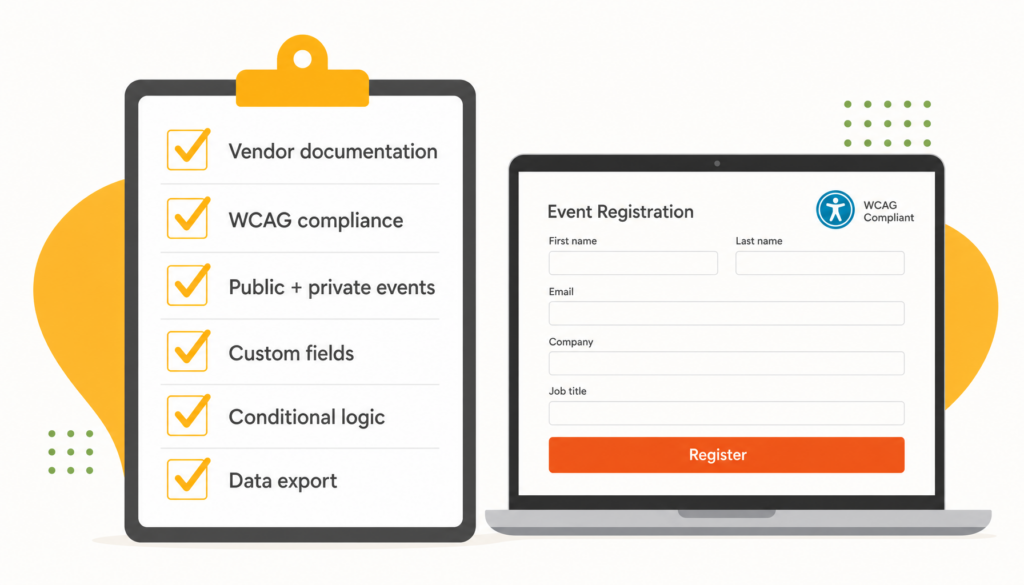
Selecting event registration software that satisfies public sector standards requires a systematic approach. Event planners and IT procurement specialists should utilize a rigorous checklist to vet potential technology partners:
1. Procurement-Friendly Vendor Documentation
Ensure vendors can rapidly supply standard contract terms, transparent pricing structures, accessible privacy policies, and verified security attestations (such as SOC 2 or ISO 27001). Vendors who can furnish these documents without delay significantly accelerate sluggish procurement cycles.
2. Verified Accessibility Conformance
Push for specific technical proofs regarding keyboard navigation, color contrast ratios, screen reader compatibility, and accessible form-field labeling. Software outputs must align directly with your required legislative benchmark—WCAG 2.0 AA for federal entities, or WCAG 2.1 AA for state and local governments. Always run sample outputs through independent accessibility checkers before committing.
3. Unified Public and Private Event Management
Government departments frequently manage a polarized event calendar, oscillating between open public town halls and highly restricted, invitation-only staff briefings or security-cleared stakeholder forums. The chosen platform should effortlessly handle both models within a single subscription, utilizing features like RSVP tracking, promo code-gated ticket tiers, and secure form gating to eliminate the need for disconnected tools.
4. Custom Fields and Conditional Logic
Standard registration forms often omit crucial government-specific data points. Look for platforms that allow custom fields for department affiliations, employee identification numbers, security clearance levels, and language preferences. Furthermore, conditional logic (if/then rules) is essential for tailoring the registration flow dynamically when diverse audiences—such as elected officials, general citizens, and working media—register through a single portal.
5. Seamless Bilingual and Multilingual Workflows
For agencies bound by official language laws, registration pages, form labels, and confirmation emails must support dual or multiple languages natively. Advanced AI concierges—such as specialized tools that automatically respond to visitors in their preferred language—can drastically reduce administrative overhead while ensuring equitable public service.
6. Robust Data Export and Records Management
Because registration data can become the subject of freedom-of-information requests or legislative audits, the platform must offer structured, clean data exports that integrate smoothly with institutional records management systems. Historical data must remain accessible and compliant with established agency retention policies.
Common Government Event Registration Patterns
Public sector events generally follow distinct operational patterns, each demanding a tailored combination of software capabilities:
- Public Consultations and Town Halls: Require barrier-free, highly accessible open registration pages, broad promotional reach, and efficient handling of high-volume public attendance.
- Stakeholder Forums and Working Groups: Rely on invitation-only workflows, RSVP tracking, curated guest lists, and conditional access tiers.
- Internal Policy Briefings and Staff Training: Demand secure authentication, employee ID tracking, department-specific custom fields, and restricted internal visibility.
- Public Sector Association Conferences: Mirror broader association models, requiring tiered member/non-member pricing, sponsor management, and multi-track session registration.
- Annual Interagency Conferences: Involve complex multi-day schedules, large-scale badge printing, integrated check-in desks, and comprehensive cross-departmental reporting.
Frequently Asked Questions
Q: Does using a third-party event registration platform shield my agency from accessibility lawsuits?
A: No. Regulatory bodies maintain that the contracting government agency remains entirely responsible for ensuring that its public-facing digital properties—including third-party registration forms—comply with applicable laws such as Section 508 or ADA Title II.

Q: Can a single software subscription handle both open public meetings and restricted internal staff briefings?
A: Yes, advanced platforms are specifically designed to support both public-facing and access-controlled events within the same overarching system, utilizing form gating and unique access codes to segment audiences securely.
Q: What security certifications should I demand from a software vendor?
A: Public sector procurement teams should routinely request SOC 2 reports, ISO 27001 compliance documentation, data processing agreements (DPAs), and comprehensive privacy policies before entering contract negotiations.
The Bottom Line
Ultimately, successful event registration in the public sector rests upon four non-negotiable pillars: strict adherence to accessibility law, navigation of formal procurement rules, the ability to manage both public and private events within a single system, and data governance capable of withstanding rigorous audits.
When evaluating software solutions, organizations should immediately filter out vendors unable to produce immediate security documentation and verifiable accessibility compliance. By prioritizing platforms that offer native bilingual support, flexible form building, and streamlined administrative workflows, government event teams can modernize their operations while maintaining the highest standards of public accountability.
Related posts: