
The Rebirth of Apple’s Ultimate Workstation: A Comprehensive Review of the M5 Ultra Mac Studio

When Apple officially discontinued the tower-format Mac Pro earlier this year, it marked the quiet end of a brief, awkward experiment. Apple had attempted to marry the compact internal components of the Mac Studio with the cavernous, PCIe-slot-equipped chassis of a traditional desktop tower. Because that iteration of the Mac Pro housed the exact same internal architecture as its smaller sibling—while sporting an inflated footprint and price tag—it ultimately failed to resonate with the professional market.
Yet, to claim that Apple has abandoned its high-end professional tier is a profound misconception. As the new M5 Ultra Mac Studio arrives on test benches and reveals performance metrics that defy conventional generational leaps, a clearer picture emerges: the Mac Pro is not dead. It has simply been reborn under the "Ultra" moniker.
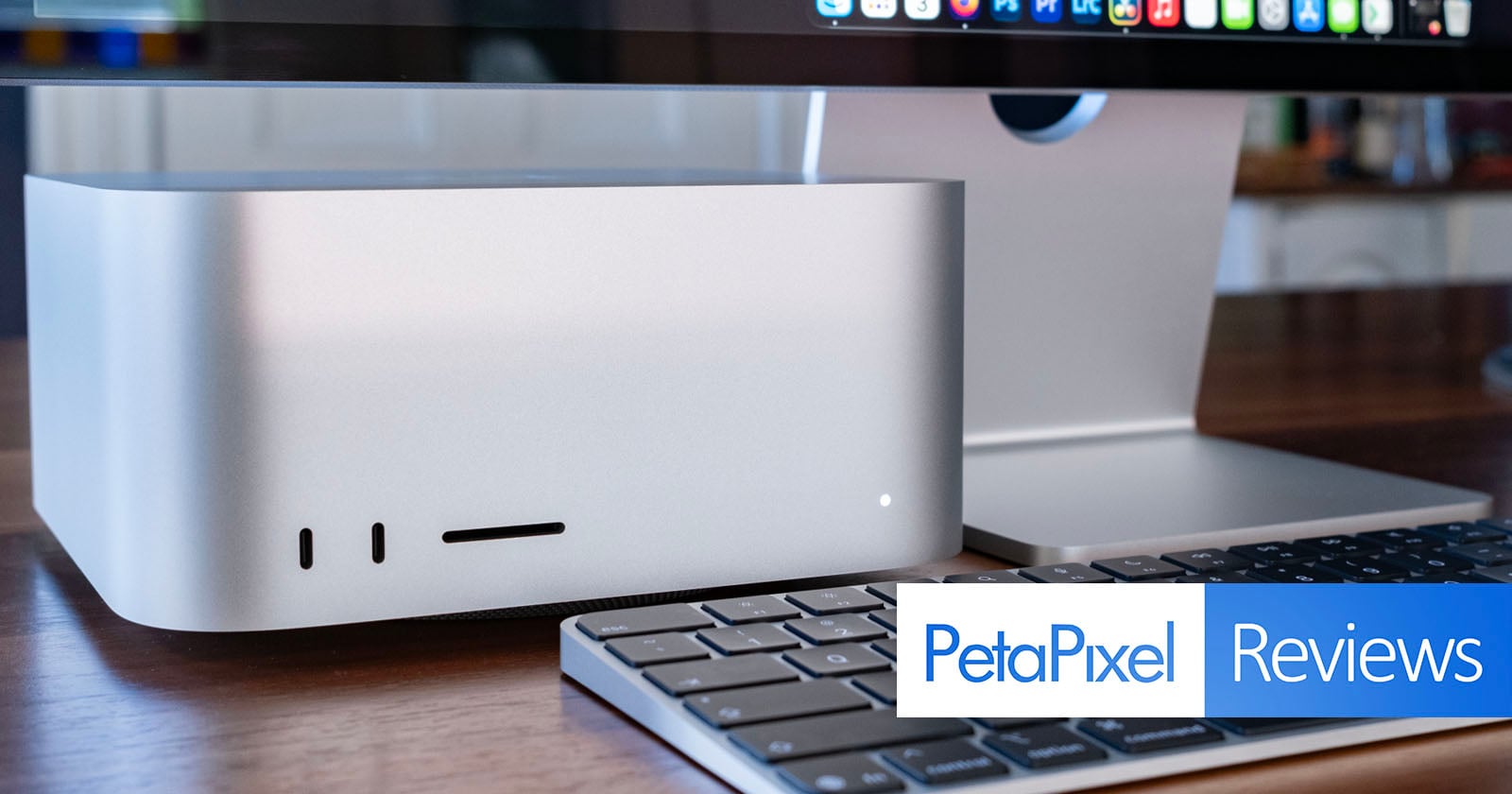
Priced at $12,300 for the maxed-out review configuration, this machine is undoubtedly an elite investment aimed strictly at commercial professionals and heavy-duty creative workflows. However, contextualized against historical Mac Pro pricing—such as the $11,800 price tag of the 2023 Apple Silicon tower or the eye-watering $52,600 peak of the 2019 Intel-based model—the M5 Ultra Mac Studio represents a remarkably potent, streamlined evolution of Apple’s most powerful computing philosophy.
Main Facts: Architecture and Specifications
The review unit furnished for testing represents the absolute pinnacle of Apple’s current consumer hardware engineering. At its heart lies the M5 Ultra system-on-a-chip, featuring a 36-core CPU split into 12 super cores and 24 performance cores, paired with an imposing 80-core GPU. This architecture is backed by 256GB of unified memory and 4TB of internal solid-state storage.

While Apple has announced plans to introduce a 512GB internal memory option at a later date, the current maximum configurations remain more than adequate for high-end professional tasks. Even though storage can be expanded up to 16TB for an additional $6,000 premium, the baseline tier evaluated here stands comfortably as the most powerful personal computer Apple currently manufactures.
Design Evolution and Connectivity
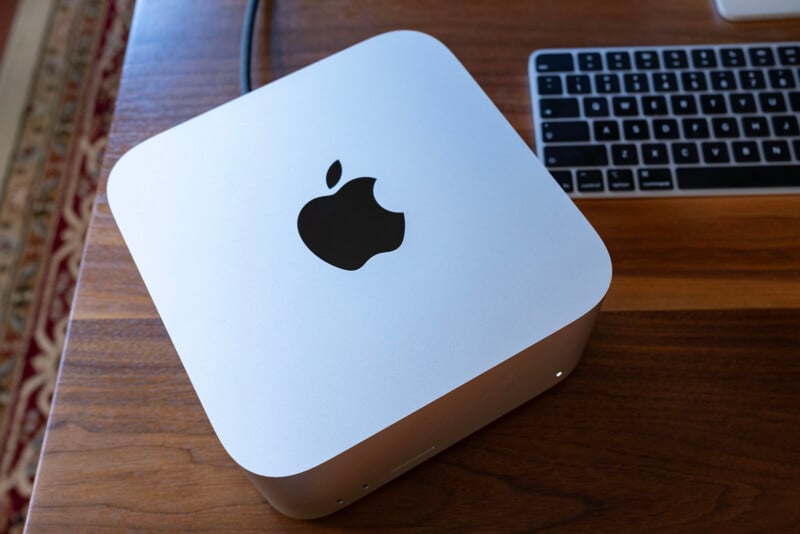
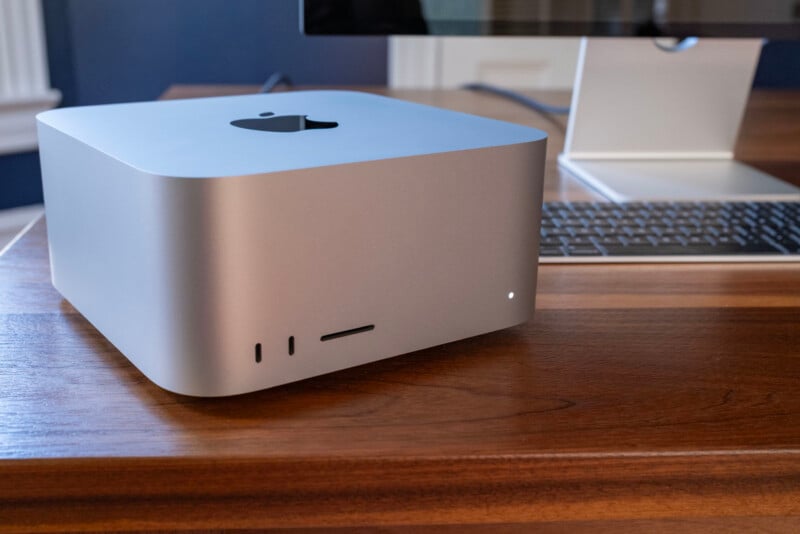
Externally, the M5 Ultra Mac Studio retains the familiar, unassuming silver aluminum rectangle silhouette established with the introduction of the line in 2023. Measuring 3.7 inches high and 7.7 inches square, and weighing approximately 8 pounds (3.6 kilograms), its physical footprint remains stubbornly compact. The chassis possesses enough heft to stay anchored to a desk, resisting shifting when cables are swapped or power buttons are pressed.

Where the machine separates itself from its lower-tier M5 Max counterpart is in its input-output capabilities.
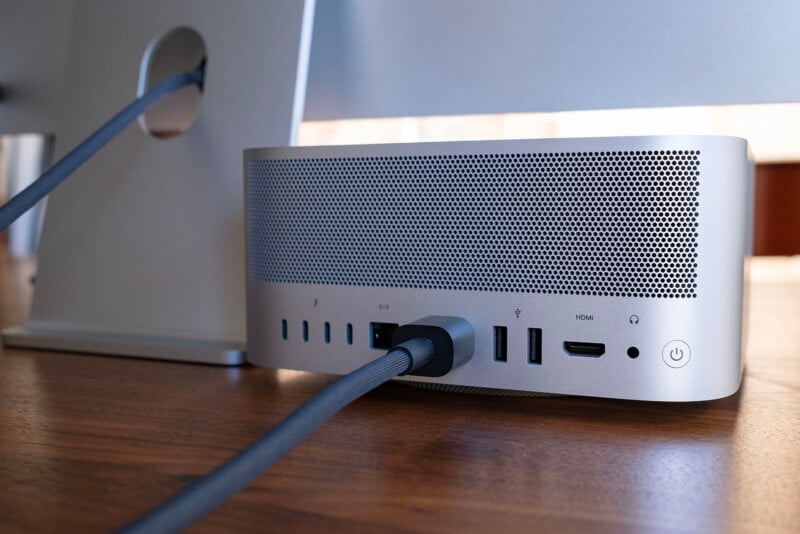
- Rear I/O: Four Thunderbolt 5 ports, a 10Gb Ethernet port, two USB-A ports, an HDMI 2.1 port, and a 3.5mm headphone jack.
- Front I/O: Two additional Thunderbolt 5 ports (supporting USB-C at 80 Gb/s) alongside an SDXC card reader.
- Wireless: Full support for Wi-Fi 7 and Bluetooth 6.
For professional video editors who regularly ingest footage from external RAID arrays or portable SSDs, the inclusion of dual, high-bandwidth Thunderbolt 5 ports on the front panel is a massive ergonomic triumph. Furthermore, while the M5 Max can drive up to five 5K displays, the M5 Ultra expands display real estate support to eight 5K displays simultaneously, including four Apple Studio Display XDR monitors running at 5K and 120Hz.
Chronology: The Evolution of Apple’s Desktop Flagship
To understand why the M5 Ultra Mac Studio represents such a critical turning point, it is helpful to trace the recent timeline of Apple’s high-end desktop hardware:
- December 2019: Apple releases the modular Intel-based Mac Pro, with fully customized configurations soaring as high as $52,600, establishing an ultra-exclusive tier for enterprise-level Hollywood studios and heavy engineering firms.
- June 2023: Apple transitions the Mac Pro to Apple Silicon, debuting an M2 Ultra-powered tower with PCIe expansion slots, alongside the initial launch of the compact Mac Studio.
- March 2026: Apple officially discontinues the Mac Pro tower configuration, concluding the experiment of housing compact system boards inside massive desktop enclosures.
- September 2026: Reviewers test the M5 Max Mac Studio, establishing a baseline for the newest generation of Apple chips.
- October 2026: The M5 Ultra Mac Studio launches, offering generational leaps in graphical and multi-core processing that redefine expectations for single-chip desktop power.
Supporting Data: Benchmark Testing Across Professional Suites
Evaluating an Ultra-tier chip in a dedicated desktop chassis highlights the unique scaling capabilities of Apple’s hardware, especially since Ultra processors launch only once every few years and remain exclusively desktop-bound. Utilizing standardized Puget Systems benchmarking protocols across major creative applications reveals precisely how the M5 Ultra handles grueling workloads.
Adobe Photoshop: Steady and Solid
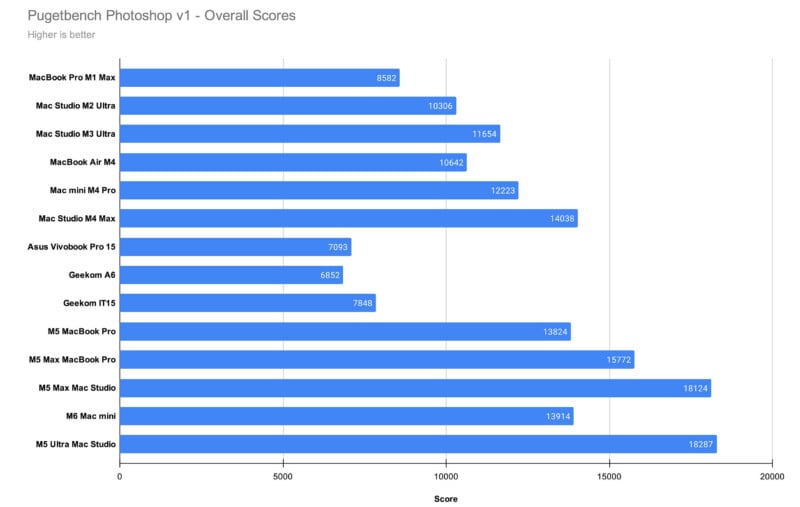
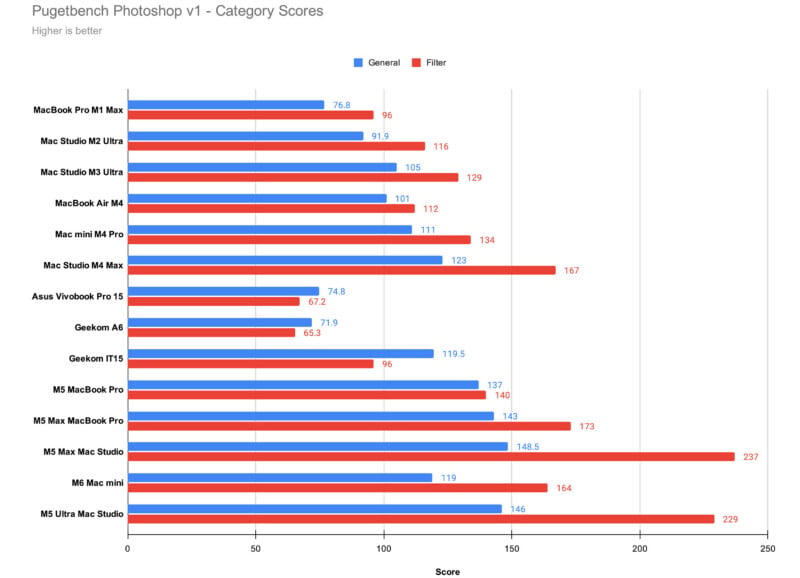
Photoshop remains primarily CPU-dependent rather than heavily reliant on massive GPU acceleration. Consequently, jumping from an 18-core M5 Max to the 36-core M5 Ultra yields diminishing returns here. While the M5 Ultra claims the crown as the fastest Photoshop machine tested to date, the margins over recent M-series predecessors are narrow. Unless upgrading from a baseline M4 or an aging M2/M3 Ultra, everyday Photoshop operations run at a largely comparable cadence across modern Apple Silicon devices.
Adobe Lightroom Classic: Dominating AI and Batch Processing
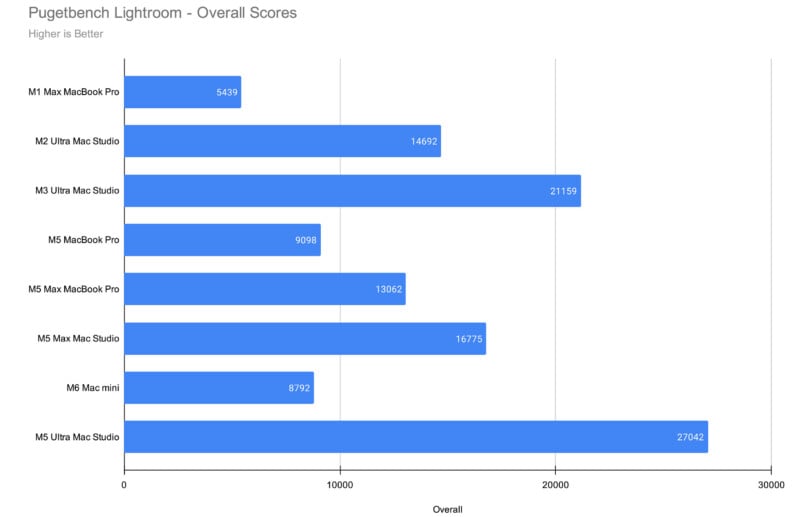
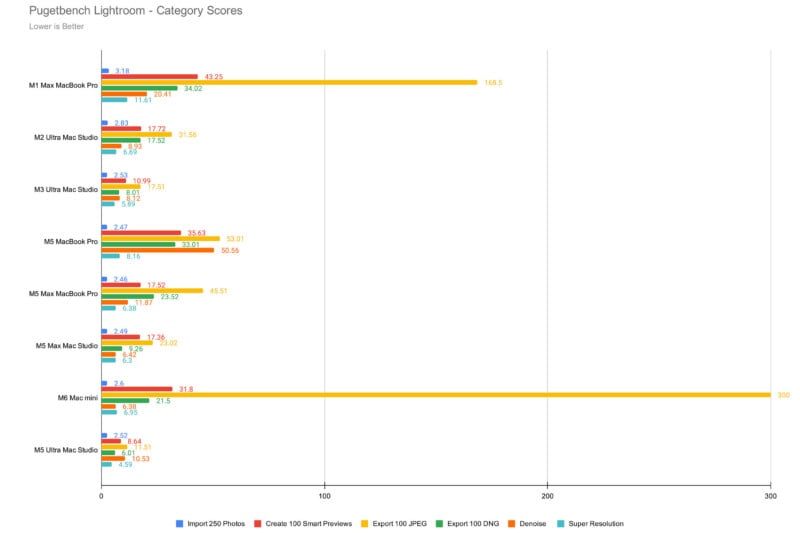
Lightroom Classic actively leverages GPU acceleration, and this is where the M5 Ultra begins to stretch its legs. Puget Systems’ benchmark suite—which imports 250 high-resolution RAW files from cameras like the Canon EOS R5 Mark II, Sony a1 II, and Nikon Z8, while running AI tasks like Denoise, Select Subject, and Super Resolution—paints a staggering picture.
The M5 Ultra’s 80-core GPU performs nearly twice as fast as the previous M2 Ultra and runs roughly 22% faster than the M3 Ultra. Compared to entry-level silicon, it delivers performance upwards of three-and-a-half times better than a baseline M6 chip. Across nearly every camera category and AI metric, the system processes massive batches of high-megapixel imagery with virtually zero system stutter.
Adobe Premiere Pro and DaVinci Resolve: The Video Editing Powerhouse
For professional video editors working with demanding formats like 6K open-gate and compressed RAW codecs (such as Sony X-OCN), the M5 Ultra transitions from being merely fast to utterly dominant.
- Premiere Pro: Benefiting from GPU-heavy effects pipelines, the M5 Ultra outpaces the M2 Ultra, M4 Max, and top-tier Windows editing rigs by a factor of two.
- DaVinci Resolve: Utilizing updated PugetBench metrics, the M5 Ultra scores an unprecedented 186,936. This marks a near-doubling of performance compared to the M3 Ultra—an astonishing leap for a single-generation hardware cadence. Fusion rendering, color grading heavy node trees, and AI-driven processing fly through export queues with the cooling fans remaining nearly imperceptible.
Official Responses and Industry Context
While Apple has not issued sweeping public statements regarding the internal philosophy behind the phasing out of the Mac Pro tower, industry analysts and hardware reviewers have coalesced around a singular consensus: the market has spoken, and form factors must follow utility.
Professional consensus emphasizes that desktop users demanding raw, uncompromised computing power care far less about empty PCIe slots and cavernous metal towers than they do about raw throughput, thermal efficiency, and desk space. By packing unmatched memory bandwidth (1.2TB/s) and an 80-core GPU into a 7.7-inch square chassis, Apple has effectively delivered the performance promise of the old Mac Pro without the redundant physical baggage.
Implications: Who Should Actually Buy the M5 Ultra?
Despite earning near-universal praise and top-tier review scores, industry experts issue a clear caveat: most photographers and video editors do not need the M5 Ultra.
For Photographers
If your workflow is strictly photography, the M5 Ultra represents extreme overkill. While Lightroom flies, the day-to-day act of fine-tuning photos in Photoshop or organizing catalogs does not fundamentally bottleneck on lesser chips like the M5 Max or M5 Pro. Photographers currently utilizing M1 or M2 architectures can comfortably continue their workflows without experiencing productivity loss.
For Video Editors and Commercial Producers
Conversely, as camera sensors push resolutions higher and workflows demand real-time playback of multi-stream RAW footage, older machines inevitably strain. For the roughly 4% of professional creators whose time directly translates to billable commercial production hours, the M5 Ultra Mac Studio is an unbeatable marvel. It eliminates rendering bottlenecks, manages complex multi-cam timelines effortlessly, and guarantees functional longevity spanning five years or more.
A Note on Memory Upgrades
Regarding Apple’s forthcoming 512GB unified memory option, industry specialists urge caution. For standard creative applications—including Photoshop, Premiere Pro, and DaVinci Resolve—doubling RAM beyond 256GB yields negligible real-world performance gains. Unless an enterprise user is running localized, large-scale artificial intelligence models or massive server clusters, creative professionals can safely bypass the exorbitant memory surcharge.
Conclusion
The market for high-end professional workstations remains fiercely competitive, with custom Windows PC builds facing unique pricing pressures due to ongoing memory and graphics card shortages. While assembling a Windows alternative featuring a Ryzen 9 or Core Ultra processor alongside an NVIDIA GPU roughly matches the entry cost of Apple’s ecosystem—while offering gaming flexibility—it introduces bulkier footprints and acoustic fan noise.
Ultimately, the M5 Ultra Mac Studio proves that Apple’s engineering team has perfected the high-end desktop. It is expensive, highly specialized, and wildly overpowered for the average user. Yet, for those who lamented the passing of the traditional tower, the message is clear: the Mac Pro is gone, but its spirit lives on inside the most powerful compact computer Apple has ever built.
Related posts: