
Beyond the Funnel: Why Modern Brands are Adopting the ‘Proof of Reality’ Flywheel

For decades, the “marketing funnel” has been the gospel of growth. It is a comforting, linear visualization: consumers move neatly from awareness to consideration, and finally, to conversion. It assumes a predictable path where a brand’s message is broadcast, received, and acted upon in a tidy sequence.
However, in 2026, the consumer journey has become a labyrinthine web of touchpoints, fragmented across AI-powered search, niche communities, and private DMs. As Sprout Social’s latest research suggests, the traditional funnel is no longer just leaking—it is fundamentally misaligned with how modern trust is built. To thrive in an era of AI-generated noise and fragmented discovery, brands are shifting toward the “Proof of Reality Flywheel,” a model that trades linear pressure for compounding momentum.
The Death of the Linear Path
The traditional marketing funnel was designed for a world where brands held the megaphone. Today, that power has shifted. When a consumer encounters a brand on social media, they rarely click a "buy" button immediately. Instead, they begin a cross-platform investigation. They might see a creator mention a product, then pivot to TikTok for a visual demo, cross-reference that with a thread on Reddit, and finally ask an AI assistant for a comparative breakdown.

By the time a user is ready to purchase, they have looped through multiple ecosystems, paused, sought peer validation, and likely disappeared into private conversations. When the path to purchase is a circle, a funnel is not just obsolete—it is an obstacle to understanding the customer.
The Rise of the Proof of Reality Flywheel
Sprout Social’s Proof of Reality Flywheel reframes the marketing ecosystem as a continuous, self-sustaining loop. Rather than pushing users toward a single conversion event, the flywheel treats every interaction as fuel for the next cycle.
The flywheel is composed of three interconnected stages:
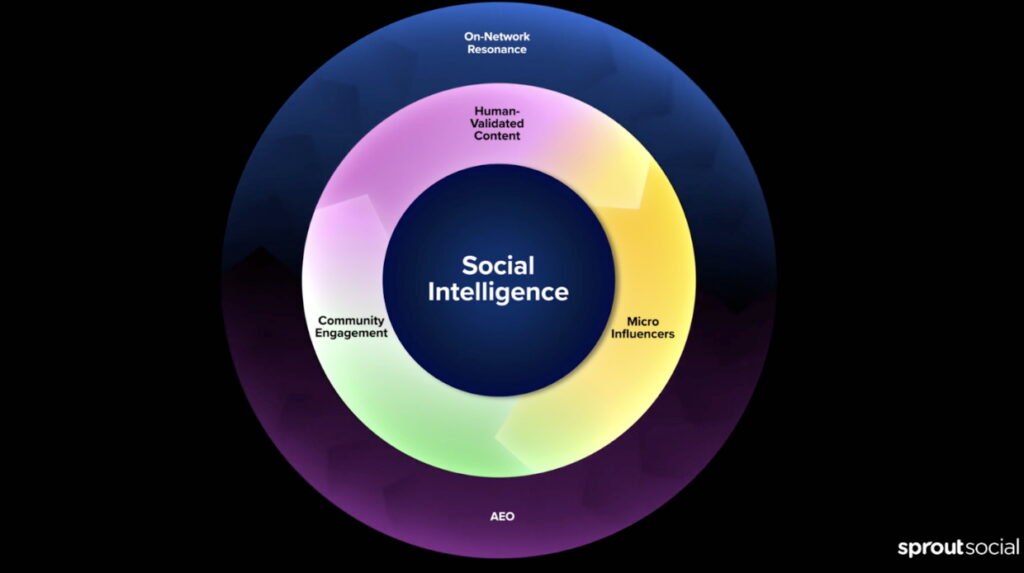
- Social Intelligence: The systematic analysis of audience sentiment and market trends to inform strategy.
- Human-Validated Content: Creating assets that satisfy the modern audience’s high bar for authenticity.
- Influence Networks: Leveraging creators and communities to provide the social proof that builds trust.
Unlike the funnel, which ends at conversion, the flywheel ensures that the trust gained from one sale becomes the visibility that drives the next.
Chronology of the Shift: How We Got Here
The erosion of the traditional funnel occurred in three distinct phases over the last decade:
- Phase 1: The Fragmentation of Search (2020–2023): As social platforms evolved into discovery engines, consumers began splitting their search habits. Traditional search engines remained for factual queries, but "social search" became the primary tool for experiential, visual, and peer-led information.
- Phase 2: The AI Content Saturation (2024–2025): The proliferation of AI-generated marketing content created a "trust vacuum." As generic, automated messaging flooded feeds, consumers developed a refined ability to detect and ignore synthetic content.
- Phase 3: The Era of Dark Social (2026–Present): With the rise of private groups, DMs, and WhatsApp communities, a significant portion of brand advocacy moved into "dark social," where public metrics cannot reach. This forced brands to look for new ways to measure influence beyond simple clicks and impressions.
Supporting Data: Why Trust is the New Currency
The necessity of the flywheel model is backed by compelling data from Sprout’s Q2 2026 Pulse Survey:

- Search Diversification: While search engines remain a starting point, social media now accounts for 21% of all search volume across age groups. This percentage is significantly higher among younger demographics, confirming that social is now a primary discovery channel.
- AI Fatigue: A staggering 83% of consumers encounter AI-generated content on social media at least sometimes, with 56% seeing it often or very often. This saturation has made "human-validated" content the most valuable commodity in marketing.
- Cross-Functional Gaps: Despite 98% of professionals agreeing that social intelligence helps achieve business goals, only 36% report that this intelligence regularly informs decisions outside of the marketing department. This gap represents a major missed opportunity for organizations to align their entire business around customer signals.
The Anatomy of the Flywheel: Stage-by-Stage
1. Social Intelligence as the Core Engine
In the traditional funnel, strategy is often driven by internal brand priorities. In the flywheel, it is driven by listening. By analyzing social conversations, competitive sentiment, and recurring customer questions, brands can create content that addresses actual market demand. When content is rooted in social data, it ceases to be a "guess" and becomes a data-backed solution to a customer problem.
2. Human-Validated Content
To win in an AI-saturated market, brands must prioritize credibility. This involves creating "human-validated" assets—behind-the-scenes videos, candid expert insights, and practical, non-salesy resources. Because AI answer engines (like those powering ChatGPT or Google’s AI Overviews) pull from high-engagement social posts, content that earns genuine human validation is more likely to be surfaced in AI discovery, creating a virtuous cycle of visibility.
3. Influence Networks
Influence no longer lives solely on a brand’s own channel. It exists in the forums where people congregate, such as Reddit, or within the circles of niche creators. By participating authentically in these spaces—rather than just running ads—brands earn "social proof." This proof is what bridges the gap during the consideration phase, providing the reassurance consumers need to finalize a purchase.
Implications for Modern Organizations
Transitioning from a funnel to a flywheel requires a cultural and structural overhaul. The implications for marketing teams are profound:
Rebuilding for AI Discovery (AEO)
"Answer Engine Optimization" (AEO) is the new SEO. As search becomes increasingly conversational, brands must structure their content to answer specific questions. By aligning social formats with how people actually ask questions, brands can ensure their expertise is indexed by the AI tools that are increasingly driving traffic.
Metrics that Matter
The flywheel requires a shift in how success is measured. Instead of focusing solely on conversion, teams must track "validation signals":

- Saves and Shares: Indicators of high-utility content.
- Community Sentiment: Shifts in how the brand is discussed in niche forums.
- AI Citation Rate: How often the brand is referenced as a source in AI-generated answers.
- Cross-Functional Impact: Utilizing social insights to inform product development, customer care, and market expansion.
The Role of Authentic Partnership
Creator marketing is shifting from broad reach to "topical relevance." The most effective partners are not necessarily those with the largest followings, but those who hold authority in specific conversations. When a creator speaks to a product with honesty and detail, they provide a form of social proof that no corporate ad can replicate.
Conclusion: The Renewable Nature of Attention
The traditional marketing funnel treated audience attention as a finite, dwindling resource. It was a race to the bottom of the funnel, where the goal was to extract value as quickly as possible.
The Proof of Reality Flywheel recognizes that attention is, in fact, a renewable resource. Every time a brand listens to its community, creates something genuinely helpful, and engages through trusted networks, it builds momentum. That momentum makes the brand more visible, more trustworthy, and more resilient to the shifting tides of the digital landscape.

By closing the loop, brands do more than just drive a single transaction; they build a perpetual engine of authority that compounds over time. In a world where trust is harder to earn than ever, the only way to move forward is to build a cycle that proves your value, over and over again.