


In an era where corporate transparency is often buried under dense legalese and impenetrable investor relations reports, Canon Inc. has taken a remarkably whimsical, if not surreal, departure from tradition. The Japanese imaging giant has released an educational booklet titled “The Secret of Canon Star,” an interactive, multi-page narrative designed to introduce children to the complex world of high-end optical engineering, semiconductor manufacturing, and medical technology.
While the project is intended for students in the third through sixth grades, its unconventional approach—featuring space-faring children, anthropomorphic printers, and multi-armed medical robots—has raised eyebrows across the tech industry. The publication serves as a bridge between corporate marketing and youth education, attempting to simplify the "magic" of light and sensors into a palatable, albeit bizarre, cosmic adventure.

The Main Facts: A Deep Dive into Planet Canon
At its core, “The Secret of Canon Star” is a digital booklet available via Canon’s official Japanese portal. Whether viewed as an 11-page condensed version or a comprehensive 20-page edition, the document functions as a narrative guide to the company’s core business pillars.
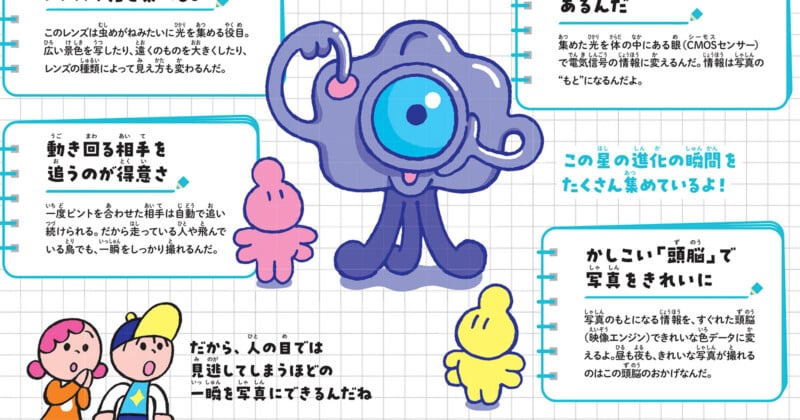
The story follows two human children who board a spaceship, leaving Earth to visit the titular "Canon Star." Upon arrival, they encounter an extraterrestrial ecosystem where Canon’s products are not merely tools, but living entities. The booklet meticulously breaks down the technical underpinnings of Canon’s success—from the basic physics of light gathering to the precision of modern manufacturing robots—using vibrant, cartoonish visuals to keep young readers engaged.

Key elements explained in the booklet include:
- Optics and Sensors: The foundational mechanics of how a camera lens focuses light onto a CMOS sensor to create a digital image.
- Precision Manufacturing: The role of automation and robotics in the production of semiconductors and lenses.
- Medical Imaging: A surprisingly technical breakdown of CT scanners and MRI machines, illustrated with friendly, multi-armed alien characters.
- Advanced Features: Practical lessons on shutter speed, aperture, and ISO, explained by an octopus-like alien character.
Chronology of the Release
The existence of “The Secret of Canon Star” was brought to the broader public’s attention by the industry outlet DC.Watch, which monitors Japanese photography developments.

- Early Development: While Canon has not disclosed the timeline for the booklet’s creation, its high production value suggests a significant period of internal coordination between the company’s educational outreach division and its design studios.
- Publication: The booklet was uploaded to the official Canon Inc. Japanese website as a downloadable PDF resource, aimed at facilitating "company introduction" lessons in schools or for home-schooling contexts.
- Public Discovery: By July 2026, the document began to circulate in Western tech circles, with industry observers noting both the educational utility of the content and the sheer eccentricity of its presentation.
- Current Availability: The document remains active on the Canon global corporate site, provided as a free resource for educators and parents.
Supporting Data: Why the Bizarre Approach?
To understand why a multi-billion dollar corporation would choose to personify a printer as a "caterpillar" or depict a camera as a walking character with a lens for a face, one must look at the demographics of the Japanese tech market. Canon, like many of its peers, faces a long-term challenge: attracting the next generation of engineers and designers in a country with a declining youth population.
Bridging the Knowledge Gap
The booklet addresses complex topics that are typically reserved for high school physics or undergraduate engineering. For example, it explains:

- Light Conversion: The transition from light photons to electrical signals via CMOS sensors is a cornerstone of modern electronics.
- Autofocus Logic: The booklet demonstrates how cameras track moving subjects—such as airplanes or animals—providing a visual comparison between a blurred, out-of-focus shot and a sharp, tracked image.
- Medical Diagnostics: By showing the interior of an MRI machine, Canon is attempting to demystify medical technology, likely aiming to reduce anxiety among children who might encounter such machines in a clinical setting.
Interactive Elements
The booklet is not a static read. It includes "spot the difference" games, where children are asked to analyze side-by-side images to find subtle discrepancies. This encourages visual literacy and attention to detail—skills that are essential for photographers and engineers alike.
Official Responses and Corporate Philosophy
While Canon has not issued a formal press release defending the artistic choices of the booklet, the document itself reflects a long-standing corporate philosophy known as Kyosei. Roughly translated as "living and working together for the common good," Kyosei is the guiding principle for Canon’s global operations.
By framing their complex industrial output within a whimsical space-travel narrative, Canon is attempting to align its brand identity with the values of curiosity, exploration, and global responsibility. In the eyes of the company, if a child can grow up viewing a camera or a CT scanner not as a cold, intimidating machine, but as a friendly, helpful extension of human ability, the brand loyalty and interest in STEM (Science, Technology, Engineering, and Mathematics) will naturally follow.
Critics have noted that the "bizarre" nature of the illustrations may be a cultural translation issue; in Japan, the use of kawaii (cute) mascots and anthropomorphic characters to explain serious, dry, or technical subjects is a standard, highly effective marketing strategy.

Implications: A New Era of Corporate Communication?
The release of “The Secret of Canon Star” signals a shift in how legacy tech companies approach "soft" marketing. In the past, companies like Canon, Nikon, and Sony relied on professional photographers and high-end advertising campaigns to capture the adult market. Now, with the democratization of photography through smartphones, companies are forced to compete for the "mindshare" of younger demographics who are increasingly tech-savvy but less loyal to legacy camera brands.
The "STEM" Factor
By positioning itself as an educational resource, Canon is effectively infiltrating the classroom. If school teachers in Japan utilize these booklets as part of their curriculum, Canon becomes synonymous with "learning" and "technology." This is a sophisticated long-term strategy to ensure that, when these children grow up and look for a camera or a medical career, the Canon brand is already ingrained in their mental framework.

The Risk of Alienation
Conversely, there is a risk that such an abstract, childish approach could alienate the professional community. Enthusiasts who view Canon as a bastion of professional-grade optics might find the "caterpillar printer" aesthetic jarring. However, the company seems to have calculated that the benefits of youth engagement outweigh the potential confusion among their existing, older user base.
The "Won’t Someone Think of the Children?" Benchmark
The tongue-in-cheek question—“Won’t someone think of the children?”—is a frequent critique leveled at modern corporations that ignore the impact of their technology on society. Canon has effectively answered this call with a definitive "Yes." By investing in the creation of high-quality, free educational materials that translate their proprietary technology into a language children can understand, Canon is setting a high bar for corporate social responsibility.

Conclusion
Whether one views “The Secret of Canon Star” as a masterpiece of educational outreach or a strange piece of corporate kitsch, it is undeniable that Canon has created something memorable. The booklet represents a bold attempt to humanize the massive, often invisible infrastructure of modern technology.
By taking the time to explain how light is captured, how machines think, and how technology helps the world, Canon is not just selling cameras; it is selling the wonder of discovery. As the children in the booklet traverse the cosmos, they remind us that at the heart of every sensor, every lens, and every printer, there is a simple, fundamental goal: to see, to record, and to understand the universe around us. For a 10-year-old reader in Japan, that lesson is delivered with the help of a space-faring robot and a talking lens—a bizarre journey, perhaps, but one that may well inspire the next generation of engineers to build the "stars" of tomorrow.