

How Fujifilm Captured the Younger Generation: Inside the Demographic Shift Reshaping the Camera Industry

In an industry long dominated by traditionalists, aging demographics, and a wall of silence regarding sales data, Fujifilm has managed to pull off a quiet revolution. Recent data highlights a striking pivot in the consumer base of the legacy photographic giant, revealing that the brand’s X-Series lineup has successfully found a vibrant, highly engaged audience among demographics that legacy camera manufacturers have historically struggled to reach: women and consumers under the age of 40.
As traditional camera makers vie for relevance in a world dominated by smartphone photography, Fujifilm’s meteoric rise—highlighted by staggering production jumps and surging global shipments—suggests the company has unlocked a blueprint for industry survival.
Main Facts: The Demographic Realignment
For decades, the dedicated digital camera market was viewed through a narrow lens: older, male photography enthusiasts upgrading bodies and glass in pursuit of technical perfection. However, data shared by Fujifilm’s Corporate Vice President, Kouji Matsumoto, shatters that stereotype.
According to figures highlighted by Nikkei Asia, over 70% of Fujifilm X-Series users are in their 30s or younger, and approximately 40% are women.
This demographic distribution is an outlier in the broader consumer camera landscape. While competitors often struggle to prove their value to a generation raised entirely on high-end smartphone cameras, Fujifilm has positioned its hardware not merely as a utility tool, but as a lifestyle accessory, a creative outlet, and an antidote to the sterile perfection of computational mobile photography.

The brand’s overarching strategy targets what Matsumoto calls "the discerning segment with a high level of information literacy." By emphasizing tactile controls, nostalgic film simulations, and aesthetically pleasing retro body designs, Fujifilm has managed to deliver a quality that deeply resonates with digital natives who value the analog experience of picture-taking.
Chronology: From Niche Retro to Mainstream Phenomenon
To understand how Fujifilm arrived at this pivotal moment, it is necessary to trace the trajectory of its imaging division over the last several years—a period marked by unprecedented demand and supply chain constraints.
2023: The Foundation of Recovery
As the global consumer market shook off the lingering disruptions of the pandemic, Fujifilm’s total digital camera shipments hovered around 430,000 units annually. Production for the X-Series sat at roughly 380,000 units. At this stage, the company was widely respected for its film simulations and rangefinder-style bodies, yet it was still viewed as a specialized alternative to industry heavyweights like Canon and Sony.
2024–2025: The Acceleration Phase
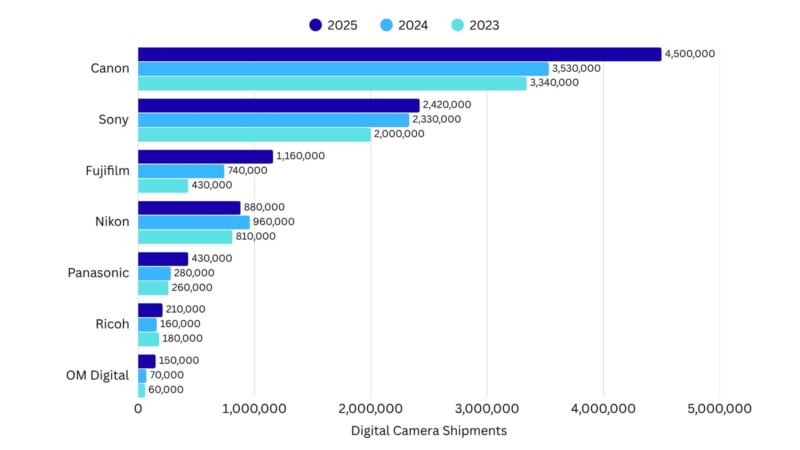
Word-of-mouth recommendations, viral social media trends on platforms like TikTok and Instagram, and the release of cult-classic devices like the X100VI catalyzed a massive influx of new buyers. By the end of 2024, annual digital camera shipments leaped to 740,000 units, before surging again to 1,160,000 units per year by 2025.
Concurrently, X-Series production nearly doubled from its 2023 baseline, scaling up to 750,000 units last year. This marked the largest percentage production increase of any major Japanese camera manufacturer during the same timeframe, signaling a massive scale-up to meet an insatiable global appetite.

Supporting Data: Peering Behind the Industry Iron Curtain
The photography industry has historically been notoriously tight-lipped. Detailed demographic metrics, sales breakdowns by specific camera models, and user profiles are guarded as closely as proprietary sensor designs. Industry publications like PetaPixel have frequently lamented the lack of rich data available to analysts, making rare disclosures from executives immensely valuable.
The numbers provided by Fujifilm and aggregated in industry maps—such as the Nikkei Industry Map and the Japan Company Handbook Industry Map (Shikiho)—paint a clear quantitative picture:
- Shipment Growth: Fujifilm’s total digital camera shipments more than doubled between 2023 and 2025 (rising from 430,000 to over 1.1 million units).
- X-Series Expansion: X-Series production nearly doubled between 2023 and the close of 2024, soaring from 380,000 to 750,000 units.
- The Tokyo Event Case Study: At a recent four-day experiential event hosted by Fujifilm in Tokyo, approximately 1,400 people attended. Crucially, 90% of visitors had never used a Fujifilm camera before, the vast majority were in their 20s and 30s, and 70% of the attendees were women.
These metrics validate the success of Fujifilm’s consumer acquisition pipeline. When 90% of event attendees are first-time users and predominantly young women, it becomes abundantly clear that the brand’s marketing engine is pulling fresh blood into the dedicated camera ecosystem rather than merely trading customers with competitors.
Official Responses and Experiential Marketing
Traditional advertising—billboards, print ads, and technical spec sheets—often fails to capture the imagination of modern consumers who prioritize feeling and experience over megapixels and readouts. Fujifilm recognized this shift early, pivoting heavily toward hands-on experiential marketing.
While large-scale global showcases like Fujikina capture headlines, the company’s localized, smaller-scale events have proven to be the secret weapon in building customer loyalty. The Tokyo event highlighted by Nikkei Asia is a textbook example of this strategy in action. By lowering the barrier to entry, putting cameras directly into the hands of curious smartphone photographers, and creating inviting, low-pressure environments, Fujifilm transforms casual onlookers into brand advocates.

Kouji Matsumoto emphasizes that this approach is deliberate:
"Our main target is the discerning segment with a high level of information literacy. We need to deliver a quality that resonates with that segment."
That "quality" extends far beyond hardware build. It encompasses the tactile joy of physical aperture rings, the dedication to color science through legendary film simulations (like Classic Chrome and Reala Ace), and the curation of a community where photography feels approachable, artistic, and fun.
Implications: What This Means for the Future of Photography
Fujifilm’s demographic breakthrough carries profound implications for the wider camera industry, signaling shifts in product design, marketing strategies, and long-term brand survival.
1. The Blueprint for Beating Smartphone Fatigue
For years, tech analysts warned that smartphones would entirely eradicate the standalone camera market outside of professional sports and wildlife niches. Fujifilm has proven that theory wrong by refusing to compete on the smartphone’s turf. Instead of chasing computational zoom and digital convenience, Fujifilm doubled down on the experience of photography. By marketing cameras as mindful, tactile counterpoints to screen fatigue, they have captured an audience that wants to engage with the physical world more intentionally.
2. Securing the Next Generation of Creators
By skewing heavily toward users under 40—and women in particular—Fujifilm is future-proofing its customer base. While competitors risk aging alongside their core demographic of older male hobbyists, Fujifilm is building a multi-decade relationship with a younger cohort. A 25-year-old who buys an X-Series camera today is likely to invest in lenses, accessories, and future upgrades for decades to come.
3. Pressure on Competitors
The industry at large is taking notice. Canon, Sony, Nikon, and other legacy players are now forced to rethink how they market their entry-level and mid-range mirrorless systems. Expect to see a greater industry-wide emphasis on aesthetic body designs, film-like color profiles, and lifestyle-oriented marketing campaigns aimed at dismantling the intimidating, hyper-technical image that traditional cameras have carried for generations.
Conclusion
Fujifilm’s rise into the upper echelons of the digital camera market is not an accident of supply chain management or a fluke of timing. It is the direct result of a calculated strategy that listened to a new wave of image-makers. By understanding that the future of photography belongs to a diverse, younger, and digitally savvy demographic, Fujifilm has not only revitalized its own business—it has injected new life into the entire cultural landscape of image-making.
Related posts: