Jefferson’s Bourbon Elevates Its Core Portfolio: Age Statements, Proof Bumps, and a Modernized Look for a Changing Whiskey Market

By Global Spirits Desk
Published: October 2024
Main Facts: The Evolution of Jefferson’s Core Lineup
In the fast-paced, highly competitive world of American whiskey, few brands have balanced out-of-the-box experimentation with traditional craftsmanship quite like Jefferson’s. Known widely for its boundary-pushing expressions—such as aging bourbon barrels aboard ocean-faring container ships or finishing ultra-aged whiskey in French Bordeaux wine casks—the brand has built a reputation for daring innovation. However, while these novelty releases frequently capture headlines among spirits enthusiasts, Jefferson’s foundational success has always rested on its core portfolio: meticulously selected and expertly blended expressions designed for consistency and approachability.
Today, Jefferson’s is shifting the spotlight back to these foundational pillars. In a strategic maneuver that signals a new era for the brand, Jefferson’s has announced significant upgrades to two of its primary flagship offerings: Jefferson’s Reserve and Jefferson’s Very Small Batch Bourbon.
The updates go far beyond minor tweaks. Jefferson’s Reserve has undergone a substantial transformation, shedding its former non-age-stated identity to proudly feature a guaranteed eight-year age statement. Alongside the newly minted maturity comes a boost in strength, with the bottling proof elevated from 90.2 to a more robust 96 proof (48% ABV). Not to be outdone, the entry-level Jefferson’s Very Small Batch Bourbon has also received a tactile adjustment, with its proof raised from a gentle 82.3 to a weightier 88 proof (44% ABV).
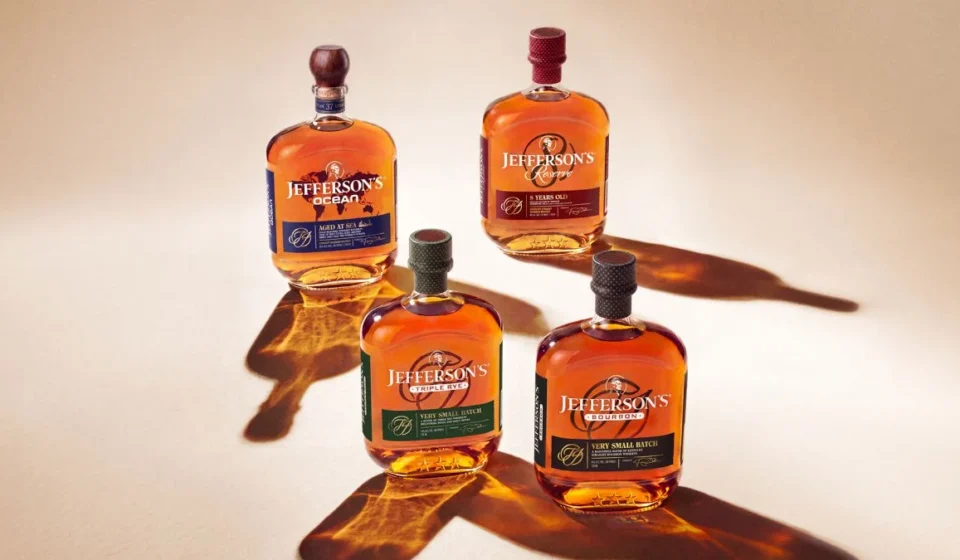
Compounding these liquid upgrades is a comprehensive visual redesign. Jefferson’s has rolled out a modernized packaging refresh across its entire core portfolio—including Very Small Batch, Triple Rye, Reserve 8-Year-Old, and the famed Ocean Aged at Sea series. According to the company, these updated labels and bottle silhouettes are designed to provide a cohesive brand identity and a clearer navigational path for consumers browsing increasingly crowded retail shelves.
These dual-pronged enhancements—elevating what is inside the bottle while refining what is on the outside—arrive at a fascinating inflection point for the American whiskey industry, as distillers navigate shifting consumer demands, fluctuating inventory levels, and a recalibrating global market.
Chronology: From Garage Blends to Global Acclaim
To understand the weight of Jefferson’s current evolution, it is helpful to trace the brand’s trajectory from its inception to its status as a heavyweight in the Pernod Ricard stable.
1997: The Genesis of Jefferson’s
Jefferson’s was founded in 1997 by the father-and-son duo of Chet and Trey Zoeller. Drawing on a deep lineage in the bourbon industry—their ancestry includes Revolutionary War-era figures involved in the whiskey trade—the Zoellers set out to disrupt the Kentucky whiskey establishment. Rather than building a massive brick-and-mortar distillery immediately, they positioned Jefferson’s as an independent "négociant" style bourbon house. They sourced exceptional barrels from various distilleries and focused their expertise entirely on the art of selection and blending. This nimble approach allowed them to experiment with flavor profiles without being tied down to a single house style or mash bill.
The 2000s and 2010s: The Era of Experimentation
Over the next two decades, Jefferson’s carved out a unique niche by introducing conceptual releases that challenged traditional whiskey-making dogma. Their most famous ongoing experiment, Jefferson’s Ocean Aged at Sea, began as a casual wager about how constant motion, dramatic temperature shifts, and salty sea air would impact maturing whiskey. The resulting expression—aged on the decks of Holland America cruise ships and commercial container vessels as they circumnavigated the globe—became a massive commercial success and a collector’s darling.
2019: The Pernod Ricard Acquisition
As the brand’s footprint expanded, corporate interest followed. In 2019, French wine and spirits giant Pernod Ricard acquired Jefferson’s parent company, Castle Brands. This multi-million-dollar acquisition provided Jefferson’s with the global distribution network, financial backing, and supply chain security necessary to scale operations dramatically while maintaining access to premium-grade aging stock.
2024: Passing the Torch and Re-Evaluating the Core
Tragedy struck the brand in 2024 with the passing of co-founder Chet Zoeller, whose contributions to the industry were cemented when he and Trey were jointly inducted into the Kentucky Bourbon Hall of Fame. Trey Zoeller assumed sole leadership of the brand’s creative direction, ensuring his father’s legacy of innovation would endure.
The culmination of this multi-decade journey is the current 2024 portfolio overhaul. By injecting guaranteed age statements and higher proofs into the core lineup, Jefferson’s is signaling that it no longer relies solely on maritime novelty to drive its reputation; it is cementing its authority on traditional, mature craft.
Supporting Data: Tasting Notes and Liquid Specifications
The decision to upgrade the core expressions was not made lightly. In the craft spirits industry, adding an age statement requires long-term inventory forecasting, as distillers must commit a portion of their aging stock to sit untouched for nearly a decade.

Jefferson’s Reserve 8-Year-Old Bourbon
- Previous Specifications: Non-age-stated (NAS), bottled at 90.2 proof (45.1% ABV).
- New Specifications: Guaranteed minimum 8-year age statement, bottled at 96 proof (48% ABV).
- Master Blender’s Perspective: Ale Ochoa, Jefferson’s master blender, noted the meticulous blending process required to reach this milestone. "Getting to this age statement meant going back through our older, more mature barrels and crafting this bourbon with intention," Ochoa explained in an official release. "Aged a minimum of eight years in American oak, this bourbon offers dark fruit and vanilla custard upfront, then baking spice, oak, and toasted almond carrying through to a long, spicy finish."
- Flavor Profile Analysis: The bump to 96 proof allows the heavier aromatic compounds—such as natural oak tannins and baking spices—to cut through the dilution, offering a richer, more viscous mouthfeel that coats the palate significantly longer than its 90.2-proof predecessor.
Jefferson’s Very Small Batch Bourbon
- Previous Specifications: Non-age-stated, bottled at 82.3 proof (41.15% ABV).
- New Specifications: Non-age-stated, bottled at 88 proof (44% ABV).
- Flavor Profile Analysis: While an increase of less than six proof points might appear modest on paper, in the realm of whiskey blending, it represents a crucial threshold. At 82.3 proof, the entry-level expression occasionally risked getting lost in cocktail applications or feeling structurally light when tasted neat. Moving to 88 proof provides a structural backbone, sharpening the sweet corn and caramel notes while introducing a cleaner, more vibrant pop of rye spice on the finish.
Packaging and Formats
In addition to the Reserve and Very Small Batch updates, the modernized labels have been applied across the portfolio, which includes:
- Jefferson’s Triple Rye
- Jefferson’s Ocean Aged at Sea
- Jefferson’s Reserve 8-Year-Old
- Jefferson’s Very Small Batch
Retail shelves across the United States are currently stocking the standard 750ml bottles featuring the new design. To capture alternative consumer segments—such as the hospitality industry, travelers, and holiday gift-shoppers—Jefferson’s has confirmed that smaller 375ml formats, as well as larger 1-liter and 1.75-liter bottles, will roll out later in the year.
Official Responses and Industry Context
The spirits landscape has experienced a seismic shift over the past 24 months. According to recent data regarding American whiskey production—which recently hit its lowest levels in years following a post-pandemic boom and subsequent inventory correction—distillers are being forced to think critically about differentiation, shelf appeal, and value proposition.
When asked about the driving force behind the brand’s simultaneous visual and liquid transformation, representatives for Jefferson’s emphasized that the updates were designed to honor the consumer’s growing sophistication.
"The new design was built to better reflect the quality and character of the liquid inside," a brand spokesperson stated. "It creates a stronger, more cohesive identity and a clearer navigation system for exploring the full Jefferson’s portfolio."
Industry analysts have drawn parallels between Jefferson’s strategy and recent moves by other prominent American whiskey players, such as the Bardstown Bourbon Company, which has systematically updated its branding and portfolio architecture to stand out in an overcrowded marketplace.
Consumer reactions to packaging overhauls are traditionally mixed; heritage whiskey drinkers often harbor a deep nostalgia for legacy labels. However, the initial reception to Jefferson’s new visual identity has been largely positive. By maintaining the core recognition cues of the brand while elevating the typography, label texture, and glass detailing, the creative team has managed to modernize the bottle without alienating long-term fans.
Furthermore, the introduction of the 8-year age statement directly addresses a vocal segment of the bourbon community that has increasingly demanded transparency regarding age, origin, and maturation periods. In an era where consumers are bombarded with aggressive marketing and NAS (non-age-stated) releases, a guaranteed eight-year age mark acts as a powerful badge of honor and authenticity.
Implications: What This Means for Collectors, Drinkers, and the Market
The strategic repositioning of Jefferson’s core portfolio carries several important implications for various stakeholders within the whiskey ecosystem:
1. For the Everyday Consumer and Cocktail Enthusiast
The proof bumps on both the Very Small Batch and the Reserve 8-Year-Old are direct wins for drinkers. Higher proof points inherently mean less water dilution, which translates directly to greater flavor retention. Whether enjoyed neat, over a large ice cube, or utilized as the backbone of a classic Manhattan or Old Fashioned, these upgraded expressions offer superior mixology potential and a richer sensory experience without requiring consumers to venture into expensive, allocated, cask-strength territory.
2. For Collectors and Connoisseurs
While Jefferson’s will undoubtedly continue to release high-end, highly allocated novelties—such as last summer’s acclaimed 20-year-old Founder’s Reserve finished in French Bordeaux casks—the formalization of an eight-year age statement for the core Reserve provides a reliable, everyday benchmark. Connoisseurs who may have previously dismissed the core lineup as "too light" or "strictly for mixing" are now given a legitimate reason to revisit the bottle.
3. For the Broader Spirits Market
As the American whiskey market corrects from years of hyper-expansion, brands can no longer rely purely on clever marketing gimmicks or inflated secondary-market hype to sustain momentum. Quality inside the bottle is returning to the absolute forefront. By investing in mature stocks, increasing proofs, and streamlining their visual identity, Jefferson’s and its parent company, Pernod Ricard, are demonstrating a long-term commitment to substance over fleeting trends.
Ultimately, these changes prove that even a brand built on the philosophy of restless experimentation recognizes the irreplaceable value of a rock-solid core. With a guaranteed eight-year age statement on its Reserve, a punchier entry-level pour, and a sleek modern wardrobe, Jefferson’s is well-equipped to navigate the next chapter of its storied history.
Related posts: