Comments Off on Rare Early Print of Dorothea Lange’s ‘Migrant Mother’ Headlines Sotheby’s Major Photography Auction Alongside Hiroshi Sugimoto Masterpiece
NEW YORK — The art world’s eyes are fixed on Sotheby’s latest online print and photographic auction, which launched today with an extraordinary lineup of museum-grade lots. Among the high-value pieces capturing the attention of international collectors, historians, and curators, two standout lots have emerged as the crown jewels of the sale: an exceptionally rare, vintage first-generation print of Dorothea Lange’s iconic Great Depression masterpiece Migrant Mother, and a monumental, ultra-rare print of Hiroshi Sugimoto’s conceptual masterwork Radio City Music Hall, New York City.
With the Lange print valued between $100,000 and $150,000, and the Sugimoto piece commanding an estimated $200,000 to $300,000, this auction event offers a fascinating look into the intersection of historical documentation, artistic conceptualism, and high-stakes fine art collecting.
Main Facts: The Centerpieces of the Sotheby’s October Auction
The ongoing Sotheby’s prints and photographs sale features numerous historical and contemporary treasures, but two specific lots dwarf the competition in terms of cultural gravity and market anticipation.
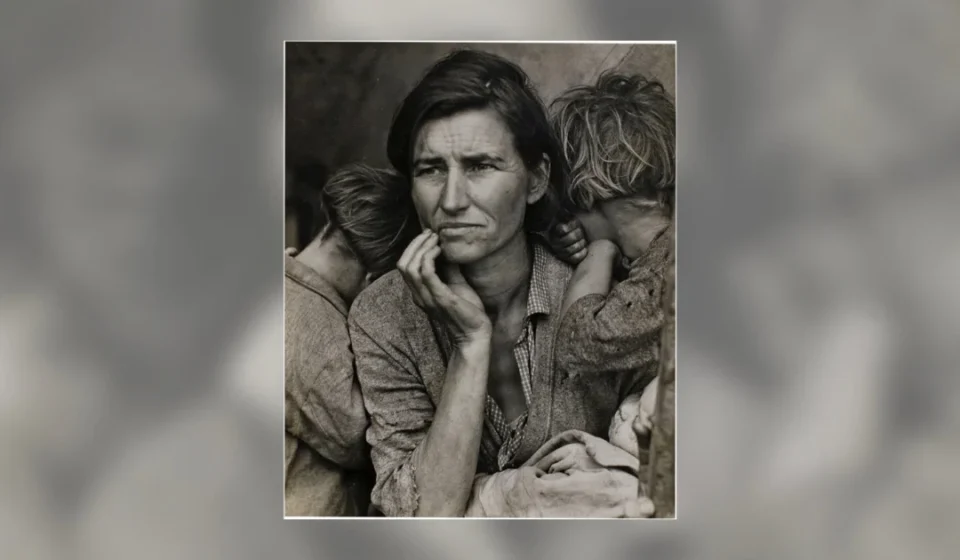
The first major highlight is a vintage, period-accurate print of Dorothea Lange’s Migrant Mother (officially titled Migrant Mother, Nipomo, California). Captured in March 1936, the image depicts Florence Owens Thompson surrounded by her children, her careworn face resting against her hand. It is widely considered one of the most recognizable and psychologically arresting photographs in human history, often mentioned in the same breath as Steve McCurry’s Afghan Girl. What sets this specific iteration apart from thousands of subsequent reproductions is its pedigree: executed in 1936 and printed no later than 1937, this print is making its very first appearance on the public auction block. It retains the original Resettlement Administration credit stamp on the reverse and features a subtle, highly sought-after anomaly—Florence Owens Thompson’s thumb visible in the lower right corner, a detail carefully cropped or airbrushed out of later iterations. Sotheby’s has estimated its value at $100,000 to $150,000.
The second major focal point of the sale is Hiroshi Sugimoto’s Radio City Music Hall, New York City (1978). Coming from the artist’s renowned and conceptually rigorous Theaters series, the photograph captures the entirety of a feature film compressed into a single frame through an extended, open-shutter long exposure. This monumental print—measuring an impressive 47 by 58 ¾ inches—is print number one from an edition of just five. Having never been offered at auction before, it is expected to fetch between $200,000 and $300,000.
Chronology: The Journey of an Icon from Nipomo to the Auction Block
To understand the immense value of the Sotheby’s Migrant Mother lot, one must retrace the harrowing historical sequence that birthed the image in the spring of 1936.
February – March 1936: Photographer Dorothea Lange spends nearly a month traveling across California documenting the plight of displaced agricultural workers on behalf of the Resettlement Administration (RA), a New Deal federal agency established in 1935 that later transitioned into the Farm Security Administration (FSA).
Late March 1936: While driving back to her home in Berkeley, California, Lange passes a roadside sign pointing toward a camp of stranded pea pickers near Nipomo. Though she initially drives past, an intuitive compulsion forces her to turn around. Entering the squalid encampment, she unloads her 4 x 5-inch Graflex camera and approaches 32-year-old mother Florence Owens Thompson.
The Shoot: Working through an increasingly intimate sequence of exposures, Lange captures Thompson and her children. The final, definitive composition frames Thompson’s weathered, anxious visage while her children turn away from the lens, burying their faces in her shoulders.
March 10–11, 1936: Within days, Lange’s negatives are rushed to the San Francisco News. While not featured in the initial March 10 report, Migrant Mother hits the presses on March 11, illustrating an article titled "What Does the ‘New Deal’ Mean to This Mother and Her Child?" The photograph immediately galvanizes public sympathy and focuses national attention on the invisible underclass of Western migrant laborers.
1936–1937: Sometime during this window, the vintage print currently offered by Sotheby’s is developed. Bearing the official Resettlement Administration credit stamp and the uncropped thumb of Florence Owens Thompson in the lower right corner, it serves as a direct physical link to the genesis of the image.
October 2026: Decades after its creation and subsequent canonization in the annals of art history, this primary-source print makes its debut at a major international auction house, setting off a scramble among institutional and private collectors.
Supporting Data and Technical Analysis
The fine art photography market relies heavily on provenance, printing vintage, and technical uniqueness. Both lots currently leading the Sotheby’s auction check every box for discerning collectors.
The Lange Print: Physical Markers of Authenticity
Vintage photographic prints—those developed by the photographer or under their direct supervision close to the date the negative was exposed—hold exponentially higher market value than posthumous or later-decade prints. The Sotheby’s Migrant Mother print is heavily validated by specific physical anomalies:
The Credit Stamp: The inclusion of the original Resettlement Administration stamp places the print securely within the governmental archive pipeline of the mid-1930s.
The Thumb Detail: In later, widely distributed versions of the photograph, Lange or darkroom technicians burned or cropped out a stray thumb belonging to Thompson in the lower right corner. The presence of this thumb on the Sotheby’s print proves its status as an exceptionally early state of the image.
Medium and Scale: Created using Lange’s working methods of the era, the print reflects the tonal range, silver gelatin chemistry, and tactile quality characteristic of Depression-era government documentation work.
The Sugimoto Print: Conceptual Rigor and Rarity
Hiroshi Sugimoto’s Theaters series represents a monumental achievement in conceptual photography. To create Radio City Music Hall, New York City, Sugimoto loaded his large-format camera and kept the shutter open for the entire duration of a feature-length movie.
The Accumulation of Light: The continuous projection of light from the motion picture film onto the movie screen for two hours effectively acts as a giant strobe, illuminating the ornate Art Deco architecture of the theater in ghostly, high-detail relief.
The Disappearance of the Audience: Because the exposure lasts the entire length of the film, the physical audience sitting in the theater registers as invisible, leaving behind only the rhythmic, glowing patterns of aisle lights and empty velvet seats.
Scarcity: As print number one from an edition of only five, combined with its massive gallery scale (47 x 58.75 inches), the lot represents an apex predator acquisition for collectors of contemporary and conceptual photography.
Official Perspectives and Historical Context
Art historians and auction specialists emphasize that these photographs transcend mere commercial commodities; they are historical artifacts that changed the trajectory of visual culture.
In its catalog notes, Sotheby’s contextualizes the weight of Lange’s assignment:
"Although the worst years of the Great Depression had passed, unemployment remained widespread and thousands of migrant laborers continued to travel in search of seasonal work… Neither Lange nor her editors could have anticipated the photograph’s future significance, [yet] the image has assumed a life beyond its original journalistic purpose."
The photograph transformed Florence Owens Thompson into an unintended Madonna of the Depression—an emblem of endurance, maternal sacrifice, and systemic poverty. Yet, the journey of the image also highlights complex ethical questions regarding documentary subjects. Thompson herself later expressed mixed feelings about the widespread fame the photograph brought, noting that she never profited from the iconic status it achieved while she struggled through poverty for decades.
Turning to Sugimoto’s work, critics note that his long-exposure technique forces viewers to confront the passage of time itself. By condensing hours into a single fraction of an image, Sugimoto strips away the ephemeral distractions of narrative cinema and lays bare the architectural majesty and melancholic emptiness of mid-20th-century picture palaces.
Implications for the Fine Art Photography Market
The inclusion of these masterworks in Sotheby’s October online auction underscores several broader trends in the contemporary art market:
Flight to Quality and Rarity: In uncertain economic climates, high-net-worth collectors increasingly gravitate toward blue-chip, historically unassailable works. A first-generation print of Migrant Mother with unique provenance (such as the uncropped thumb) acts as a safe-haven asset.
Institutional vs. Private Acquisitions: Given the museum-grade nature of both the Lange and Sugimoto prints, industry insiders anticipate fierce bidding from both private billionaires and major international institutions (such as the Museum of Modern Art, the Getty, or the National Gallery of Art) looking to plug gaps in their permanent collections.
The Evolution of Online-First Sales: Once relegated to physical auction rooms in New York and London, major anchor lots worth hundreds of thousands of dollars are increasingly anchoring digital-forward sales platforms, democratizing global bidding access while maintaining rigorous authentication standards.
As the Sotheby’s auction progresses through the month, all eyes will remain locked on whether these estimated price ceilings are shattered, signaling continued robust health for the upper tiers of the fine art photography market.