The Death of the Registration Desk: Why Mobile Badge Printing is Reshaping Event Operations

Picture two versions of the same conference opening.
Version one: A long, monolithic table anchors the hotel lobby. Staff stand behind alphabetized badge bins, squinting at printed manifests while attendees wait in a stagnant, winding queue that stretches toward the elevator bank. Every typo or missing record brings the entire operation to a grinding halt.
Version two: Attendees walk into the atrium and are greeted by a series of sleek, distributed welcome stations. A quick QR scan on an iPad triggers a compact printer, and a personalized badge is produced on demand in seconds. People keep moving, transitioning seamlessly from arrival to coffee, conversation, and sessions.
The question is no longer whether check-in matters—you already know it does. The question is: How do you build a fast, resilient check-in infrastructure that eliminates bottlenecks during peak arrival windows, even when your venue layout or Wi-Fi environment works against you?

The answer lies in the strategic shift toward mobile badge printing. By decentralizing the print and check-in process, organizers can place technology exactly where attendees arrive, transforming a high-stress administrative chore into a frictionless, modern welcome experience.
The Historical Compromise: Why Centralized Registration Fails
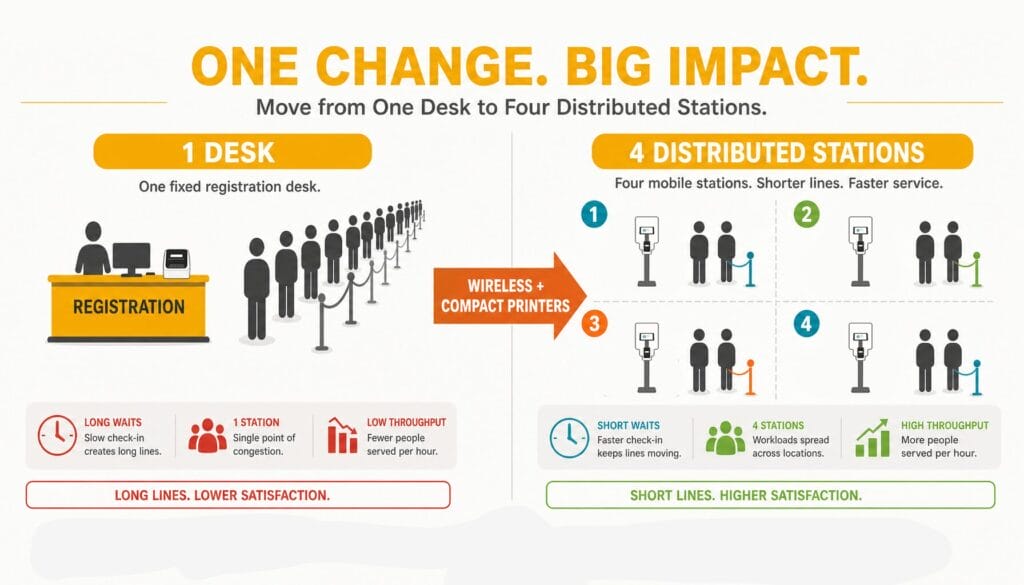
For decades, the “registration desk” has been the standard of the event industry. It is not inherently wrong; rather, it is a fixed constraint that forces the entire arrival process to revolve around a single, physical point of failure.
The Anatomy of a Bottleneck
A fixed, centralized setup inherently demands:
- Linear Throughput: Every attendee must pass through the same physical gate.
- Congestion: If 500 people arrive within a 30-minute window, a single desk—no matter how well-staffed—becomes a natural chasm.
- The "Exception" Trap: A single attendee with a registration error (a misspelled name, a missing payment, or a last-minute walk-in) creates a backlog that affects everyone behind them.
- Equipment Dependence: When workflows are anchored to power outlets and hardwired printers, the physical space dictates the flow, not the human experience.
The root cause of these issues is rarely poor planning; it is that registration systems were historically designed around the equipment rather than the attendees. The industry has long accepted "the line" as a necessary evil. However, with the miniaturization of hardware—printers, tablets, and high-speed wireless modules—the registration desk no longer needs to be a stationary monument.
Defining Mobile Badge Printing in Practice
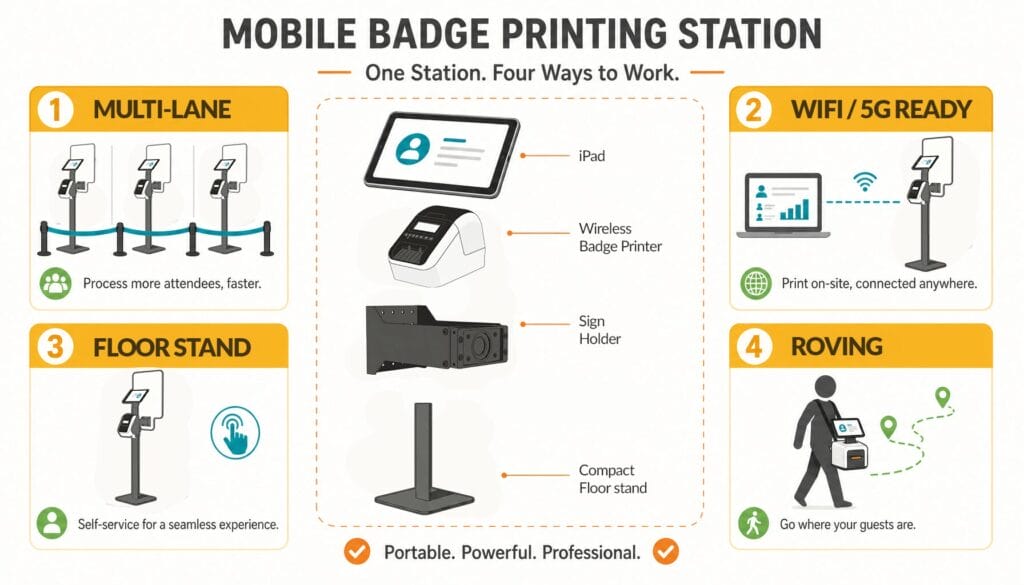
"Mobile badge printing" is an operational strategy that replaces a single, heavy-duty registration hub with a series of agile, portable stations.
The Core Components
At its most basic, a mobile station consists of three components:
- The Interface: An iPad or iPhone running robust, cloud-synced event software.
- The Printer: A compact, high-speed thermal label printer.
- The Logic: A database that links attendee lookup (QR scan or name search) to instantaneous, on-demand printing.
By moving these units to entrance doors, session halls, or even off-site transport hubs, planners shift the burden of logistics. Instead of 300 people congregating at a single desk, four distributed stations can each handle 75 arrivals simultaneously. This distributed load reduces the "peak wait time" significantly more effectively than simply adding more staff to one location.
The "Reg-Ception" Concept: Blending Arrival and Experience
One of the most profound shifts in modern event management is the "Reg-Ception"—the operational integration of registration and the welcome reception.
From Processing to Welcoming
In a traditional flow, registration is a "dead zone." Attendees feel stuck in an administrative waiting room before they are allowed to officially "start" the event. Under the Reg-Ception model:
- Arrival: The attendee enters the venue.
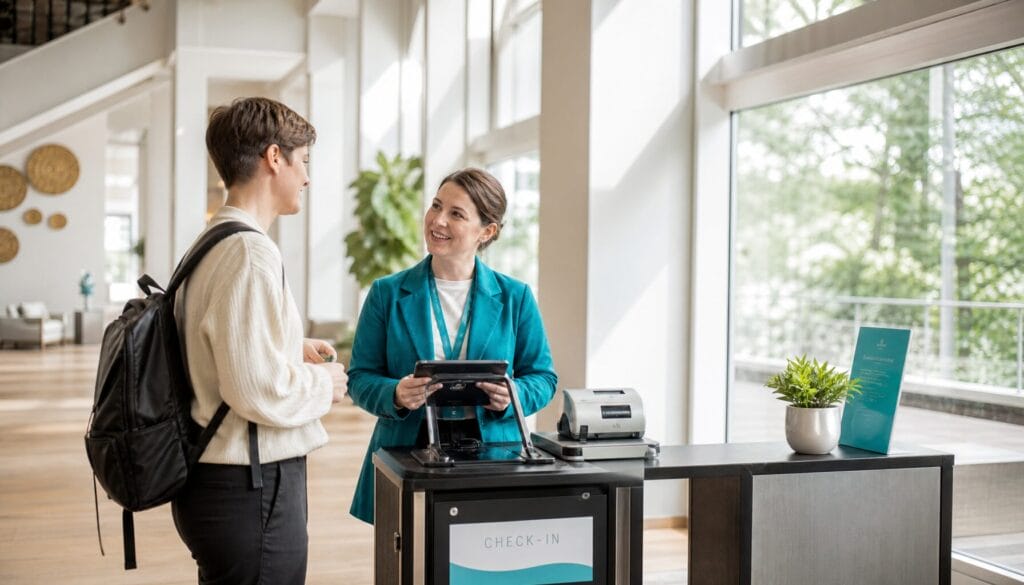
- Engagement: They are greeted immediately by staff with tablets.
- Badge Issuance: The badge is printed as they walk toward the refreshments.
- Integration: The attendee enters the event space already wearing their credentials.
This shift removes the psychological barrier of being "processed." It reduces the need for massive, wasted space dedicated to empty tables and allows staff to focus on hospitality rather than data entry.
The Connectivity Layer: Managing Risk and Reliability
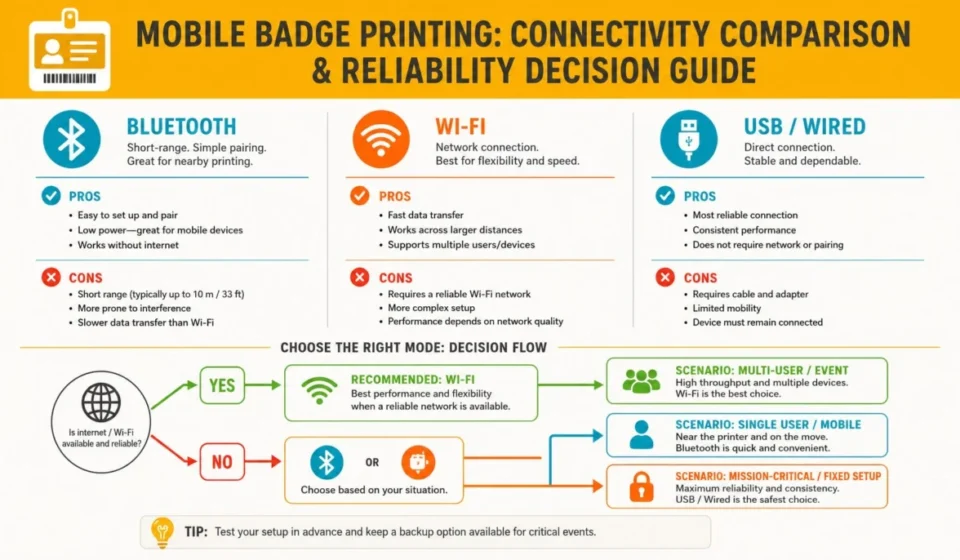
Mobility is only an asset if it is dependable. The most common point of failure for mobile printing is the connectivity layer. Before the doors open, organizers must answer the fundamental question: What happens if the network gets crowded, a device drops a connection, or a printer needs to be swapped?
Connectivity Cheat Sheet
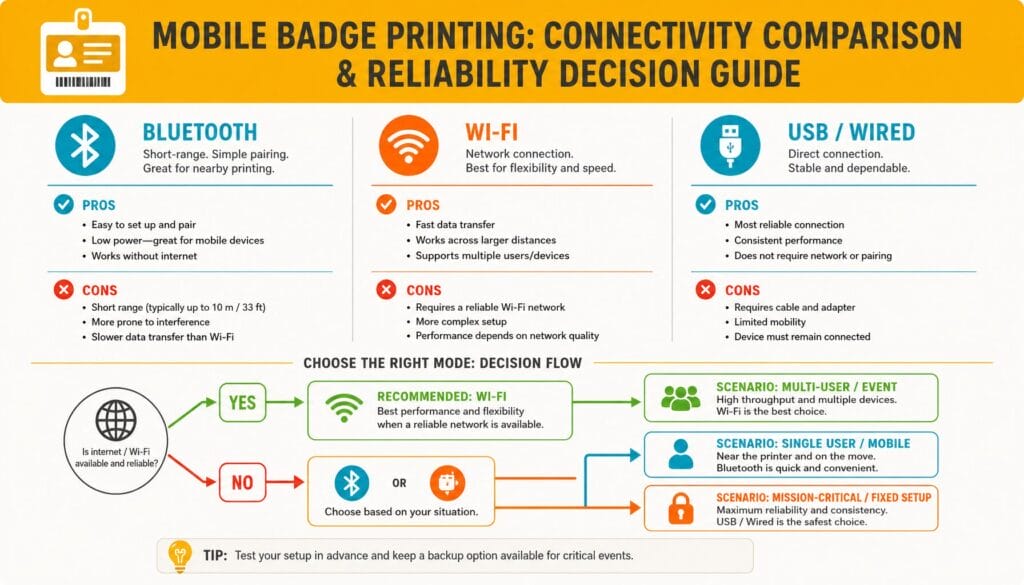
- Bluetooth: Ideal for "roving" or satellite stations. It is low-power and creates a direct link between the tablet and printer, bypassing venue Wi-Fi entirely.
- Wi-Fi: Suitable for high-density environments where you can control the network. It offers more flexibility for placement but requires a robust, dedicated network infrastructure to prevent lag.
- Wired (USB/Ethernet): The gold standard for primary, high-volume lanes. It is the most reliable, "zero-interference" connection and should always serve as the backbone of your main registration bank.
The "Local First" Principle
A critical rule for onsite printing: Plan around what must be live and what can be local. Printing can often continue without a live internet connection if the attendee data is cached locally on the iPad. By ensuring that your check-in platform supports local database synchronization, you ensure that a hotel Wi-Fi outage does not halt your entire event.
Setting Up for Success: An Operational Checklist
Building a mobile check-in system requires more than just buying hardware; it requires a rigorous operational plan.
- Map the 30-Minute Peak: Forget total headcount. Calculate your busiest 30-minute window. If 600 people arrive between 8:30 AM and 9:00 AM, you need enough stations to process 20 people per minute.
- Define Station Roles: Use wired connections for the "heavy lifters" in the main lobby, and Bluetooth-enabled satellites for secondary entrances.
- Pre-Flight Data Sync: Always ensure all devices are fully synced with the attendee database at least two hours before doors open.
- Test Under Pressure: Run a "stress test" where you simulate a high volume of check-ins to ensure that printer paper, battery life, and device connectivity hold up.
- The Exception Desk: Always have one dedicated station for "exceptions" (e.g., walk-ins, complex registration issues). Keep this away from the main flow to ensure the "fast lanes" remain fast.
- Signage as Architecture: Use clear, large signage to guide attendees. If people are confused about where to go, they will stop moving, creating the very bottlenecks you are trying to avoid.
Industry Innovation: The EventMobi BadgeON™ Approach
As the industry matures, specialized tools like EventMobi’s BadgeON™ have emerged to solve the fragmentation of registration hardware. Rather than relying on disparate point solutions, BadgeON™ integrates attendee data, check-in software, and printer drivers into a unified ecosystem.
This platform allows for a seamless workflow: an attendee scans a QR code from a confirmation email, the system validates their registration, and the printer produces a high-quality, pre-branded badge on demand. By using standardized hardware like the Brother QL-820WNB, organizers can maintain a lean, portable kit that can be deployed across various event sizes.
Implications for the Future of Events
The transition to mobile badge printing represents a larger cultural shift in the events industry: the move away from "controlling" the attendee and toward "facilitating" their experience.
When check-in is mobile, the event begins at the front door. Staff are no longer tethered to a desk, which allows them to move into the crowd, solve problems proactively, and provide a warmer welcome. By treating mobile badge printing as an operational system rather than just a set of gadgets, planners can ensure that their event starts with a moment of efficiency rather than a moment of frustration.
Summary of Next Steps for Planners
- Analyze your flow: Use heat maps of your venue to identify where people actually enter the building.
- Size for the peak: Use your 30-minute arrival data to determine the number of stations required.
- Build a redundancy plan: Always keep an extra printer and spare labels staged at each station, and ensure your data is synced locally.
When you successfully decouple registration from the "fixed desk" mindset, you gain something invaluable: time. Time for your attendees to network, time for your staff to breathe, and time for your event to make an incredible first impression. The registration desk isn’t dead—it’s just finally becoming as mobile as the people it serves.