Comments Off on Digital Alterations on the Tarmac: Inside the Controversy Over President Trump’s Shared Photo of Chinese President Xi Jinping
WASHINGTON — In an era where digital manipulation has become a seamless and ubiquitous part of modern media consumption, the boundary between reality and fabrication continues to blur at the highest levels of global politics.
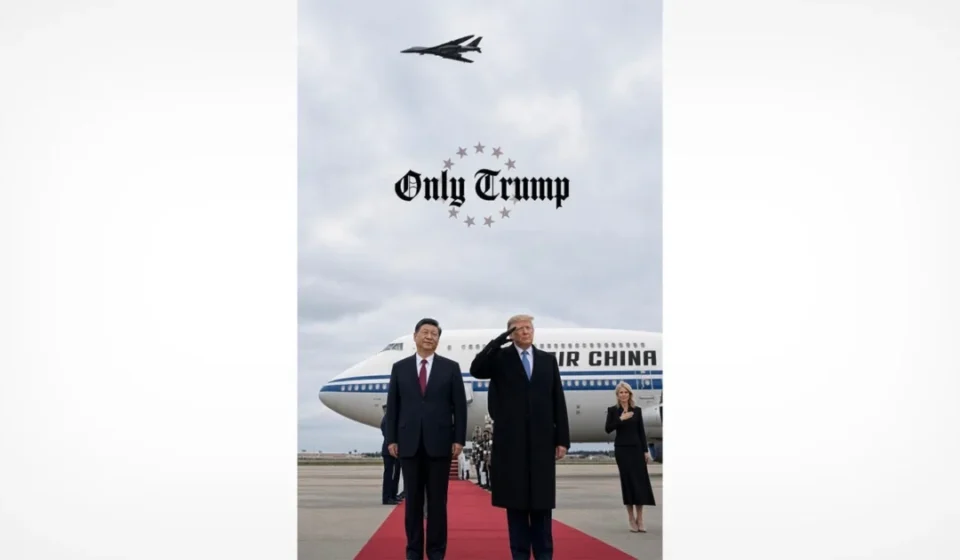
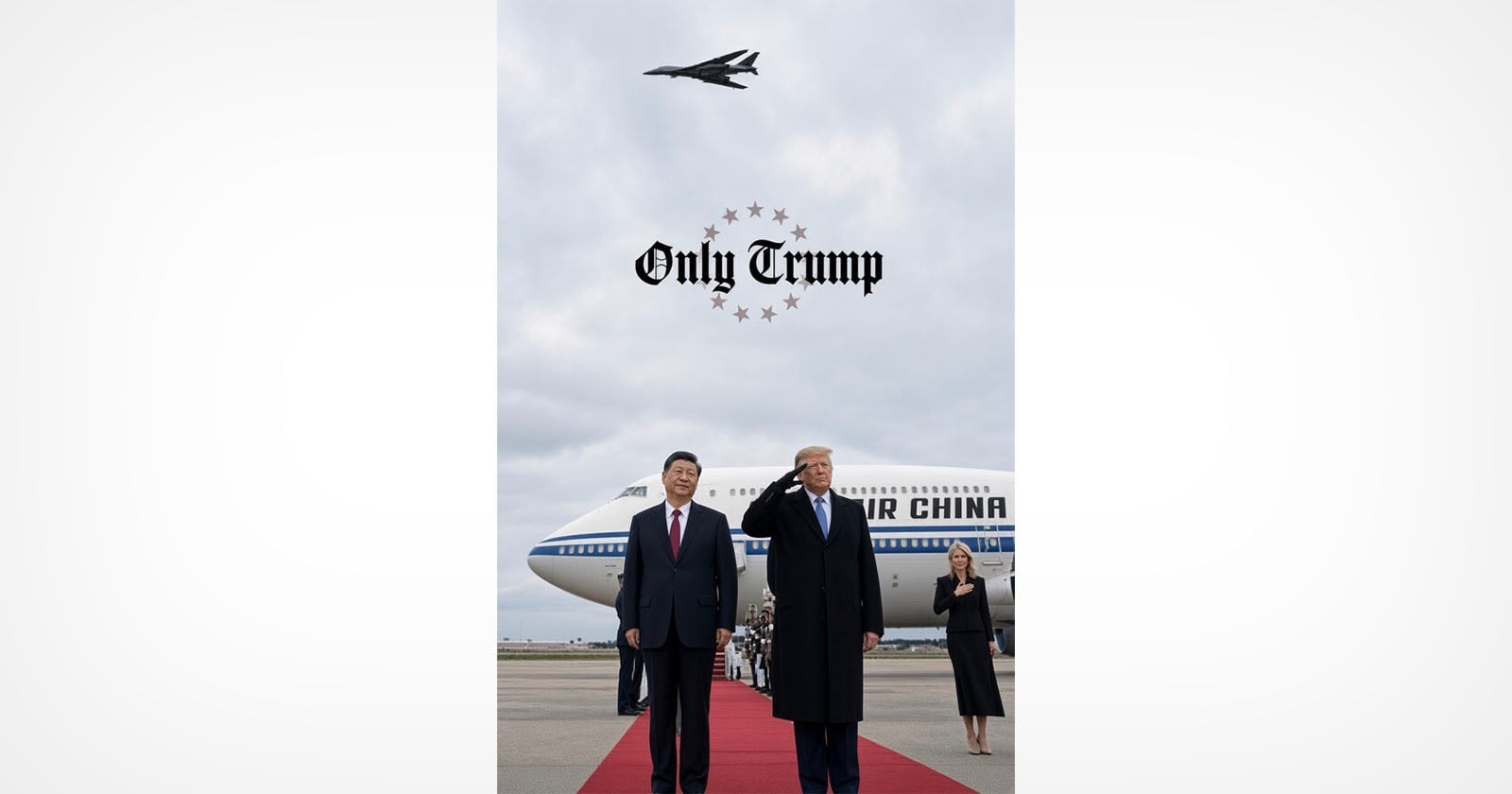
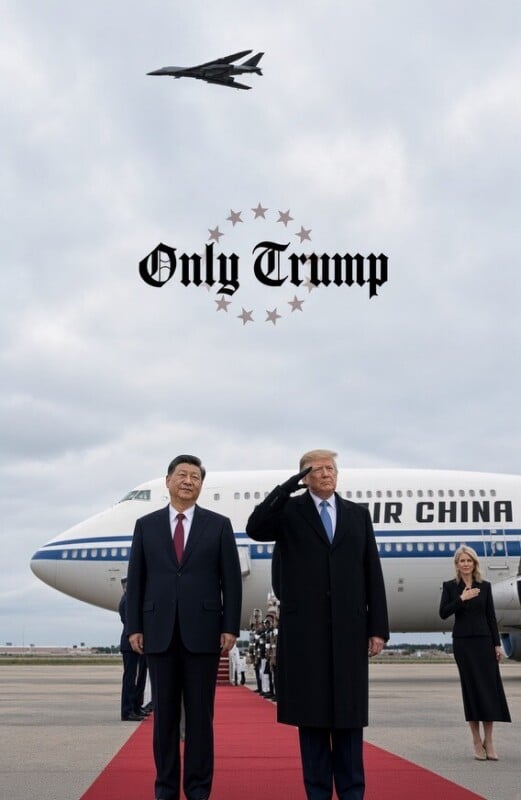
A fresh controversy erupted in international diplomatic and digital circles after President Donald Trump shared an image on Truth Social depicting a high-stakes arrival ceremony for Chinese President Xi Jinping at Joint Base Andrews in Maryland. Independent visual verification teams, photojournalism experts, and digital forensics analysts have confirmed that the image shared by the former U.S. president was heavily doctored, altering not only his own facial expression and posture but also replacing key personnel and modifying the background aircraft.
The incident highlights a growing intersection between political optics, social media amplification, and the accessibility of advanced digital and artificial intelligence (AI) editing tools. As details emerge from forensic investigations conducted by major news outlets and technical security firms, the implications of state and political figures sharing manipulated imagery point toward a challenging future for visual authentication.
Main Facts
The core of the controversy centers on a photograph originally captured during President Xi Jinping’s official arrival ceremony at Joint Base Andrews.
The Core Discrepancy: In the photograph posted to Donald Trump’s official Truth Social account, the U.S. president is depicted standing stoically on a red carpet, rendering a sharp, composed military salute as a bomber aircraft flies overhead.
The Reality: Authentic photojournalism captured by major news agencies—including Getty Images, Reuters, and the Associated Press—tells a distinctly different story. In the genuine frames, Trump is captured grimacing as the military jet screeched loudly overhead during the low-altitude flyover.
The Counterpart: Chinese state and mainstream media heavily circulated footage of the event, gloating over President Xi’s unwavering, nonplussed composure during the abrupt and loud military display, which contrasted sharply with Trump’s visible reaction.
Forensic Confirmation: Subsequent investigations by BBC Verify, alongside digital forensics experts, revealed multiple blatant inconsistencies in the Truth Social photo, proving it was digitally manipulated to present a more flattering, controlled aesthetic for the American leader.
Chronology of Events
Understanding how the image transitioned from a live tarmac spectacle to a viral, contested piece of digital media requires examining the timeline of events on and immediately following Wednesday’s diplomatic reception.
Wednesday: The Tarmac Welcome at Joint Base Andrews
President Xi Jinping landed at Joint Base Andrews in Maryland for a high-profile diplomatic visit. As part of the ceremonial welcome, a U.S. military jet performed a low-altitude flyover. As the aircraft thundered across the airspace, the sudden roar caught leaders on the red carpet off guard.
Photographers from Getty Images, Reuters, and the AP captured the exact moment. The resulting images and video clips—subsequently shared widely by outlets like the New York Post—showed President Trump grimacing from the sudden, deafening noise of the jet engines, while President Xi maintained a stoic, expressionless demeanor.
The Immediate Aftermath and Social Media Posting
Shortly after the event concluded, curated imagery began circulating across digital platforms. President Trump published a version of the photograph to his Truth Social account. Unlike the grimacing expressions caught by live video feeds and press pools, the Truth Social version showed a composed Trump saluting firmly, free of discomfort.
Thursday and Friday: Media Scrutiny and Independent Investigations
Within 24 to 48 hours, sharp-eyed social media users and journalists began comparing the Truth Social photo side-by-side with frames distributed by Getty Images. Discrepancies were immediately flagged, leading major verification desks to take a closer look.
By the end of the week, BBC Verify published an exhaustive breakdown of the image, utilizing forensic markers, lighting analysis, and comparative media to definitively label the photograph as doctored. Digital security specialists were brought in to weigh in on the likely methods used to achieve the alterations.
Supporting Data and Technical Evidence
The determination that the image was doctored is not based on subjective interpretation, but rather on a series of glaring, verifiable inconsistencies identified by forensic investigators and journalists.
1. The Glove Anomaly
One of the most immediate visual giveaways noted by BBC Verify involves Trump’s attire. In the Truth Social version of the photo, Trump is wearing only a single black glove on one hand. However, video footage and multiple independent photographs taken throughout the entirety of Wednesday’s ceremony at Joint Base Andrews clearly show him wearing a matching pair of gloves on both hands.
2. The Mysterious Case of the Replaced Aide
A more bizarre alteration involves the supporting personnel positioned directly behind the president.
The Original Scene: Chief of Protocol Monica Crowley was physically standing directly behind Trump to his right during the ceremony, as verified by live video and unedited press pools.
The Altered Scene: In the Truth Social version, Crowley’s face and identity have been entirely replaced by a different woman. Journalist Aaron Rupar pointed out via social media platform X that the replacement figure bears a striking physical resemblance to Natalie Harp, a Trump aide frequently referred to in political media circles as the "human printer" due to her constant proximity and role in providing real-time digital printouts to the former president.
3. Background and Cosmetic Alterations
Further forensic scrutiny revealed several structural and cosmetic modifications designed to polish the overall visual composition:
Aircraft Markings: Specific red graphical markings and insignia clearly visible on the side of the Air China plane parked in the background of the authentic photos are entirely missing from the Truth Social version.
Hair Styling: Trump’s hair appears noticeably different in the manipulated photo compared to the official news agency captures, suggesting targeted retouching.
Expert Analysis
Henry Farid, co-founder of GetReal Security and a recognized expert in digital media forensics, spoke with the BBC regarding the nature of the alterations.
"The changes are the types of cosmetic edits that you often see to ‘clean up’ photos," Farid explained. "Given the other obvious edits, it is clear that this image has been modified. So that increases the chance that all of these differences are due to digital or AI editing."
The combination of generative AI tools and standard digital retouching software appears to have been deployed to smooth over an unflattering moment, trading documentary accuracy for idealized presentation.
Official Responses and Reactions
As the findings spread across traditional and digital news outlets, reactions ranged from partisan defense to sharp critique regarding the integrity of political communication.
Chinese Media Glosses: As noted by the South China Morning Post, domestic and state-aligned Chinese media seized upon the unedited reality of the event. They highlighted President Xi’s unflappable composure during the military flyover as a symbol of steady leadership, contrasting it with the visible discomfort captured by Western photojournalists.
The Silence on Provenance: Representatives for President Trump’s digital and communications teams have not issued a detailed technical explanation regarding how the altered image made its way onto the Truth Social feed, nor have they directly addressed the substitution of staff members within the frame.
Journalistic Watchdogs: Press freedom and media literacy organizations have seized the moment as a textbook case study in the dangers of synthetic media. Analysts argue that when public figures—particularly those with millions of followers—share altered visual records of historic diplomatic events, it actively erodes public trust in objective reality.
Implications for Digital Media and Politics
The controversy surrounding the Joint Base Andrews tarmac photo is far more than a localized social media gaffe; it touches upon critical questions regarding the future of truth, documentation, and political accountability in the digital age.
The Normalization of "Polishing" Reality
For decades, political campaigns have utilized photo retouching for promotional materials, campaign posters, and official portraits. However, sharing modified images of live, breaking news events—such as an international diplomatic arrival—represents a significant escalation. When a real-time news photograph is swapped for a digitally "cleaned-up" version that alters physical facts (such as clothing, hair, background insignia, and attending personnel), it crosses the line from public relations curation into misinformation.
The Erosion of Trust in Photojournalism
Photojournalism has historically served as an unyielding witness to history. When political actors routinely cast doubt on authentic press photography by propagating alternative, digitally enhanced versions of the same moments, it fosters a "liar’s dividend." In this environment, the public becomes increasingly cynical, prone to dismissing genuine, unflattering photographs as "fake news" while accepting manufactured imagery that aligns with preferred narratives.
Challenges for Verification Technology
As generative AI and advanced image-editing suites become accessible to anyone with a smartphone or internet connection, verification desks face an uphill battle. While outlets like BBC Verify and forensic experts can successfully dissect high-profile images, the sheer volume of daily digital content means that millions of viewers consume altered media without ever encountering the subsequent fact-checks.
Conclusion
The doctored tarmac photo stands as a stark reminder of the fragile nature of visual truth in modern politics. Whether the edits were executed by a zealous staffer, an automated AI tool, or through manual retouching, the result is a fictionalized record of a historic diplomatic meeting. As technology makes rewriting visual history easier than ever, the burden on journalists, verification experts, and the public to demand and defend authenticity has never been greater.